



ACVR2B Protein, Human/Cynomolgus (HEK293, His)

Based on 1 Customer Validation
ACVR2B is a type II member of the TGF-β family of receptor Serine/Threonine kinases. ACVR2B binds to activins and growth differentiation factors (GDF), which in turn activate type I receptors, activating downstream molecule SMAD2/3. ACVR2B Protein, Human/Cynomolgus (HEK293, His) is produced in HEK293 cells with six C-Terminal His-tags. It consists of 116 amino acids (S19-T134).
- Species: Human; Cynomolgus
- Source: HEK293
-
Storage:Stored at -20°C for 2 years from date of receipt. After reconstitution, it is stable at 4°C for 1 week or -20°C for longer (with carrier protein). It is recommended to freeze aliquots at -20°C or -80°C for extended storage.


To place orders, for customer services and technical support, please contact: MedChemExpress USA
Tel: 609-228-6898 E-mail: [email protected] [email protected]


-
 Biological Activity
-
Technical Parameters
-
Product Properties
- Documentation
- References
- Help & FAQs





Biological Activity
Description
ACVR2B is a type II member of the TGF-β family of receptor Serine/Threonine kinases. ACVR2B binds to activins and growth differentiation factors (GDF), which in turn activate type I receptors, activating downstream molecule SMAD2/3[1]. ACVR2B Protein, Human/Cynomolgus (HEK293, His) is produced in HEK293 cells with six C-Terminal His-tags. It consists of 116 amino acids (S19-T134).
Background
Activin receptor type-2B (ACVR2B), also known as ActR-IIB and MGC116908, is an activin type II receptor. Type I receptors are essential for signaling; and type II receptors are required for binding ligands and for expression of type I receptors[1].
The sequence of amino acids in ACVR2B proteins from different species is very stable, which leads to the conclusion that in the process of evolution, ACVR2B has been only slightly altered, and that both in humans and in animals, its function is similar.
Activins and growth differentiation factors (GDF) bind to ACVR2B, which in turn activate type I receptors such as activin receptor-like kinases (ALK) ALK4 and ALK5, activating downstream molecule SMAD2/3. SMADSs regulate a number of myogenic genes, such as myoD, myogenin, and Myf5, that are involved in cellular hypertrophy, proliferation, or differentiation. Noncanonical ACVR2B pathways have also been shown to regulate MAP kinases. ACVR2B blocks signaling of myostatin, its close homolog GDF11, as well as activin A, activin B, and BMP10[1]. Activin A primarily binds to the type 1 receptors ALK4 or ALK7 in complex with ACVR2A or ACVR2B, causing activation of SMAD2 or SMAD3[2].
In myeloma cells, BMP-6- and BMP-9-induced activation of SMAD1/5/8 through ACVR2A/ACVR2B/ALK2 is inhibited by activin A treatment[2]. ACVR2B has been shown to preserve muscle mass and prolong survival in tumor hosts, and to increase bone mass in models of osteogenesis imperfecta and muscular dystrophy[3].
In Vitro
Recombinant human ACVR2B (5 μg/mL) inhibits the effects of BMP-9 on INA-6 and IH-1 cells[2].
Verified Bioactivity
1.This product does not contain protein kinase domain.
2.Measured by its ability to neutralize Activin-mediated inhibition on MPC11 cell proliferation. The ED50 for this effect is 0.1-0.5 µg/mL in the presence of 10 ng/mL recombinant Activin A (HY-P70311).
MCE Validation Data
-
Purity - SDS-PAGE
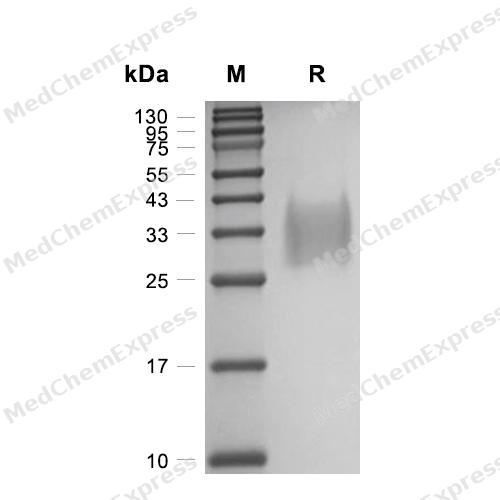
Purity - SDS-PAGE
-
Bioactivity - Cell-Based Assay
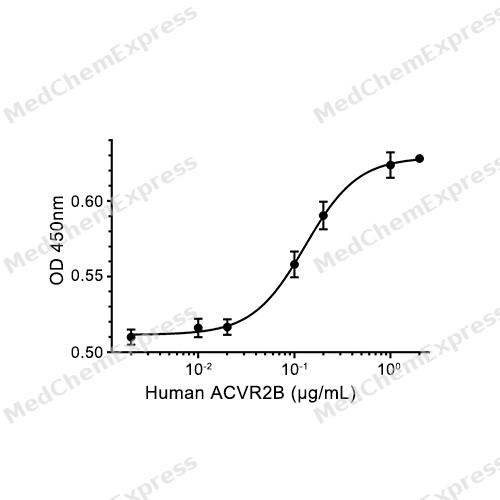
Bioactivity - Cell-Based Assay


Technical Parameters
-
Species Human; Cynomolgus
-
Source HEK293
-
Tag C-6*His
-
Accession
Q13705-1 (S19-T134)/XP_045242398.1 (S40-T155)
-
Molecular Construction
-
N-term
-
ACVR2B (S19-T134)
Accession # Q13705-1 -
6*His
-
C-term
-
-
Protein Length
Extracellular Domain
-
Synonyms
ACVR2B; Serine/Threonine-Protein Kinase Receptor; Activin A Receptor Type 2B; Activin Receptor Type IIB; ActR-IIB; ACTR-IIB; Activin A Receptor, Type IIB; ACTRIIB; Activin Receptor Type-2B; HTX4
-
AA Sequence
SGRGEAETRECIYYNANWELERTNQSGLERCEGEQDKRLHCYASWRNSSGTIELVKKGCWLDDFNCYDRQECVATEENPQVYFCCCEGNFCNERFTHLPEAGGPEVTYEPPPTAPT
-
Molecular Weight
Approximately 25-38 kDa, based on SDS-PAGE under reducing conditions.
-
Glycosylation
Yes
-
Purity
≥ 95%, as determined by reducing SDS-PAGE.


Product Properties
Lyophilized powder.
Lyophilized from a 0.2 μm filtered solution of 20 mM PB, 150 mM NaCl, pH 7.4.
<1 EU/μg, determined by LAL method.
It is not recommended to reconstitute to a concentration less than 100 μg/mL in ddH2O. For long term storage it is recommended to add a carrier protein (0.1% BSA, 5% HSA, 10% FBS or 5% Trehalose).
Stored at -20°C for 2 years from date of receipt. After reconstitution, it is stable at 4°C for 1 week or -20°C for longer (with carrier protein). It is recommended to freeze aliquots at -20°C or -80°C for extended storage.
Room temperature in continental US; may vary elsewhere.


Documentation
-
Data Sheet (263 KB)
-
SDS (252 KB)
- English - EN (252 KB)
- Français - FR (252 KB)
- Deutsch - DE (252 KB)
- Norwegian - NO (252 KB)
- Español - ES (252 KB)
- Swedish - SV (252 KB)
- Italian - IT (252 KB)
- Korean - KR (252 KB)
- Portuguese - PT (252 KB)
-
Handling Instructions (2659 KB)


References
[1]. Johanna Magga, et al. Systemic Blockade of ACVR2B Ligands Protects Myocardium from Acute Ischemia-Reperfusion Injury. Mol Ther. 2019 Mar 6;27(3):600-610. [Content Brief]
[2]. Oddrun Elise Olsen, et al. Activin A inhibits BMP-signaling by binding ACVR2A and ACVR2B. Cell Commun Signal. 2015 Jun 6;13:27. [Content Brief]
[3]. Rafael Barreto, et al. ACVR2B/Fc counteracts chemotherapy-induced loss of muscle and bone mass. Sci Rep. 2017 Oct 31;7(1):14470. [Content Brief]

Calculators
Concentration (start) × Volume (start) = Concentration (final) × Volume (final)


 Powered by Bioz

