



Bimagrumab
Based on 3 publication(s) in Google Scholar
Bimagrumab (Anti-ACVR2B Reference Antibody; BYM338) is a monoclonal antibody targeting activin type II receptors (ActRII). Bimagrumab binds to human ActRIIB (Kd 1.7 pM) and ActRIIA (Kd 434 pM), blocks ligand binding and downstream Smad activation, and inhibits myostatin/activin A-induced Smad phosphorylation. Bimagrumab induces skeletal muscle hypertrophy in an Akt-independent manner via mTOR-mediated muscle protein synthesis, increases muscle mass and strength, promotes myoblast differentiation/fusion, prevents myotube atrophy and glucocorticoid-induced muscle loss, reduces fat mass and fat depot weight/adipocyte size, inhibits adipose inflammation, induces fat oxidation, preserves lean body mass during incretin-induced weight loss, and enhances the appetite-suppressive effect of incretins. Bimagrumab can be used in research on obesity and skeletal muscle atrophy and weakness.
For research use only. We do not sell to patients.
- Purity : 99.31%
- CAS No.: 1356922-05-8
- Molecular Weight:142.78 kDa
-
Storage:Shipping with dry ice
Please store the product under the recommended conditions in the Certificate of Analysis.


To place orders, for customer services and technical support, please contact: MedChemExpress USA
Tel: 609-228-6898 E-mail: [email protected] [email protected]


-
 Biological Activity
-
Chemical Information
- Protocols
- Purity & Documentation
- References
-
 Help & FAQs


-
HY-P99632
GaretosmabAnti-Activin A mAb -

HY-P99388
TrevogrumabAnti-GDF8 Antibody -
HY-114118
SemaglutideGLP-1R Agonist -
HY-P99241
PonsegromabGDF15 Inhibitor -
HY-P99992
Human IgG1 lambda1, Isotype ControlIgG1λ1 Isotype Control -

HY-P9904
AtezolizumabAnti-PD-L1 Antibody -

HY-P9908
AdalimumabTNF-α Inhibitor -

HY-P70311
Activin A Protein, Human/Mouse/Rat (HEK293) -
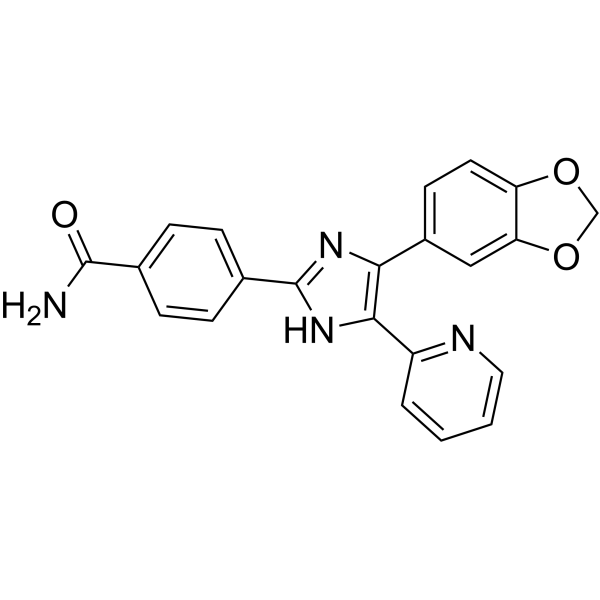
HY-10431
SB-431542TGF-β Receptor Kinase Inhibitor -
HY-P99441
ApitegromabMonoclonal Antibody -

HY-P99370
LandogrozumabAnti-Myostatin Antibody -
HY-P99590
SotaterceptACVR2A-IgG Fc Fusion Protein
Publications Citing Use of MedChemExpress (MCE) Bimagrumab
More Customer Validation & Images

-
IF

-
In Vivo Efficacy Study

-
WB

-
Histological Imaging/Staining

-
Histological Imaging/Staining


Biological Activity
Description
Isotype
Human IgG1 (L234A/L235A) lambda2
Recommend Isotype Controls
Species Reactivity
Human
In Vitro
Bimagrumab (4 days) enhances primary human skeletal myoblast differentiation and reverses myostatin/activin A inhibition, with IC50 values of 519 pM and 3,105 pM in the CK differentiation assay[4].
Bimagrumab (30 μg/mL; 2-72 h) prevents myostatin- and activin A-induced atrophy and Smad2/3 activation in human primary myotubes[4].
MedChemExpress (MCE) has not independently confirmed the accuracy of these methods. They are for reference only.
In Vivo
Bimagrumab (20 mg/kg; i.p.; once weekly; 3 weeks) increases 3-week weight loss to -14.5 g and achieves 96.4% weight-loss quality when added to Tirzepatide (HY-P1731) in diet-induced obese mice[3].
Bimagrumab (20 mg/kg; i.p.; once weekly; 3 weeks) increases 3-week weight loss to -9.8 g and achieves 104.6% weight-loss quality when added to Semaglutide in diet-induced obese mice[3].
Bimagrumab (20 mg/kg; i.p.; once weekly; 3 weeks) increases 3-week weight loss to -4.5 g and achieves 122.8% weight-loss quality when added to liraglutide in diet-induced obese mice[3].
Bimagrumab (20 mg/kg; s.c.; days 0, 7, 14, 21, and 28) increases body weight, lean mass, and muscle weight in wild-type mice[4].
Bimagrumab (20 mg/kg; s.c.; days 0, 7, 14, 21, and 28) increases body weight, lean mass, and muscle weight in myostatin-deficient MstnLn/Ln mice[4].
Bimagrumab (5-20 mg/kg; i.p.; days 21, 23, and 28) enhances recovery from glucocorticoid-induced skeletal muscle atrophy in mice[4].
MedChemExpress (MCE) has not independently confirmed the accuracy of these methods. They are for reference only.
-
Animal Model:C57Bl/6J background (male, 24-25 weeks, diet-induced obese)[1]
-
Dosage:20 mg/kg
-
Administration:s.c.; once weekly; 14 days
-
Result:Decreased fat mass by approximately 30% and increased lean mass by approximately 8%.
At day 14, adipose depot weights were iWAT 1.339 g, eWAT 1.122 g, rpWAT 0.481 g, and BAT 0.281 g.
Average adipocyte size was decreased in iWAT and eWAT.
Skeletal muscle weights were TA 64.39 mg, EDL 16.89 mg, soleus 12.89 mg, and gastrocnemius 202.44 mg.
Skeletal muscle size increased by approximately 10-20% across all four muscles.
TA muscle fiber cross-sectional area was larger than in control mice.
Fed blood glucose was modestly elevated, plasma insulin trended lower, adiponectin was comparable, leptin trended lower, IL-6 and MCP-1 trended lower, and circulating glycerol and free fatty acids were reduced.
Exercise performance showed VO2 max 4.83 mL/min (18% improvement) and time to exhaustion 682.0 s; the VO2 max effect was lean-mass dependent by ANCOVA.
-
Animal Model:C57Bl/6J background (male, 24-25 weeks, diet-induced obese)[1]
-
Dosage:20 mg/kg
-
Administration:s.c.; once weekly (bimagrumab); once daily (semaglutide); 14 days
-
Result:Combination administration produced greater than 25% body weight loss and 70% fat mass loss.
Lean mass proportion was indistinguishable from control at day 13, indicating preservation of lean mass despite reduced food intake.
At day 14, adipose depot weights were iWAT 0.606 g, eWAT 0.589 g, rpWAT 0.203 g, and BAT 0.174 g; eWAT, iWAT, and rpWAT showed greater than 60% reductions relative to control.
Adipocyte size was smallest in the combination group.
Skeletal muscle weights were TA 58.69 mg, EDL 14.88 mg, soleus 11.38 mg, and gastrocnemius 184.63 mg, comparable to control.
Adiponectin increased compared with semaglutide alone, leptin decreased compared with control, IL-6 and MCP-1 trended lower, and circulating glycerol and free fatty acids were reduced.
Exercise performance showed VO2 max 4.61 mL/min (13% average improvement) and time to exhaustion 760.5 s.
-
Animal Model:Akt1 loxp/loxp;Akt2 loxp/loxp with ACTA1-Cre (M-AktDKO; male, 4-6 months) and control mice[1]
-
Dosage:20 mg/kg
-
Administration:s.c.; once weekly; 14 days
-
Result:In control mice, TA, EDL, soleus, and gastrocnemius weights increased to 52.64 mg, 12.61 mg, 7.89 mg, and 148.5 mg, respectively.
In M-AktDKO mice, TA, EDL, soleus, and gastrocnemius weights were 32.52 mg, 8.43 mg, 5.58 mg, and 99.41 mg, respectively; EDL and gastrocnemius were larger than in M-AktDKO mice, and TA and soleus trended larger.
The percent increase in muscle weights was 17-27% in control mice and 11-23% in M-AktDKO mice.
-
Animal Model:C57BL/6J (5-6 weeks of age at diet initiation; average body weight 54 g at start of dosing)[3]
-
Dosage:20 mg/kg
-
Administration:i.p. once weekly for 3 weeks; s.c. daily for 3 weeks
-
Result:Three-week weight loss increased to -14.5 g when combined with tirzepatide.
Weight-loss quality in combination was 96.4%.
-
Animal Model:C57BL/6J (5-6 weeks of age at diet initiation; average body weight 54 g at start of dosing)[3]
-
Dosage:20 mg/kg
-
Administration:i.p. once weekly for 3 weeks; s.c. daily for 3 weeks
-
Result:Three-week weight loss increased to -9.8 g when combined with semaglutide.
Weight-loss quality in combination was 104.6%.
Fat mass loss greater than 100% of total weight loss reflected additive fat mass loss and muscle mass gain.
-
Animal Model:C57BL/6J (5-6 weeks of age at diet initiation; average body weight 54 g at start of dosing)[3]
-
Dosage:20 mg/kg
-
Administration:i.p. once weekly for 3 weeks; s.c. twice daily for 3 weeks
-
Result:Three-week weight loss increased to -4.5 g when combined with liraglutide.
Weight-loss quality in combination was 122.8%.
Fat mass loss greater than 100% of total weight loss reflected additive fat mass loss and muscle mass gain.
-
Animal Model:CB17/ICR-Prkdcscid/Crl (SCID; female; 10 weeks old)[4]
-
Dosage:6 mg/kg; 20 mg/kg
-
Administration:s.c.; once weekly; 4 weeks
-
Result:Increased body weight and skeletal muscle mass in all examined muscles, including slow, fast, and mixed muscles, in a dose-dependent manner.
Maximal muscle increases reached 25% to 50% depending on the muscle.
The fiber cross-sectional area distribution of gastrocnemius/plantaris increased, reflecting increased individual fiber diameter without changes in fiber number.
Fiber type composition was not altered.
Microarray analysis after 4 weeks at 20 mg/kg identified 58 differentially regulated genes: 47 upregulated and 11 downregulated.
Igf1 was upregulated with a log2 fold change of 0.98 (Table 1).
Pathway analysis suggested extracellular matrix remodeling and downregulation of translation and oxidative phosphorylation.
-
Animal Model:C57BL/6J (wild-type; male; 15 to 20 weeks old)[4]
-
Dosage:20 mg/kg
-
Administration:s.c.; days 0, 7, 14, 21, and 28
-
Result:Increased body weight, lean body mass, and muscle weight in wild-type mice.
-
Animal Model:C57BL/6J-Mstnlean/J (MstnLn/Ln; male; 15 to 20 weeks old)[4]
-
Dosage:20 mg/kg
-
Administration:s.c.; days 0, 7, 14, 21, and 28
-
Result:Increased body weight, lean body mass, and muscle weight in MstnLn/Ln mice.
-
Animal Model:C57BL/6 (male; 4 months old)[4]
-
Dosage:5 mg/kg/week; 20 mg/kg/week; 5 or 20 mg/kg (i.p.; days 0, 2, and 7)
-
Administration:s.c.; weekly; 14 days; i.p. on days 0, 2, and 7
-
Result:Prevented dexamethasone-induced loss of muscle mass, tetanic force, and fiber cross-sectional area.
Dexamethasone-induced tetanic force loss of more than 20% was fully reversed.
Reduced dexamethasone-induced MAFbx and MuRF1 mRNA expression.
-
Animal Model:C57BL/6 (male; 4 months old)[4]
-
Dosage:5 mg/kg; 20 mg/kg
-
Administration:i.p.; days 21, 23, and 28
-
Result:Recovery of skeletal muscle mass in gastrocnemius/plantaris and tibialis cranialis muscles was dose-dependently enhanced after 3 weeks of dexamethasone exposure and dexamethasone withdrawal.
- Kinase activity and phosphorylation assays
- Western Blot
- Research Protocol for Endocrine Diseases
- Large-size fat particle sorting
- C2C12 myoblast-to-myotube differentiation
- Protocol for Kinase activity and phosphorylation assays
- Research Protocol for Inflammation-related Diseases
- Research Protocol for Metabolic Diseases
Clinical Trial
| NCT Number | Sponsor | Condition | Start Date |
Phase

|
|---|---|---|---|---|
| NCT01329991 | 2011-05 | PHASE1 |
Gene ID
Accession
Conjugated
Unconjugated
Reconsititution
The product can be reconstituted/diluted with sterile PBS or saline.
Format
-
Human IgG1 lambda

Application
ELISA, FACS, Functional assay
Verified Bioactivity
-
 Immobilized ACVR2B Protein, Human can bind Bimagrumab. The EC50 for this effect is 8.254 ng/mL.
-
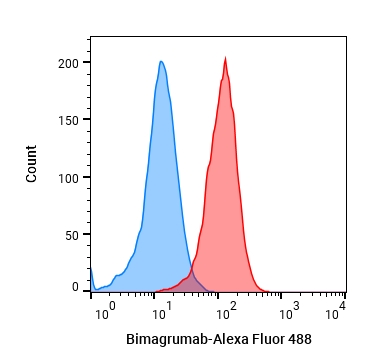 Flow cytometric analysis of 106 Jurkat cells with Bimagrumab (HY-P99355, red). Cells were fixed with 4% paraformaldehyde. Then stained with the primary antibody at 1/200 dilution for an hour at 4℃. Alexa Fluor® 488-conjugated AffiniPure Goat Anti-Human IgG H&L (HY-P83776) was used as the secondary antibody at 1/1,000 dilution for 30 minutes at 4℃. Human IgG1 lambda1 (HY-P99992, blue) was used as the isotype control.


Chemical Information
-
CAS No. 1356922-05-8
-
Appearance Liquid
-
Molecular Weight 142.78 kDa
-
Color Colorless to light yellow
-
SMILES
[Bimagrumab]
-
Synonyms
Anti-ACVR2B Reference Antibody; BYM338
-
Shipping
Shipping with dry ice.
-
Formulation
Please refer to the lot-specific COA for specific buffer information.
-
Storage
Please store the product under the recommended conditions in the Certificate of Analysis.


Publications (3)
-
Journal Impact Factor
-
Most Recent
-
Nat Commun
Diabetes reshapes pancreatic cancer-associated endothelial niche by accelerating senescence. [Abstract]2025 Sep 30;16(1):8654. PMID: 41027967
Bimagrumab purchased from MedChemExpress. Usage Cited in: Nat Commun. 2025 Sep 30;16(1):8654. [Abstract]
Pancreatic tumor samples from chow (n = 6 mice per group) and diabetic (n = 9 mice per group) KPC tumor-bearing mice treated with IgG, bimagrumab, or bimagrumab+metformin. The results showed that two injections of bimagrumab (20 mg/kg, subcutaneously, once weekly) reduced tumor burden in diabetic mice.
Bimagrumab purchased from MedChemExpress. Usage Cited in: Nat Commun. 2025 Sep 30;16(1):8654. [Abstract]
Phosphorylated Smad2 levels and total Smad2 expression were detected via western blotting in KPC tumors from the chow and diabetic mice treated with IgG or bimagrumab (20 mg/kg, subcutaneous injection, once weekly for two weeks) (n=3 mice per group).
Bimagrumab purchased from MedChemExpress. Usage Cited in: Nat Commun. 2025 Sep 30;16(1):8654. [Abstract]
Representative images of picrosirius red staining (red) in tumors from chow and diabetic KPC tumor-bearing mice treated with IgG or bimagrumab (20 mg/kg, subcutaneous injection, once weekly for two weeks) (n = 6 mice per group).
-
Nat Commun
2025 Jul 1;16(1):5976. PMID: 40593645
Bimagrumab purchased from MedChemExpress. Usage Cited in: Nat Commun. 2025 Jul 1;16(1):5976. [Abstract]
Representative microscopy images showing C2C12 myoblast differentiation in the presence of Myostatin, soluble DLK1 + Myostatin, Bimagrumab + Myostatin, or Bimagrumab + soluble DLK1 + Myostatin. Control cells were allowed to differentiate for 72h. Myostatin treatment (4 µg/ml) inhibits C2C12 myoblast differentiation into myotubes as determined by MyoHC staining. Bimagrumab (100 nM) and soluble DLK1 (2 μM) reverse the effect of myostatin on C2C12 differentiation, with no additive effect of adding soluble DLK1 to Bimagrumab treated cells. C2C12 cells were fixed with 4% PFA, immunostained with an anti-MyoHC antibody and an anti-mouse Alexa Fluor 488 secondary antibody. Nuclei were counterstained with Hoechst 33342. Nuclei represented with pseudo color (magenta). The images are representative of one out of two imaging wells per treatment from one experiment. The experiment was independently repeated two times. Scale bar, 100 μm.
-
Mol Metab
Antibody Blockade of Activin Type II Receptors Preserves Skeletal Muscle Mass and Enhances Fat Loss During GLP-1 Receptor Agonism. [Abstract]2024 Feb:80:101880. PMID: 38218536
Bimagrumab purchased from MedChemExpress. Usage Cited in: Mol Metab. 2024 Feb:80:101880. [Abstract]
Bimagrumab (20 mg/kg, subcutaneous injection, once weekly for two weeks). Representative TA sections stained with H&E (20x magnification, scale bar = 100 um).


Purity & Documentation
-
Data Sheet (293 KB)
-
SDS (252 KB)
- English - EN (252 KB)
- Français - FR (252 KB)
- Deutsch - DE (252 KB)
- Norwegian - NO (252 KB)
- Español - ES (252 KB)
- Swedish - SV (252 KB)
- Italian - IT (252 KB)
- Korean - KR (252 KB)
- Portuguese - PT (252 KB)
-
Inhibitory Antibodies User Guide (603 KB)
References
[1]. Nunn E, et al. Antibody blockade of activin type II receptors preserves skeletal muscle mass and enhances fat loss during GLP-1 receptor agonism. Molecular metabolism. 2024 Feb;80:101880. [Content Brief]
[2]. Kaiser M, et al. Bimagrumab: Novel Medical Therapy for Inclusion Body Myositis, Sarcopenia, and Medication-Induced Lean Body Mass Loss. Cardiology in review. 2025 Nov 03. [Content Brief]
[4]. Lach-Trifilieff E, et al. An antibody blocking activin type II receptors induces strong skeletal muscle hypertrophy and protects from atrophy. Molecular and cellular biology. 2014 Feb;34(4):606-18. [Content Brief]

Calculators
Concentration (start) × Volume (start) = Concentration (final) × Volume (final)


Bimagrumab Related Classifications
HY-P99355 Related Classifications
 Powered by Bioz
Keywords
- Bimagrumab
- 1356922-05-8
- Anti-ACVR2B Reference Antibody
- BYM338
- BYM338
- BYM 338
- BYM-338
- Ser/Thr Kinase
- Protein Serine-Threonine Kinase
- ActRIIA
- ActRIIB
- Smad activation
- Smad phosphorylation
- activin A
- activin type II receptor signaling
- mTOR-mediated muscle protein synthesis
- myostatin
- skeletal muscle atrophy
- skeletal muscle hypertrophy
- Inhibitor
- inhibitor
- inhibit