



BPHL Protein, Human (His)

Based on 1 Customer Validation
The BPHL protein is a serine hydrolase that catalyzes the hydrolytic activation of amino acid ester prodrugs, such as nucleoside analogs such as valacyclovir and valganciclovir. It converts valacyclovir to acyclovir via hydrolysis. BPHL Protein, Human (His) is the recombinant human-derived BPHL protein, expressed by E. coli , with N-His labeled tag.
- Species: Human
- Source: E. coli
-
Storage:Stored at -20°C for 2 years from date of receipt. After reconstitution, it is stable at 4°C for 1 week or -20°C for longer (with carrier protein). It is recommended to freeze aliquots at -20°C or -80°C for extended storage.


To place orders, for customer services and technical support, please contact: MedChemExpress USA
Tel: 609-228-6898 E-mail: [email protected] [email protected]


-
 Biological Activity
-
Technical Parameters
-
Product Properties
- Documentation
- Help & FAQs




Biological Activity
Description
The BPHL protein is a serine hydrolase that catalyzes the hydrolytic activation of amino acid ester prodrugs, such as nucleoside analogs such as valacyclovir and valganciclovir. It converts valacyclovir to acyclovir via hydrolysis. BPHL Protein, Human (His) is the recombinant human-derived BPHL protein, expressed by E. coli , with N-His labeled tag.
Background
BPHL protein, a serine hydrolase, serves as a catalyst for the hydrolytic activation of amino acid ester prodrugs, exemplified by nucleoside analogs like valacyclovir and valganciclovir. Notably, it facilitates the conversion of valacyclovir to acyclovir through hydrolysis. Beyond its role in drug activation, BPHL is implicated in potential detoxification processes. As a specific alpha-amino acid ester hydrolase, it displays a preference for small, hydrophobic, and aromatic side chains, without imposing strict requirements on the leaving group, except for a preference toward a primary alcohol. Existing as a monomer, BPHL may also engage in the formation of homodimers.
Verified Bioactivity
Defined as the amount of valacyclovir that 1μg of BPHL can hydrolysis at 37°C for 1 minute. The specific activity is 25.264 pmol/min/μg.
MCE Validation Data
-
Purity - SDS-PAGE
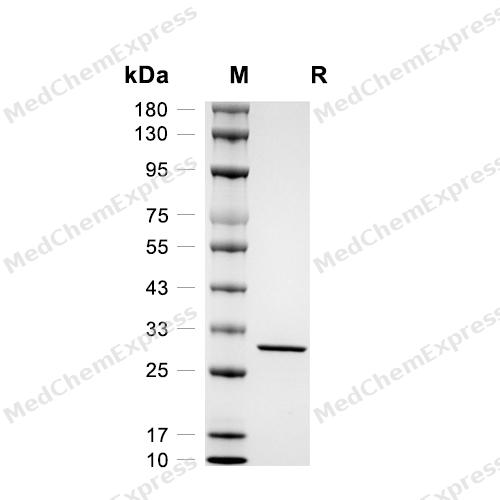
Purity - SDS-PAGE


Technical Parameters
-
Species Human
-
Source E. coli
-
Tag N-6*His
-
Accession
Q86WA6-1 (S38-Q291)
-
Molecular Construction
-
N-term
-
His
-
BPHL (S38-Q291)
Accession # Q86WA6 -
C-term
-
-
Protein Length
Full Length of Isoform-1
-
Synonyms
BPHL; Biphenyl Hydrolase-Related Protein; Prev. MCNAA; Serine Hydrolase BPHL; VACVase; Valacyclovirase; Bph-Rp; Biphenyl Hydrolase-Like (Serine Hydrolase Breast Epithelial Mucin-Associated Antigen), Isoform CRA_a; Breast Epithelial Mucin-Associated Antige
-
AA Sequence
SVTSAKVAVNGVQLHYQQTGEGDHAVLLLPGMLGSGETDFGPQLKNLNKKLFTVVAWDPRGYGHSRPPDRDFPADFFERDAKDAVDLMKALKFKKVSLLGWSDGGITALIAAAKYPSYIHKMVIWGANAYVTDEDSMIYEGIRDVSKWSERTRKPLEALYGYDYFARTCEKWVDGIRQFKHLPDGNICRHLLPRVQCPALIVHGEKDPLVPRFHADFIHKHVKGSRLHLMPEGKHNLHLRFADEFNKLAEDFLQ
-
Molecular Weight
Approximately 31 kDa, based on SDS-PAGE under reducing conditions.
-
Purity
≥ 95%, as determined by reducing SDS-PAGE.


Product Properties
Lyophilized powder.
Lyophilized from a 0.22 μm filtered solution of 50 mM Tris-HCl, 300 mM NaCl, pH 7.4.
Note: For SPR assay, please replace the buffer. Primary amine components (e.g., Tris, imidazole) can affect protein-coupled chips.
<1 EU/μg, determined by LAL method.
It is not recommended to reconstitute to a concentration less than 100 μg/mL in ddH2O. For long term storage it is recommended to add a carrier protein (0.1% BSA, 5% HSA, 10% FBS or 5% Trehalose).
Stored at -20°C for 2 years from date of receipt. After reconstitution, it is stable at 4°C for 1 week or -20°C for longer (with carrier protein). It is recommended to freeze aliquots at -20°C or -80°C for extended storage.
Room temperature in continental US; may vary elsewhere.


Documentation
-
Data Sheet (236 KB)
-
SDS (252 KB)
- English - EN (252 KB)
- Français - FR (252 KB)
- Deutsch - DE (252 KB)
- Norwegian - NO (252 KB)
- Español - ES (252 KB)
- Swedish - SV (252 KB)
- Italian - IT (252 KB)
- Korean - KR (252 KB)
- Portuguese - PT (252 KB)
-
Handling Instructions (2659 KB)

Calculators
Concentration (start) × Volume (start) = Concentration (final) × Volume (final)


 Powered by Bioz

