



CNPY3/PRAT4A Protein, Human (HEK293, Fc)

Based on 1 Customer Validation
CNPY3/PRAT4A is a Toll-like receptor (TLR)-specific co-chaperone of HSP90B1 and is essential for correct TLR folding (except TLR3). It ensures controlled TLR exit from the endoplasmic reticulum, affecting innate and adaptive immune responses. CNPY3/PRAT4A Protein, Human (HEK293, Fc) is the recombinant human-derived CNPY3/PRAT4A protein, expressed by HEK293 , with C-hFc labeled tag.
- Species: Human
- Source: HEK293
-
Storage:Stored at -20°C for 2 years from date of receipt. After reconstitution, it is stable at 4°C for 1 week or -20°C for longer (with carrier protein). It is recommended to freeze aliquots at -20°C or -80°C for extended storage.


To place orders, for customer services and technical support, please contact: MedChemExpress USA
Tel: 609-228-6898 E-mail: [email protected] [email protected]


-
 Biological Activity
-
Technical Parameters
-
Product Properties
- Documentation
- Help & FAQs




Biological Activity
Description
CNPY3/PRAT4A is a Toll-like receptor (TLR)-specific co-chaperone of HSP90B1 and is essential for correct TLR folding (except TLR3). It ensures controlled TLR exit from the endoplasmic reticulum, affecting innate and adaptive immune responses. CNPY3/PRAT4A Protein, Human (HEK293, Fc) is the recombinant human-derived CNPY3/PRAT4A protein, expressed by HEK293 , with C-hFc labeled tag.
Background
The CNPY3/PRAT4A protein acts as a Toll-like receptor (TLR)-specific co-chaperone for HSP90B1, playing a crucial role in the proper folding of TLRs, with the exception of TLR3. This function is essential for the controlled exit of TLRs from the endoplasmic reticulum, thereby influencing both innate and adaptive immune responses. CNPY3/PRAT4A interacts with HSP90B1, and this interaction is disrupted in the presence of ATP. Furthermore, it interacts with multiple TLRs, including TLR1, TLR2, TLR4, and TLR9, with the strongest interaction observed with TLR4. These interactions highlight the intricate regulatory role of CNPY3/PRAT4A in TLR folding and function, shedding light on its importance in the orchestration of immune responses.
MCE Validation Data
-
Purity - SDS-PAGE
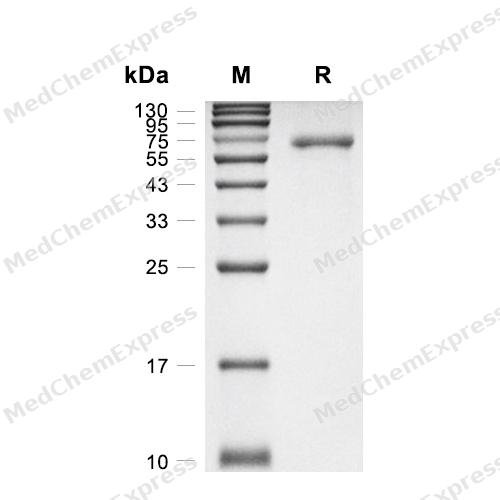
Purity - SDS-PAGE


Technical Parameters
-
Species Human
-
Source HEK293
-
Tag C-hFc
-
Accession
Q9BT09-1 (G31-P274)
-
Molecular Construction
-
N-term
-
CNPY3 (M1-P274)
Accession # Q9BT09 -
hFc
-
C-term
-
-
Protein Length
Full Length of Protein canopy homolog 3 Chain
-
Synonyms
CNPY3; PRAT4A; Prev. TNRC5; Protein Associated With Toll-Like Receptor 4A; CAG4A; Trinucleotide Repeat Containing 5; Trinucleotide Repeat-Containing Gene 5 Protein; Canopy 3 Homolog (Zebrafish); Expanded Repeat-Domain Protein CAG/CTG 5; CAG Repeat Contain
-
AA Sequence
GPSQAGAEENDWVRLPSKCEVCKYVAVELKSAFEETGKTKEVIGTGYGILDQKASGVKYTKSDLRLIEVTETICKRLLDYSLHKERTGSNRFAKGMSETFETLHNLVHKGVKVVMDIPYELWNETSAEVADLKKQCDVLVEEFEEVIEDWYRNHQEEDLTEFLCANHVLKGKDTSCLAEQWSGKKGDTAALGGKKSKKKSSRAKAAGGRSSSSKQRKELGGLEGDPSPEEDEGIQKASPLTHSP
-
Molecular Weight
Approximately 60-70 kDa, based on SDS-PAGE under reducing conditions, due to the glycosylation.
-
Glycosylation
Yes
-
Purity
≥ 95%, as determined by reducing SDS-PAGE.


Product Properties
Lyophilized powder.
Lyophilized from a 0.22 μm filtered solution of PBS, pH 7.4.
<1 EU/μg, determined by LAL method.
It is not recommended to reconstitute to a concentration less than 100 μg/mL in ddH2O. For long term storage it is recommended to add a carrier protein (0.1% BSA, 5% HSA, 10% FBS or 5% Trehalose).
Stored at -20°C for 2 years from date of receipt. After reconstitution, it is stable at 4°C for 1 week or -20°C for longer (with carrier protein). It is recommended to freeze aliquots at -20°C or -80°C for extended storage.
Room temperature in continental US; may vary elsewhere.


Documentation
-
Data Sheet (236 KB)
-
SDS (251 KB)
- English - EN (251 KB)
- Français - FR (251 KB)
- Deutsch - DE (251 KB)
- Norwegian - NO (251 KB)
- Español - ES (251 KB)
- Swedish - SV (251 KB)
- Italian - IT (251 KB)
- Korean - KR (251 KB)
- Portuguese - PT (251 KB)
-
Handling Instructions (2659 KB)

Calculators
Concentration (start) × Volume (start) = Concentration (final) × Volume (final)


 Powered by Bioz

