



FGF-9 Protein, Mouse (His, solution)

Based on 1 Customer Validation
FGF-9 Protein, Mouse (His, solution) is a member of mouse fibroblast growth factors, Plays an important role in brain development and functions.
- Species: Mouse
- Source: E. coli
-
Storage:Stored at -80°C for 1 year from date of receipt. It is stable at -20°C for 3 months after opening. It is recommended to freeze aliquots at -80°C for extended storage. Avoid repeated freeze-thaw cycles.


To place orders, for customer services and technical support, please contact: MedChemExpress USA
Tel: 609-228-6898 E-mail: [email protected] [email protected]


-
 Biological Activity
-
Technical Parameters
-
Product Properties
- Documentation
- References
- Help & FAQs




Biological Activity
Description
FGF-9 Protein, Mouse (His, solution) is a member of mouse fibroblast growth factors, Plays an important role in brain development and functions.
Background
Fibroblast growth factors are important growth factors for physiological systems, and play critical and multifunctional roles during development, tumorigenesis, neuronal systems and disease progressions. FGF9 involves in neuronal disorders, plays an important role for brain development and functions[1].
Verified Bioactivity
Measured in a cell proliferation assay using Balb/3T3 mouse embryonic fibroblast cells. The ED50 is <7.4 ng/mL, corresponding to a specific activity of >1.3 × 10⁵ units/mg.
MCE Validation Data
-
Bioactivity - Cell-Based Assay
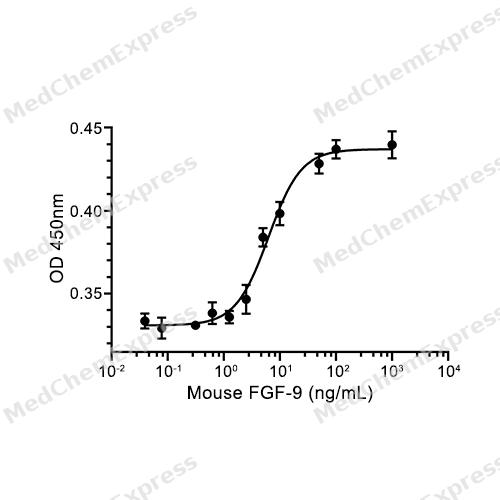
Bioactivity - Cell-Based Assay


Technical Parameters
-
Species Mouse
-
Source E. coli
-
Tag N-6*His
-
Accession
P54130 (M1-S208)
-
Molecular Construction
-
N-term
-
6*His
-
FGF-9 (M1-S208)
Accession # P54130 -
C-term
-
-
Protein Length
Full Length
-
Synonyms
FGF9; FGF-9; Fibroblast Growth Factor 9; GAF; Fibroblast Growth Factor 9 (Glia-Activating Factor); Fibroblast Growth Factor; Heparin-Binding Growth Factor 9; HBFG-9; Glia-Activating Factor; SYNS3; HBGF-9; FGF
-
AA Sequence
MAPLGEVGSYFGVQDAVPFGNVPVLPVDSPVLLSDHLGQSEAGGLPRGPAVTDLDHLKGILRRRQLYCRTGFHLEIFPNGTIQGTRKDHSRFGILEFISIAVGLVSIRGVDSGLYLGMNEKGELYGSEKLTQECVFREQFEENWYNTYSSNLYKHVDTGRRYYVALNKDGTPREGTRTKRHQKFTHFLPRPVDPDKVPELYKDILSQS
-
Predicted Molecular Mass
24.4 kDa
-
Molecular Weight
Approximately 25-25 kDa, based on SDS-PAGE under reducing conditions, due to the glycosylation.
-
Purity
≥ 95%, as determined by reducing SDS-PAGE.


Product Properties
Solution
Supplied as a 0.22 μm filtered solution of 20 mM Tris-HCl, 150 mM NaCl, 5% Trehalose, 1 mM EDTA, 20% glycerol, 1 mM DTT, pH 8.5.
Note: For SPR assay, please replace the buffer. Primary amine components (e.g., Tris, imidazole) can affect protein-coupled chips.
<1 EU/μg, determined by LAL method.
Stored at -80°C for 1 year from date of receipt. It is stable at -20°C for 3 months after opening. It is recommended to freeze aliquots at -80°C for extended storage. Avoid repeated freeze-thaw cycles.
Shipping with dry ice.


Documentation
-
Data Sheet (262 KB)
-
SDS (251 KB)
- English - EN (251 KB)
- Français - FR (251 KB)
- Deutsch - DE (251 KB)
- Norwegian - NO (251 KB)
- Español - ES (251 KB)
- Swedish - SV (251 KB)
- Italian - IT (251 KB)
- Korean - KR (251 KB)
- Portuguese - PT (251 KB)
-
Handling Instructions (2659 KB)


References

Calculators
Concentration (start) × Volume (start) = Concentration (final) × Volume (final)


 Powered by Bioz

