



IFN-alpha/beta R2 Protein, Human (HEK293, His)
Based on 1 publication(s) in Google Scholar
IFN-alpha/beta R2, one of the subunit of IFN-α/β receptor, is a type I IFN receptor. IFN-alpha/beta R2 forms the heterodimeric receptor with IFNAR1, and binds to type I IFNs. IFN-alpha/beta R2 also interacts with JAK1 and leads to tyrosine phosphorylation of the IFNARs and STAT proteins. Upon activation by these IFNs, IFNAR1 and IFN-alpha/beta R2 undergo a conformational change to promote a cascade of downstream signaling events, including the phosphorylation of Tyk2 and JAK1, STAT1 and STAT2. IFN-alpha/beta R2 Protein, Human (HEK293, His) is a recombinant human IFN-alpha/beta R2 (I27-K243) with C-terminal 6*His tag, which is produced in HEK293 cells.
- Species: Human
- Source: HEK293
-
Storage:Stored at -20°C for 2 years from date of receipt. After reconstitution, it is stable at 4°C for 1 week or -20°C for longer (with carrier protein). It is recommended to freeze aliquots at -20°C or -80°C for extended storage.


To place orders, for customer services and technical support, please contact: MedChemExpress USA
Tel: 609-228-6898 E-mail: [email protected] [email protected]


-
 Biological Activity
-
Technical Parameters
-
Product Properties
- Documentation
- References
- Help & FAQs




Biological Activity
Description
IFN-alpha/beta R2, one of the subunit of IFN-α/β receptor, is a type I IFN receptor. IFN-alpha/beta R2 forms the heterodimeric receptor with IFNAR1, and binds to type I IFNs[1]. IFN-alpha/beta R2 also interacts with JAK1 and leads to tyrosine phosphorylation of the IFNARs and STAT proteins[2]. Upon activation by these IFNs, IFNAR1 and IFN-alpha/beta R2 undergo a conformational change to promote a cascade of downstream signaling events, including the phosphorylation of Tyk2 and JAK1, STAT1 and STAT2[3]. IFN-alpha/beta R2 Protein, Human (HEK293, His) is a recombinant human IFN-alpha/beta R2 (I27-K243) with C-terminal 6*His tag, which is produced in HEK293 cells.
Background
IFN-alpha/beta R2, one of the subunit of IFN-α/β receptor, is a type I IFN receptor. IFN-alpha/beta R2 is expressed on peripheral blood B cells and monocytes, and mediates differentiation and activation of these cells[4].
IFN-alpha/beta R2 forms the heterodimeric receptor (IFN-α/β receptor) together with IFNAR1. IFNs such as IFN-α/-β can induce association of the IFNAR1 and IFN-alpha/beta R2, which makes JAK1 and TYK2 form a functional signaling unit[1]. Upon activation by these IFNs, IFNAR1 and IFN-alpha/beta R2 undergo a conformational change to promote a cascade of downstream signaling events. The signaling events includes the phosphorylation of Tyk2 and JAK1, the signal transducers and activators of transcription STAT1 and STAT2, and the formation of the IFN-stimulated gene factor 3 (ISGF3) complex which consists of phosphorylated STAT1 and STAT2 and IRF9[3]. IFNAR2 is critical for anti-viral immunity[5].
Human IFN-alpha/beta R2 consists of extracellular domain (I27-K243), helical domain (I244-L264), and cytoplasmic domain (K265-R515). The sequence of amino acids in IFN-alpha/beta R2 differs in different species. Human IFN-alpha/beta R2 shares <50% aa sequence identity with mouse.
IFN-alpha/beta R2 mediates IFN-induced tyrosine phosphorylation of the IFNARs and STAT proteins, and activates the JAK-STAT signaling cascade[1]
In Vitro
IFN-alpha/beta R2 (human, 30 μg/mL, 4 h) down-regulates the production of IL-17 and IFN-γ in PBMCs[6].
IFN-alpha/beta R2 (human, 100 ng/mL, 40 h) reduces the cell proliferation rate in PBMCs[6].
Verified Bioactivity
1.Immobilized Human IFNA2 at 10 μg/mL (100 μL/well) can bind IFNAR2. The ED50 for this effect is 568.9 ng/mL.
2.Measured by its ability to inhibit rh IFNβ mediated protection of WISH Human amnion cells infected with vesicular stomatitis virus (VSV) to viral lysis.The EC50 for this effect is typically 1-4 μg/mL.
MCE Validation Data
-
Purity - SDS-PAGE
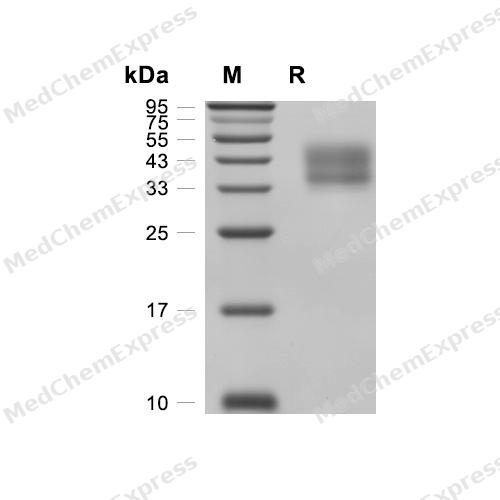
Purity - SDS-PAGE
-
Bioactivity - ELISA
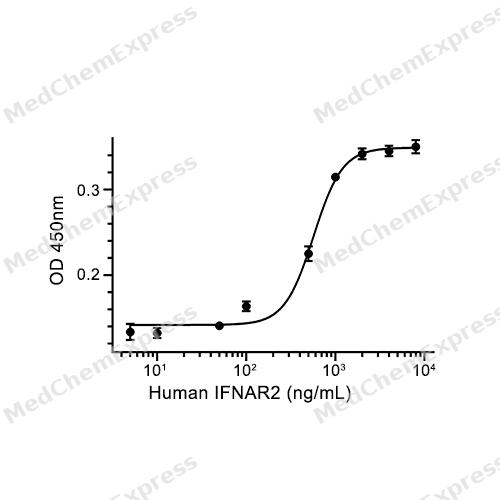
Bioactivity - ELISA


Publications (1)
-
Journal Impact Factor
-
Most Recent
-
J Virol
2025 Mar 18;99(3):e0217624. PMID: 39927774


Technical Parameters
-
Species Human
-
Source HEK293
-
Tag C-His
-
Accession
P48551-1 (I27-K243)
-
Molecular Construction
-
N-term
-
IFNAR2 (I27-K243)
Accession # P48551-1 -
His
-
C-term
-
-
Protein Length
Extracellular Domain
-
Synonyms
IFNAR2; IFN-R-2; Prev. IFNABR; Interferon-Alpha/Beta Receptor Beta Chain; Interferon Alpha/Beta Receptor 2; Human Interferon Alpha/Beta Receptor; Type I Interferon Receptor 2; IFN-Alpha Binding Protein; Interferon (Alpha, Beta And Omega) Receptor 2; Inter
-
AA Sequence
ISYDSPDYTDESCTFKISLRNFRSILSWELKNHSIVPTHYTLLYTIMSKPEDLKVVKNCANTTRSFCDLTDEWRSTHEAYVTVLEGFSGNTTLFSCSHNFWLAIDMSFEPPEFEIVGFTNHINVMVKFPSIVEEELQFDLSLVIEEQSEGIVKKHKPEIKGNMSGNFTYIIDKLIPNTNYCVSVYLEHSDEQAVIKSPLKCTLLPPGQESESAESAK
-
Molecular Weight
Approximately 34-55 kDa, based on SDS-PAGE under reducing conditions, due to the glycosylation.
-
Glycosylation
Yes
-
Purity
≥ 95%, as determined by reducing SDS-PAGE.


Product Properties
Lyophilized powder
1.Lyophilized from a 0.22 μm filtered solution of PBS, pH 7.4.
2.Lyophilized from a 0.22 μm filtered solution of 50 mM Tris-HCl, 300 mM NaCl, pH 7.4.
Please refer to the lot-specific COA for specific buffer information.
Note: For SPR assay, please replace the buffer. Primary amine components (e.g., Tris, imidazole) can affect protein-coupled chips.
<1 EU/μg, determined by LAL method.
It is not recommended to reconstitute to a concentration less than 100 μg/mL in ddH2O. For long term storage it is recommended to add a carrier protein (0.1% BSA, 5% HSA, 10% FBS or 5% Trehalose).
Stored at -20°C for 2 years from date of receipt. After reconstitution, it is stable at 4°C for 1 week or -20°C for longer (with carrier protein). It is recommended to freeze aliquots at -20°C or -80°C for extended storage.
Room temperature in continental US; may vary elsewhere.


Documentation
-
Data Sheet (265 KB)
-
SDS (252 KB)
- English - EN (252 KB)
- Français - FR (252 KB)
- Deutsch - DE (252 KB)
- Norwegian - NO (252 KB)
- Español - ES (252 KB)
- Swedish - SV (252 KB)
- Italian - IT (252 KB)
- Korean - KR (252 KB)
- Portuguese - PT (252 KB)
-
Handling Instructions (2659 KB)


References
[1]. Zanin N, et al. Interferon Receptor Trafficking and Signaling: Journey to the Cross Roads. Front Immunol. 2021 Jan 20;11:615603. [Content Brief]
[2]. Shemesh M, et al. IFNAR1 and IFNAR2 play distinct roles in initiating type I interferon-induced JAK-STAT signaling and activating STATs. Sci Signal. 2021 Nov 23;14(710):eabe4627. [Content Brief]
[4]. Pogue SL, et al. The receptor for type I IFNs is highly expressed on peripheral blood B cells and monocytes and mediates a distinct profile of differentiation and activation of these cells. J Interferon Cytokine Res. 2004 Feb;24(2):131-9. [Content Brief]
[5]. Duncan CJ, et al. Human IFNAR2 deficiency: Lessons for antiviral immunity. Sci Transl Med. 2015 Sep 30;7(307):307ra154. [Content Brief]
[6]. Hurtado-Guerrero I, et al. Immunomodulatory and Antiproliferative Activities of Recombinant Soluble IFNAR2 without IFN-β Mediation. J Clin Med. 2020 Mar 31;9(4):959. [Content Brief]

Calculators
Concentration (start) × Volume (start) = Concentration (final) × Volume (final)


 Powered by Bioz

