



IFN-gamma Protein, Canine
Based on 2 publication(s) in Google Scholar
IFN-gamma (interferon-gamma) is a type II interferon produced by immune cells such as T cells and NK cells, and plays a key role in activating antibacterial, antiviral, and antitumor responses. Through the JAK-STAT pathway, its interaction with the receptor IFNGR1 triggers gene regulation. IFN-gamma Protein, Canine is the recombinant canine-derived IFN-gamma protein, expressed by E. coli , with tag free.
- Species: Canine
- Source: E. coli
-
Storage:Stored at -20°C for 2 years from date of receipt. After reconstitution, it is stable at 4°C for 1 week or -20°C for longer (with carrier protein). It is recommended to freeze aliquots at -20°C or -80°C for extended storage.


To place orders, for customer services and technical support, please contact: MedChemExpress USA
Tel: 609-228-6898 E-mail: [email protected] [email protected]


-
 Biological Activity
-
Technical Parameters
-
Product Properties
- Documentation
- Help & FAQs





Biological Activity
Description
IFN-gamma (interferon-gamma) is a type II interferon produced by immune cells such as T cells and NK cells, and plays a key role in activating antibacterial, antiviral, and antitumor responses. Through the JAK-STAT pathway, its interaction with the receptor IFNGR1 triggers gene regulation. IFN-gamma Protein, Canine is the recombinant canine-derived IFN-gamma protein, expressed by E. coli , with tag free.
Background
IFN-gamma (Interferon-gamma), a type II interferon produced by immune cells like T-cells and NK cells, plays pivotal roles in antimicrobial, antiviral, and antitumor responses by activating effector immune cells and enhancing antigen presentation. Its primary signaling pathway involves the JAK-STAT pathway upon interaction with its receptor, IFNGR1, influencing gene regulation. Upon IFN-gamma binding, the IFNGR1 intracellular domain undergoes conformational changes, facilitating the association of downstream signaling components, including JAK2, JAK1, and STAT1. This cascade leads to STAT1 activation, nuclear translocation, and subsequent transcription of IFN-gamma-regulated genes, many of which are transcription factors like IRF1, capable of driving a subsequent wave of transcription. IFN-gamma contributes to the class I antigen presentation pathway by inducing the replacement of catalytic proteasome subunits with immunoproteasome subunits, thereby enhancing the quantity, quality, and repertoire of peptides for class I MHC loading. It also increases the efficiency of peptide generation by inducing the expression of the activator PA28, which associates with the proteasome and alters its proteolytic cleavage preference. Furthermore, IFN-gamma up-regulates MHC II complexes on the cell surface by promoting the expression of key molecules such as cathepsins B/CTSB, H/CTSH, and L/CTSL. Beyond its direct immune functions, IFN-gamma participates in the regulation of hematopoietic stem cells during development and under homeostatic conditions, influencing their development, quiescence, and differentiation. Existing as a homodimer, IFN-gamma interacts with IFNGR1 via its extracellular domain, a crucial interaction that promotes IFNGR1 dimerization, orchestrating its diverse and critical functions in immune responses and hematopoiesis.
Verified Bioactivity
1.Measured by its ability to inhibit the proliferation of HT-29 human coloncancer cells. The ED50 for this effect is 0.02-0.1 ng/mL.
2.Measured by its ability to inhibit the proliferation of MDCK cells. The ED50 for this effect is < 0.1 μg/mL.
MCE Validation Data
-
Purity - SDS-PAGE
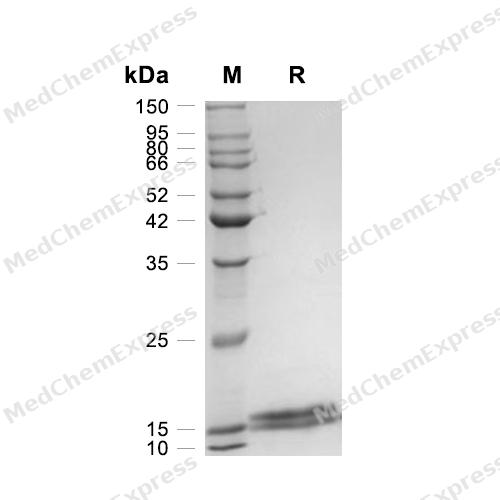
Purity - SDS-PAGE
-
Bioactivity - Cell-Based Assay
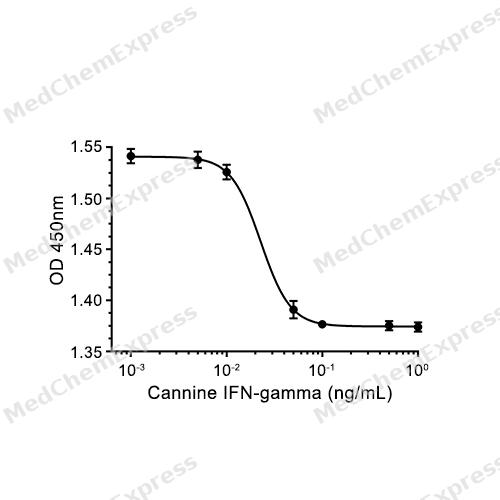
Bioactivity - Cell-Based Assay


Publications (2)
-
Journal Impact Factor
-
Most Recent
-
Int Immunopharmacol
Targeting CD161 inhibitory receptors enhances NK cell-mediated changes in synovial fibroblast function in rheumatoid arthritis. [Abstract]2025 Sep 12:165:115528. PMID: 40945032 -
Cytokine
Role of FGF19 in regulating mitochondrial dynamics and macrophage polarization through FGFR4/AMPKα-p38/MAPK Axis in bleomycin-induced pulmonary fibrosis. [Abstract]2025 Sep:193:156978. PMID: 40550190


Technical Parameters
-
Species Canine
-
Source E. coli
-
Tag Tag Free
-
Accession
P42161 (Q24-K166)
-
Molecular Construction
-
N-term
-
IFN-gamma (Q24-K166)
Accession # P42161 -
C-term
-
-
Protein Length
Full Length of Mature Protein
-
Synonyms
IFNG; IMD69; Interferon Gamma; IFG; IFN-Gamma; IFI; Immune Interferon
-
AA Sequence
QAMFFKEIENLKEYFNASNPDVSDGGSLFVDILKKWREESDKTIIQSQIVSFYLKLFDNFKDNQIIQRSMDTIKEDMLGKFLNSSTSKREDFLKLIQIPVNDLQVQRKAINELIKVMNDLSPRSNLRKRKRSQNLFRGRRASK
-
Predicted Molecular Mass
16.9 kDa
-
Molecular Weight
Approximately 16 kDa, based on SDS-PAGE under reducing conditions.
-
Purity
≥ 95%, as determined by reducing SDS-PAGE.


Product Properties
Lyophilized powder.
Lyophilized from a 0.22 μm filtered solution of 20 mM PB, 150 mM NaCl, pH 7.4, 8% trehalose.
<1 EU/μg, determined by LAL method.
It is not recommended to reconstitute to a concentration less than 100 μg/mL in ddH2O. For long term storage it is recommended to add a carrier protein (0.1% BSA, 5% HSA, 10% FBS or 5% Trehalose).
Stored at -20°C for 2 years from date of receipt. After reconstitution, it is stable at 4°C for 1 week or -20°C for longer (with carrier protein). It is recommended to freeze aliquots at -20°C or -80°C for extended storage.
Room temperature in continental US; may vary elsewhere.


Documentation
-
Data Sheet (236 KB)
-
SDS (251 KB)
- English - EN (251 KB)
- Français - FR (251 KB)
- Deutsch - DE (251 KB)
- Norwegian - NO (251 KB)
- Español - ES (251 KB)
- Swedish - SV (251 KB)
- Italian - IT (251 KB)
- Korean - KR (251 KB)
- Portuguese - PT (251 KB)
-
Handling Instructions (2659 KB)

Calculators
Concentration (start) × Volume (start) = Concentration (final) × Volume (final)


 Powered by Bioz

