



IL-22 Protein, Human
Based on 4 publication(s) in Google Scholar
IL-22 Protein, Human is a cytokine protein and intricate member of the immune response.
- Species: Human
- Source: E. coli
-
Storage:Stored at -20°C for 2 years from date of receipt. After reconstitution, it is stable at 4°C for 1 week or -20°C for longer (with carrier protein). It is recommended to freeze aliquots at -20°C or -80°C for extended storage.


To place orders, for customer services and technical support, please contact: MedChemExpress USA
Tel: 609-228-6898 E-mail: [email protected] [email protected]


-
 Biological Activity
-
Technical Parameters
-
Product Properties
- Documentation
- References
- Help & FAQs


-

HY-P7027
IL-1 alpha Protein, Human -
HY-P70465
OSM Protein, Human (His) -
HY-P7058
TNF-alpha/TNFSF2 Protein, Human -
HY-P70527
IL-17A Protein, Human (HEK293, His) -
HY-P7036
IL-17A Protein, Human -
HY-P7025
IFN-gamma Protein, Human -
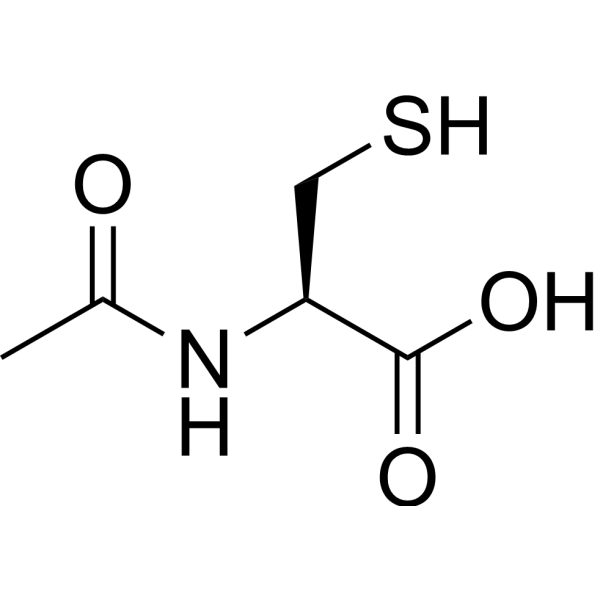
HY-B0215
Acetylcysteine -
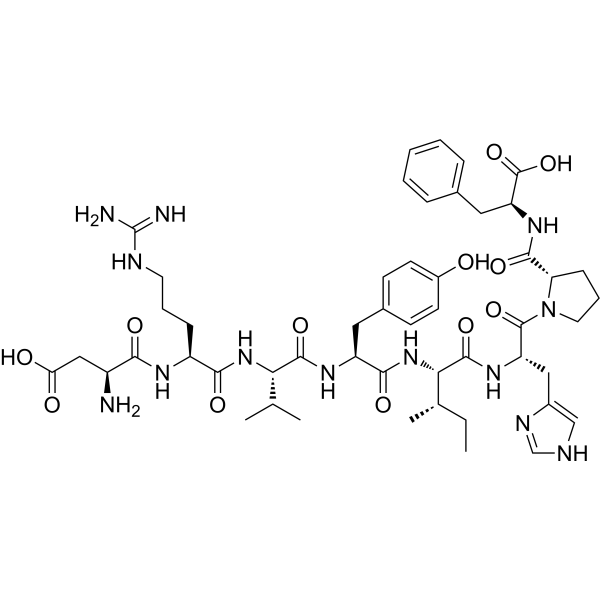
HY-13948
Angiotensin II human -
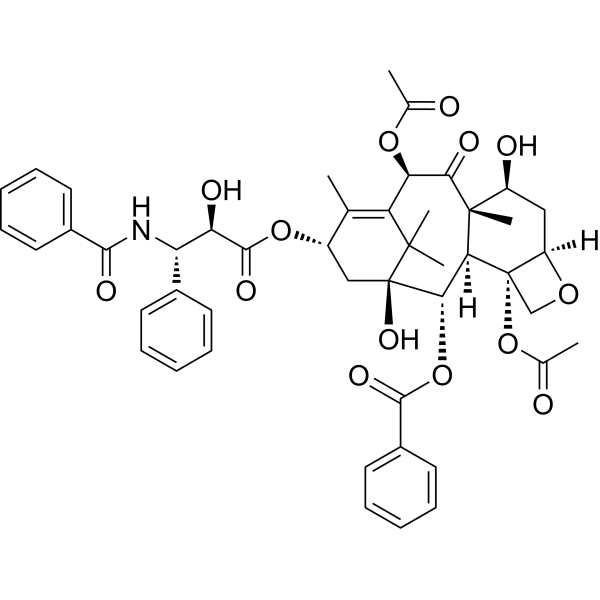
HY-B0015
Paclitaxel -
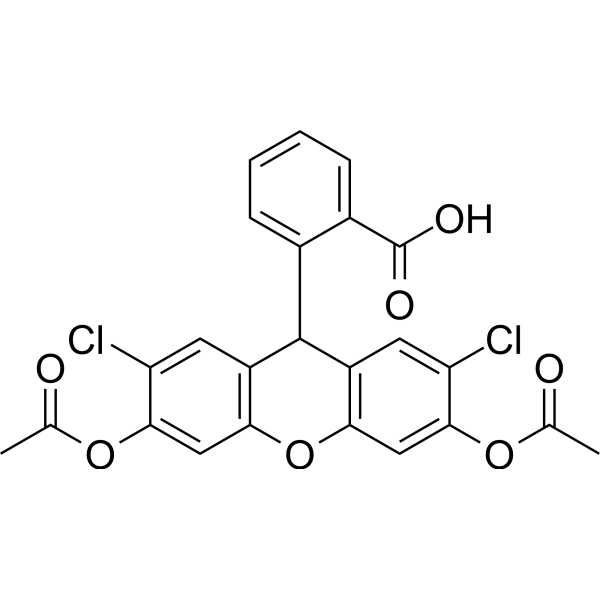
HY-D0940
H2DCFDA -
HY-N0830
Palmitic acid -
HY-14519
Methotrexate


Biological Activity
Description
IL-22 Protein, Human is a cytokine protein and intricate member of the immune response.
Background
Interleukin-22 (IL-10-related T cell-derived inducible factor/IL-TIF/IL-22) is a novel cytokine belonging to the IL-10 family. Recombinant humanIL-22 (hIL-22) is found to activate the signal transducers and activators of transcription factors 1 and 3 as well as acute phase reactants in several hepatoma cell lines, suggesting its involvement in the inflammatory response. IL-22 is a member of interleukin-10 family of cytokines, which also includes IL-19, IL-20, and IL-24 in addition to IL-10 and a number of its viral homologs[1].
Verified Bioactivity
Measured by its ability to induce IL-10 secretion in COLO 205 human colorectal adenocarcinoma cells. The EDsub>50 for this effect is <1 ng/mL.


Publications (4)
-
Journal Impact Factor
-
Most Recent
-
Sci Rep
BIRC5 modulates keratinocyte proliferation and apoptosis via PI3K/AKT/mTOR-mediated autophagy. [Abstract]2026 Apr 29;16(1):20062. PMID: 42056221 -
Naunyn Schmiedebergs Arch Pharmacol
The molecular mechanism of berberine affecting psoriasis skin inflammation by regulating keratinocyte pyroptosis via the p38 MAPK/NF-κB pathway. [Abstract]2025 Apr;398(4):3843-3859. PMID: 39365309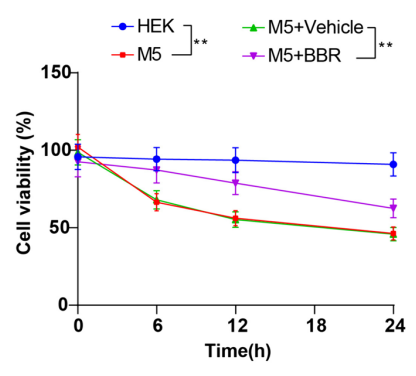
IL-22 Protein, Human purchased from MedChemExpress. Usage Cited in: Naunyn Schmiedebergs Arch Pharmacol. 2025 Apr;398(4):3843-3859. [Abstract]
Cell viability was assessed via the CCK-8 assay. To explore the molecular mechanism by which BBR regulates psoriatic skin inflammation, human epidermal keratinocytes (HEKs) were cultured in vitro and stimulated with M5 (IL-17A, IL-22 (HY-P7039, human IL-22 protein), IL-1α, OSM and TNF-α) (each cytokine at 10 ng/mL; 24 h) to mimic the immune microenvironment of psoriasis. CCK-8 results indicated that cell viability was markedly reduced in the M5 group compared with the control HEK group (p < 0.01).
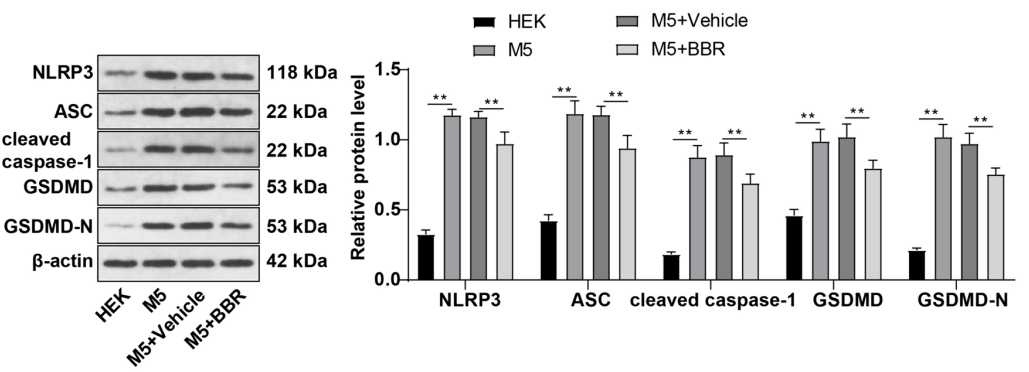
IL-22 Protein, Human purchased from MedChemExpress. Usage Cited in: Naunyn Schmiedebergs Arch Pharmacol. 2025 Apr;398(4):3843-3859. [Abstract]
Western blot to determine cell NLRP3, ASC, cleaved caspase-1, and GSDMD and GSDMD-N levels. To explore the molecular mechanism by which BBR regulates psoriatic skin inflammation, human epidermal keratinocytes (HEKs) were cultured in vitro and stimulated with M5 (IL-17A, IL-22 (HY-P7039, human IL-22 protein), IL-1α, OSM and TNF-α) (each cytokine at 10 ng/mL; 24 h) to mimic the immune microenvironment of psoriasis. The Western blot results showed that cellular protein levels of GSDMD-N, NLRP3, cleaved caspase-1, ASC and GSDMD were markedly elevated in the M5 group compared with the HEK group (p<0.01).
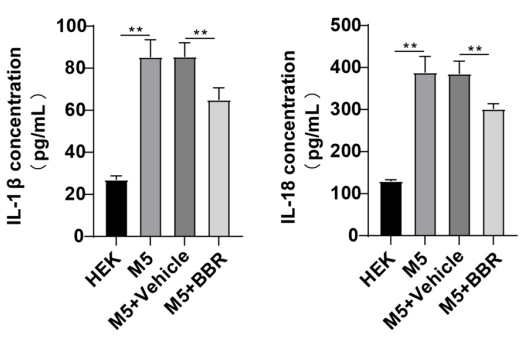
IL-22 Protein, Human purchased from MedChemExpress. Usage Cited in: Naunyn Schmiedebergs Arch Pharmacol. 2025 Apr;398(4):3843-3859. [Abstract]
ELISA kits to assess IL-1β and IL-18 levels in the supernatants of cell culture medium. To explore the molecular mechanism by which BBR regulates psoriatic skin inflammation, human epidermal keratinocytes (HEKs) were cultured in vitro and stimulated with M5 (IL-17A, IL-22 (HY-P7039, human IL-22 protein), IL-1α, OSM and TNF-α) (each cytokine at 10 ng/mL; 24 h) to mimic the immune microenvironment of psoriasis. ELISA results revealed that the levels of IL-1β and IL-18 in cell supernatants were significantly elevated in the M5 group relative to the HEK group.
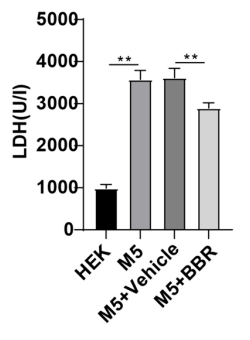
IL-22 Protein, Human purchased from MedChemExpress. Usage Cited in: Naunyn Schmiedebergs Arch Pharmacol. 2025 Apr;398(4):3843-3859. [Abstract]
Measurement of cell LDH release using a reagent kit. To explore the molecular mechanism by which BBR regulates psoriatic skin inflammation, human epidermal keratinocytes (HEKs) were cultured in vitro and stimulated with M5 (IL-17A, IL-22 (HY-P7039, human IL‑22 protein), IL-1α, OSM and TNF-α) (each cytokine at 10 ng/mL; 24 h) to mimic the immune microenvironment of psoriasis. The results showed that lactate dehydrogenase (LDH) release in the M5-induced group was significantly higher than that in the HEK control group (p < 0.01).
-
AMB Express
Therapeutic potential of recombinant IL-22BP in psoriasis: suppression of IL-22/STAT3 signaling in mice. [Abstract]2025 Aug 18;15(1):121. PMID: 40824430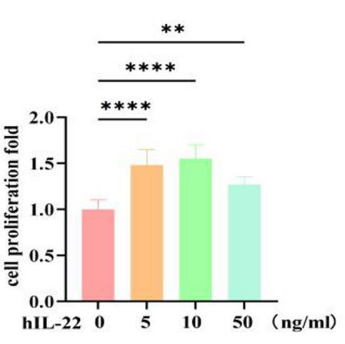
IL-22 Protein, Human purchased from MedChemExpress. Usage Cited in: AMB Express. 2025 Aug 18;15(1):121. [Abstract]
The effect of 5, 10 and 50 ng/mL IL-22 (12 h) (HY-P7039, IL-22 Protein, Human) on the proliferation of HaCaT cells was detected by CCK8 assay.
-


Technical Parameters
-
Species Human
-
Source E. coli
-
Tag Tag Free
-
Accession
Q9GZX6 (A34-I179)
-
Molecular Construction
-
N-term
-
IL-22 (A34-I179)
Accession # Q9GZX6 -
C-term
-
-
Protein Length
Full Length of Mature Protein
-
Synonyms
IL22; TIFa; Interleukin 22; IL-10-Related T-Cell-Derived Inducible Factor; IL-TIF; Cytokine Zcyto18; ILTIF; Interleukin-22; IL-22; MGC79382; TIFIL-23; MGC79384; Zcyto18; IL-10-Related T-Cell-Derived-Inducible Factor; IL-D110; Interferon 2B1; IL-21; ZCYTO1
-
AA Sequence
APISSHCRLDKSNFQQPYITNRTFMLAKEASLADNNTDVRLIGEKLFHGVSMSERCYLMKQVLNFTLEEVLFPQSDRFQPYMQEVVPFLARLSNRLSTCHIEGDDLHIQRNVQKLKDTVKKLGESGEIKAIGELDLLFMSLRNACI
-
Predicted Molecular Mass
16.9 kDa
-
Molecular Weight
Approximately 14-17 kDa, based on SDS-PAGE under reducing conditions, due to the glycosylation.
-
Purity
≥ 95%, as determined by reducing SDS-PAGE.


Product Properties
Lyophilized powder
Lyophilized from a 0.22 μm filtered solution of PBS, pH 7.4.
<0.2 EU/μg, determined by LAL method.
It is not recommended to reconstitute to a concentration less than 100 μg/mL in ddH2O. For long term storage it is recommended to add a carrier protein (0.1% BSA, 5% HSA, 10% FBS or 5% Trehalose).
Stored at -20°C for 2 years from date of receipt. After reconstitution, it is stable at 4°C for 1 week or -20°C for longer (with carrier protein). It is recommended to freeze aliquots at -20°C or -80°C for extended storage.
Room temperature in continental US; may vary elsewhere.


Documentation
-
Data Sheet (260 KB)
-
SDS (252 KB)
- English - EN (252 KB)
- Français - FR (252 KB)
- Deutsch - DE (252 KB)
- Norwegian - NO (252 KB)
- Español - ES (252 KB)
- Swedish - SV (252 KB)
- Italian - IT (252 KB)
- Korean - KR (252 KB)
- Portuguese - PT (252 KB)
-
Handling Instructions (2659 KB)


References

Calculators
Concentration (start) × Volume (start) = Concentration (final) × Volume (final)


 Powered by Bioz

