



OSM Protein, Human (His)
Based on 6 publication(s) in Google Scholar
OSM protein is a multifunctional growth regulator with dual functions of inhibiting tumor cell lines and stimulating the proliferation of AIDS-KS cells. It coordinates the production of cytokines, including IL-6, G-CSF, and GM-CSF, and binds to type I and type II OSM receptors, forming heterodimers with LIFR/IL6ST and OSMR/IL6ST, respectively. OSM Protein, Human (His) is the recombinant human-derived OSM protein, expressed by E. coli , with N-6*His labeled tag.
- Species: Human
- Source: E. coli
-
Storage:Stored at -20°C for 2 years from date of receipt. After reconstitution, it is stable at 4°C for 1 week or -20°C for longer (with carrier protein). It is recommended to freeze aliquots at -20°C or -80°C for extended storage.


To place orders, for customer services and technical support, please contact: MedChemExpress USA
Tel: 609-228-6898 E-mail: [email protected] [email protected]


-
 Biological Activity
-
Technical Parameters
-
Product Properties
- Documentation
- Help & FAQs


-

HY-P7058
TNF-alpha/TNFSF2 Protein, Human -
HY-P7027
IL-1 alpha Protein, Human -
HY-P7039
IL-22 Protein, Human -
HY-P70527
IL-17A Protein, Human (HEK293, His) -
HY-P7036
IL-17A Protein, Human -
HY-15371
Forskolin -
HY-14648
Dexamethasone -
HY-12318
IBMX -
HY-P70311
Activin A Protein, Human/Mouse/Rat (HEK293) -
HY-P7109
EGF Protein, Human -
HY-P7007
BMP-4 Protein, Human -
HY-P7044
IL-6 Protein, Human


Biological Activity
Description
OSM protein is a multifunctional growth regulator with dual functions of inhibiting tumor cell lines and stimulating the proliferation of AIDS-KS cells. It coordinates the production of cytokines, including IL-6, G-CSF, and GM-CSF, and binds to type I and type II OSM receptors, forming heterodimers with LIFR/IL6ST and OSMR/IL6ST, respectively. OSM Protein, Human (His) is the recombinant human-derived OSM protein, expressed by E. coli , with N-6*His labeled tag.
Background
OSM Protein stands as a versatile growth regulator with dual inhibitory effects on the proliferation of various tumor cell lines and stimulatory effects on AIDS-KS cell proliferation. Notably, OSM orchestrates the regulation of cytokine production, including IL-6, G-CSF, and GM-CSF from endothelial cells. This multifaceted growth regulator engages both the type I OSM receptor, forming heterodimers composed of LIFR and IL6ST, and the type II OSM receptor, forming heterodimers composed of OSMR and IL6ST. Beyond its antiproliferative and proliferative roles, OSM plays a crucial part in the maturation of fetal hepatocytes, contributing significantly to liver development and regeneration.
Verified Bioactivity
Measured in a cell proliferation assay using TF-1 human erythroleukemic cells. The ED50 for this effect is 0.1-1.0 ng/mL.
MCE Validation Data
-
Purity - SDS-PAGE
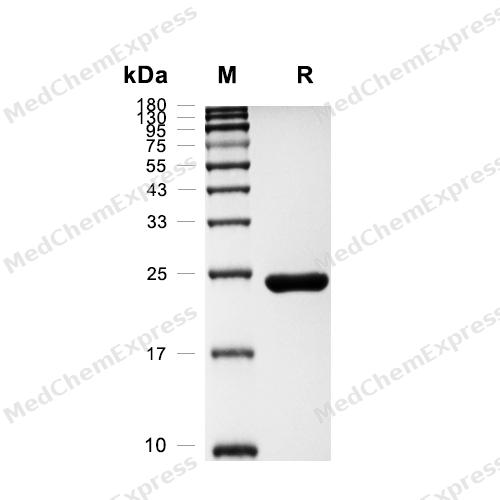
Purity - SDS-PAGE
-
Bioactivity - Cell-Based Assay
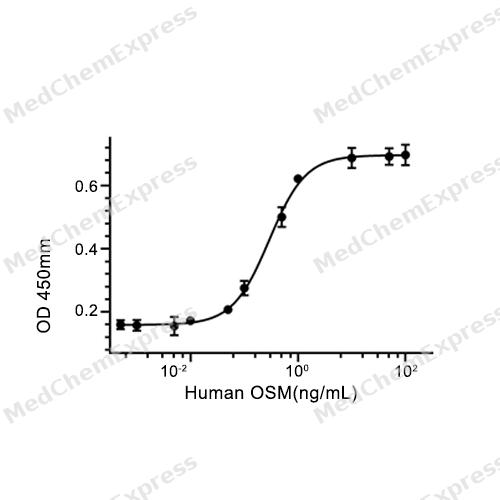
Bioactivity - Cell-Based Assay


Publications (6)
-
Journal Impact Factor
-
Most Recent
-
Sci Adv
GPAM mediates mitochondrial dysfunction and the progression of alcoholic liver disease through lipid remodeling. [Abstract]2026 Jun 26;12(26):eaef1896. PMID: 42341117 -
J Orthop Translat
Oncostatin-M functionalized cryogel microspheres for promoting diabetic bone defects regeneration. [Abstract]2025 Jun 20:53:138-148. PMID: 40606844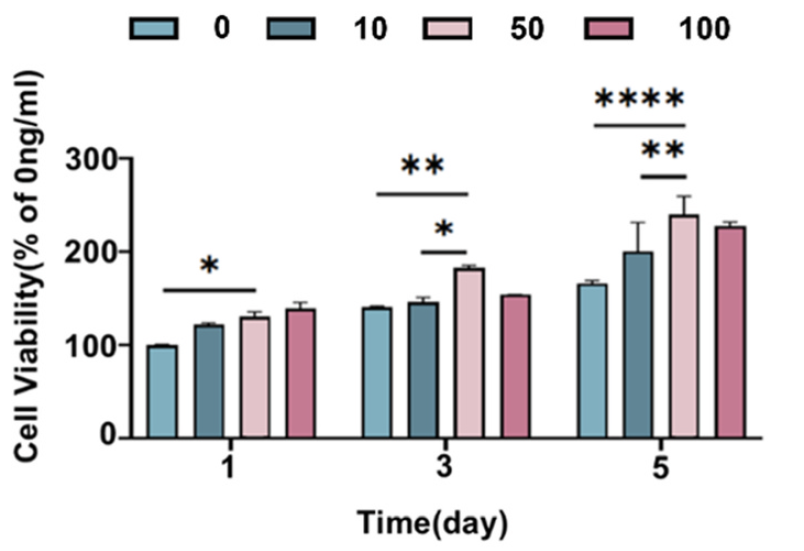
OSM Protein, Human (His) purchased from MedChemExpress. Usage Cited in: J Orthop Translat. 2025 Jun 20:53:138-148. [Abstract]
OSM (10-100 ng/mL; 1-5 Days). Quantitative assessment of BMSC proliferation capacity was performed via CCK-8 assay on days 1, 3, and 5.
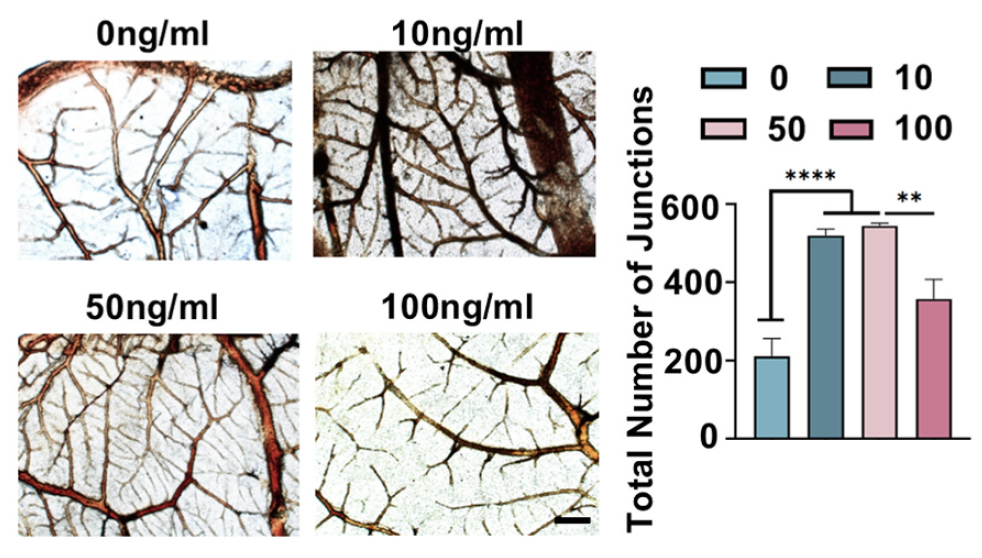
OSM Protein, Human (His) purchased from MedChemExpress. Usage Cited in: J Orthop Translat. 2025 Jun 20:53:138-148. [Abstract]
OSM (10–50 ng/mL; 200 μL applied dropwise onto the chicken chorioallantoic membrane (CAM) surface) significantly promoted angiogenesis. The 50 ng/mL OSM group exhibited 545.3 branch points, which were 2.6- and 1.5-fold higher than those in the control and 100 ng/mL OSM groups, respectively.
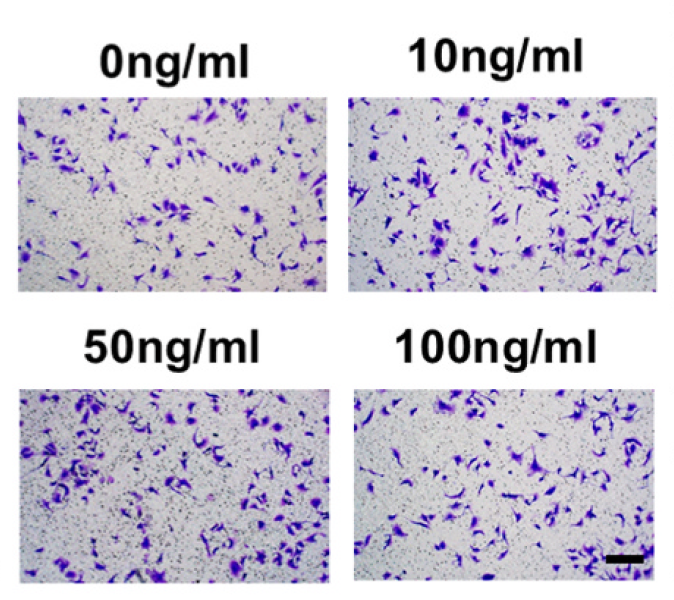
OSM Protein, Human (His) purchased from MedChemExpress. Usage Cited in: J Orthop Translat. 2025 Jun 20:53:138-148. [Abstract]
OSM (50 ng/mL; 24 h) significantly promoted the vertical migration of BMSCs, with the number of migrated cells reaching 94 per field of view—1.3 times that of the control group, 1.1 times that of the 10 ng/mL OSM group, and 1.1 times that of the 100 ng/mL OSM group.
-
Transl Res
Spleen derived monocytes regulate pulmonary vascular permeability in Hepatopulmonary syndrome through the OSM-FGF/FGFR1 signaling. [Abstract]2024 Sep:271:93-104. PMID: 38797433 -
Sci Rep
BIRC5 modulates keratinocyte proliferation and apoptosis via PI3K/AKT/mTOR-mediated autophagy. [Abstract]2026 Apr 29;16(1):20062. PMID: 42056221 -
Naunyn Schmiedebergs Arch Pharmacol
The molecular mechanism of berberine affecting psoriasis skin inflammation by regulating keratinocyte pyroptosis via the p38 MAPK/NF-κB pathway. [Abstract]2025 Apr;398(4):3843-3859. PMID: 39365309 -
bioRxiv
2025 Jun 19:2025.06.15.659815. PMID: 40667248


Technical Parameters
-
Species Human
-
Source E. coli
-
Tag N-6*His
-
Accession
P13725 (A26-R221)
-
Molecular Construction
-
N-term
-
6*His
-
OSM (A26-R221)
Accession # P13725 -
C-term
-
-
Protein Length
Full Length of Mature Protein
-
Synonyms
OSM; Oncostatin-M; Oncostatin M; MGC20461
-
AA Sequence
AAIGSCSKEYRVLLGQLQKQTDLMQDTSRLLDPYIRIQGLDVPKLREHCRERPGAFPSEETLRGLGRRGFLQTLNATLGCVLHRLADLEQRLPKAQDLERSGLNIEDLEKLQMARPNILGLRNNIYCMAQLLDNSDTAEPTKAGRGASQPPTPTPASDAFQRKLEGCRFLHGYHRFMHSVGRVFSKWGESPNRSRR
-
Predicted Molecular Mass
24.4 kDa
-
Molecular Weight
Approximately 28 kDa, based on SDS-PAGE under reducing conditions.
-
Purity
≥ 95%, as determined by reducing SDS-PAGE.


Product Properties
Lyophilized powder
1.Lyophilized from a 0.22 μm filtered solution of 20 mM Tris-HCl, 200 mM NaCl, pH 7.5.
2.Lyophilized from a 0.22 μm filtered solution of 20 mM Tris-HCl, 1 mM EDTA, 200 mM NaCl,4% Mannitol, pH 7.5.
Please refer to the lot-specific COA for specific buffer information.
Note: For SPR assay, please replace the buffer. Primary amine components (e.g., Tris, imidazole) can affect protein-coupled chips.
<1 EU/μg, determined by LAL method.
It is not recommended to reconstitute to a concentration less than 100 μg/mL in ddH2O. For long term storage it is recommended to add a carrier protein (0.1% BSA, 5% HSA, 10% FBS or 5% Trehalose).
Stored at -20°C for 2 years from date of receipt. After reconstitution, it is stable at 4°C for 1 week or -20°C for longer (with carrier protein). It is recommended to freeze aliquots at -20°C or -80°C for extended storage.
Room temperature in continental US; may vary elsewhere.


Documentation
-
Data Sheet (236 KB)
-
SDS (251 KB)
- English - EN (251 KB)
- Français - FR (251 KB)
- Deutsch - DE (251 KB)
- Norwegian - NO (251 KB)
- Español - ES (251 KB)
- Swedish - SV (251 KB)
- Italian - IT (251 KB)
- Korean - KR (251 KB)
- Portuguese - PT (251 KB)
-
Handling Instructions (2659 KB)

Calculators
Concentration (start) × Volume (start) = Concentration (final) × Volume (final)


 Powered by Bioz

