



LAG-1/CCL4L1 Protein, Human

Based on 1 Customer Validation
LAG-1/CCL4L1 protein acts as a chemokine and can induce chemotaxis in cells expressing CCR5 or CCR1, indicating its role in cell migration (chemotaxis). Furthermore, it demonstrated the ability to inhibit HIV replication, particularly in CCR5-expressing peripheral blood mononuclear cells, suggesting a potential impact on antiviral defense mechanisms. LAG-1/CCL4L1 Protein, Human is the recombinant human-derived LAG-1/CCL4L1 protein, expressed by E. coli , with tag free.
- Species: Human
- Source: E. coli
-
Storage:Stored at -20°C for 2 years from date of receipt. After reconstitution, it is stable at 4°C for 1 week or -20°C for longer (with carrier protein). It is recommended to freeze aliquots at -20°C or -80°C for extended storage.


To place orders, for customer services and technical support, please contact: MedChemExpress USA
Tel: 609-228-6898 E-mail: [email protected] [email protected]


-
 Biological Activity
-
Technical Parameters
-
Product Properties
- Documentation
- Help & FAQs




Biological Activity
Description
LAG-1/CCL4L1 protein acts as a chemokine and can induce chemotaxis in cells expressing CCR5 or CCR1, indicating its role in cell migration (chemotaxis). Furthermore, it demonstrated the ability to inhibit HIV replication, particularly in CCR5-expressing peripheral blood mononuclear cells, suggesting a potential impact on antiviral defense mechanisms. LAG-1/CCL4L1 Protein, Human is the recombinant human-derived LAG-1/CCL4L1 protein, expressed by E. coli , with tag free.
Background
LAG-1 (CCL4L1) is a chemokine with the capacity to induce chemotaxis in cells expressing CCR5 or CCR1. Notably, LAG-1 exerts an inhibitory effect on HIV replication in peripheral blood monocytes that express CCR5, highlighting its potential role in immune defense mechanisms against viral infections. This protein achieves its chemotactic effects by interacting with CCR5, underscoring its specificity in modulating cellular responses. The ability of LAG-1 to influence chemotaxis and inhibit HIV replication suggests its significance in orchestrating immune responses and potential therapeutic implications in combating viral infections (
Verified Bioactivity
Measured by its ability to chemoattract BaF3 mouse pro-B cells transfected with human CCR5. The ED50 for this effect is 1.927 ng/mL, corresponding to a specific activity is 5.19×10^5 U/mg.
MCE Validation Data
-
Purity - SDS-PAGE
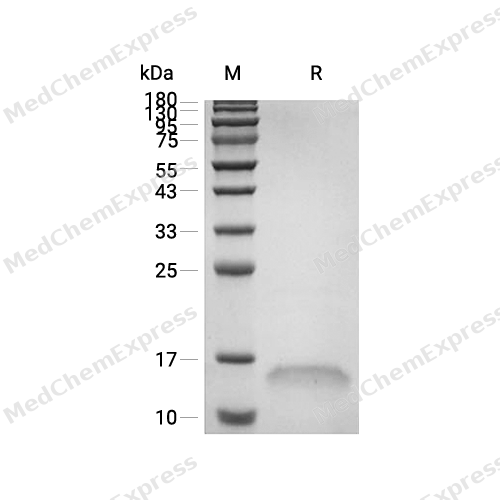
Purity - SDS-PAGE
-
Bioactivity - Cell-Based Assay
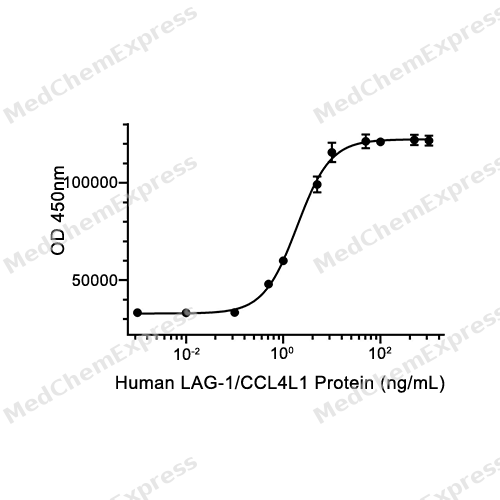
Bioactivity - Cell-Based Assay


Technical Parameters
-
Species Human
-
Source E. coli
-
Tag Tag Free
-
Accession
Q8NHW4-1 (A24-N92)
-
Gene ID388372
-
Molecular Construction
-
N-term
-
LAG-1 (A24-N92)
Accession # Q8NHW4 -
C-term
-
-
Protein Length
Full Length of Isoform-1
-
Synonyms
CCL4L1; MIP-1-Beta; Prev. CCL4L; SCYA4L1; Prev. SCYA4L; SCYA4L2; LAG-1; LAG1; Monocyte Adherence-Induced Protein 5-Alpha; Chemokine (C-C Motif) Ligand 4-Like 1, Telomeric; Macrophage Inflammatory Protein 1-Beta; Chemokine (C-C Motif) Ligand 4-Like 1; Lymp
-
AA Sequence
APMGSDPPTACCFSYTARKLPRNFVVDYYETSSLCSQPAVVFQTKRGKQVCADPSESWVQEYVYDLELN
-
Predicted Molecular Mass
7.8 kDa
-
Molecular Weight
Approximately 15 kDa, based on SDS-PAGE under reducing conditions.
-
Purity
≥ 95%, as determined by reducing SDS-PAGE.


Product Properties
Lyophilized powder
Lyophilized from a 0.22 μm filtered solution of PBS, pH 7.4, 8% trehalose.
<1 EU/μg, determined by LAL method.
It is not recommended to reconstitute to a concentration less than 100 μg/mL in ddH2O.
Stored at -20°C for 2 years from date of receipt. After reconstitution, it is stable at 4°C for 1 week or -20°C for longer (with carrier protein). It is recommended to freeze aliquots at -20°C or -80°C for extended storage.
Room temperature in continental US; may vary elsewhere.


Documentation
-
Data Sheet (235 KB)
-
SDS (252 KB)
- English - EN (252 KB)
- Français - FR (252 KB)
- Deutsch - DE (252 KB)
- Norwegian - NO (252 KB)
- Español - ES (252 KB)
- Swedish - SV (252 KB)
- Italian - IT (252 KB)
- Korean - KR (252 KB)
- Portuguese - PT (252 KB)
-
Handling Instructions (2659 KB)

Calculators
Concentration (start) × Volume (start) = Concentration (final) × Volume (final)


 Powered by Bioz

