



NRG1-alpha Protein, Human (HEK293, His)
Based on 1 Customer Validation
NRG1-α protein binds directly to ERBB3 and ERBB4 receptors, leading to the recruitment of ERBB1 and ERBB2 coreceptors. NRG1-alpha Protein, Human (HEK293, His) is the recombinant human-derived NRG1-alpha protein, expressed by HEK293 , with C-His, C-6*His labeled tag.
- Species: Human
- Source: HEK293
-
Storage:Stored at -20°C for 2 years from date of receipt. After reconstitution, it is stable at 4°C for 1 week or -20°C for longer (with carrier protein). It is recommended to freeze aliquots at -20°C or -80°C for extended storage.


To place orders, for customer services and technical support, please contact: MedChemExpress USA
Tel: 609-228-6898 E-mail: [email protected] [email protected]


-
 Biological Activity
-
Technical Parameters
-
Product Properties
- Documentation
- Help & FAQs




Biological Activity
Description
NRG1-α protein binds directly to ERBB3 and ERBB4 receptors, leading to the recruitment of ERBB1 and ERBB2 coreceptors. NRG1-alpha Protein, Human (HEK293, His) is the recombinant human-derived NRG1-alpha protein, expressed by HEK293 , with C-His, C-6*His labeled tag.
Background
NRG1-alpha protein acts as a direct ligand for ERBB3 and ERBB4 tyrosine kinase receptors, concurrently recruiting ERBB1 and ERBB2 coreceptors, thereby inducing ligand-stimulated tyrosine phosphorylation and activation of the ERBB receptors. The diverse functions of its multiple isoforms encompass the induction of growth and differentiation in various cell types, including epithelial, glial, neuronal, and skeletal muscle cells. NRG1-alpha is also involved in the expression of acetylcholine receptors during neuromuscular junction formation, the stimulation of lobuloalveolar budding and milk production in the mammary gland, and the induction of differentiation in mammary tumor cells. Furthermore, it stimulates Schwann cell proliferation and plays a role in myocardial development, specifically contributing to the trabeculation of the developing heart. Isoform 10 is implicated in motor and sensory neuron development. NRG1-alpha binds to ERBB4 and ERBB3, acting as a ligand for integrins and forming a ternary complex with integrins and ERBB3, a crucial step in NRG1-ERBB signaling. It induces the phosphorylation and activation of MAPK3/ERK1, MAPK1/ERK2, and AKT1. Additionally, NRG1-alpha participates in ligand-dependent ERBB4 endocytosis, essential for the activation of these kinases in neurons, and interacts with the LIM domain region of LIMK1. It also forms a ternary complex with ERBB3 and integrins ITGAV:ITGB3 or ITGA6:ITGB4 and interacts with NRDC and BACE1.
Verified Bioactivity
Measured in a serum-free cell proliferation assay using MCF-7 human breast cancer cells. The ED50 for this effect is 40.8 ng/mL, corresponding to a specific activity is 2.45×10⁴ units/mg
MCE Validation Data
-
Purity - SDS-PAGE
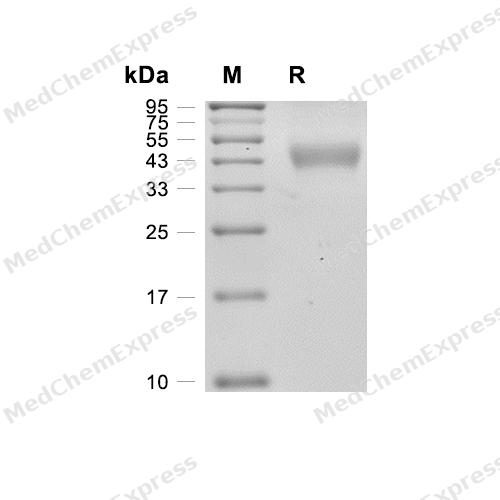
Purity - SDS-PAGE
-
Bioactivity - Cell-Based Assay
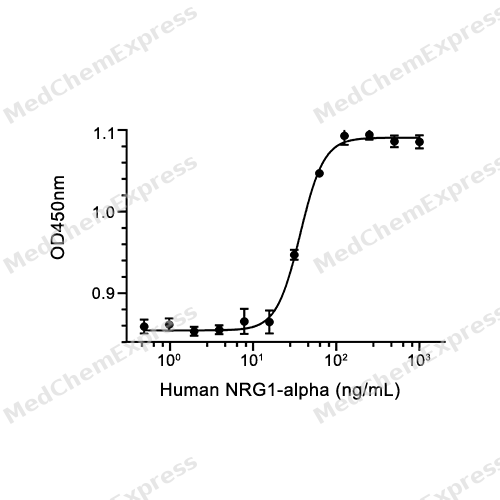
Bioactivity - Cell-Based Assay


Technical Parameters
-
Species Human
-
Source HEK293
-
Tag C-6*His
-
Accession
Q02297-1 (S20-K241)
-
Molecular Construction
-
N-term
-
NRG1-alpha (S20-K241)
Accession # Q02297-1 -
6*His
-
C-term
-
-
Protein Length
Extracellular Domain
-
Synonyms
NRG1; NRG1 Class VII Isoform Alpha 2a; Prev. HGL; NRG1 Class VII Isoform Beta 2a; Prev. NRG1-IT2; Neuregulin 1 Isoform HRG-Gamma; NDF; Neuregulin 1 Isoform HRG-Beta3; GGF; Neuregulin 1 Isoform HRG-Beta2; Pro-Neuregulin-1, Membrane-Bound Isoform; Neureguli
-
AA Sequence
SGKKPESAAGSQSPALPPRLKEMKSQESAAGSKLVLRCETSSEYSSLRFKWFKNGNELNRKNKPQNIKIQKKPGKSELRINKASLADSGEYMCKVISKLGNDSASANITIVESNEIITGMPASTEGAYVSSESPIRISVSTEGANTSSSTSTSTTGTSHLVKCAEKEKTFCVNGGECFMVKDLSNPSRYLCKCQPGFTGARCTENVPMKVQNQEKAEELYQK
-
Predicted Molecular Mass
25.5 kDa
-
Molecular Weight
Approximately 40-50 kDa, based on SDS-PAGE under reducing conditions, due to the glycosylation.
-
Glycosylation
Yes
-
Purity
≥ 95%, as determined by reducing SDS-PAGE.


Product Properties
Lyophilized powder.
Lyophilized from a 0.2 μm filtered solution of PBS, pH 7.4.
<1 EU/μg, determined by LAL method.
It is not recommended to reconstitute to a concentration less than 100 μg/mL in ddH2O or PBS, pH 7.4. For long term storage it is recommended to add a carrier protein (0.1% BSA, 5% HSA, 10% FBS or 5% Trehalose).
Stored at -20°C for 2 years from date of receipt. After reconstitution, it is stable at 4°C for 1 week or -20°C for longer (with carrier protein). It is recommended to freeze aliquots at -20°C or -80°C for extended storage.
Room temperature in continental US; may vary elsewhere.


Documentation
-
Data Sheet (237 KB)
-
SDS (252 KB)
- English - EN (252 KB)
- Français - FR (252 KB)
- Deutsch - DE (252 KB)
- Norwegian - NO (252 KB)
- Español - ES (252 KB)
- Swedish - SV (252 KB)
- Italian - IT (252 KB)
- Korean - KR (252 KB)
- Portuguese - PT (252 KB)
-
Handling Instructions (2659 KB)

Calculators
Concentration (start) × Volume (start) = Concentration (final) × Volume (final)


 Powered by Bioz

