



Neuregulin-4/NRG4 Protein, Human

Based on 1 Customer Validation
Neuregulin-4 (NRG4) Protein, a low-affinity ligand for the ERBB4 tyrosine kinase receptor, serves as a signaling molecule that recruits ERBB1 and ERBB2 coreceptors. This recruitment leads to ligand-stimulated tyrosine phosphorylation and activation of the ERBB receptors. NRG4 specifically interacts with the ERBB4 receptor, mediating cellular responses through its activation, without binding to ERBB1, ERBB2, and ERBB3 receptors. Neuregulin-4/NRG4 Protein, Human is the recombinant human-derived Neuregulin-4/NRG4 protein, expressed by E. coli, with tag free.
- Species: Human
- Source: E. coli
-
Storage:Stored at -20°C for 2 years from date of receipt. After reconstitution, it is stable at 4°C for 1 week or -20°C for longer (with carrier protein). It is recommended to freeze aliquots at -20°C or -80°C for extended storage.


To place orders, for customer services and technical support, please contact: MedChemExpress USA
Tel: 609-228-6898 E-mail: [email protected] [email protected]


-
 Biological Activity
-
Technical Parameters
-
Product Properties
- Documentation
- Help & FAQs


-

HY-P7365
NRG1-beta 1 Protein, Human -
HY-P7005
Betacellulin Protein, Human -
HY-P7411
TGF alpha/TGFA Protein, Human -
HY-P74682A
Neuregulin-2/NRG2 Protein, Human (HEK293, His) -
HY-P73304
NRG1-beta 2 Protein, Human -
HY-P75944
Neuregulin-3/NRG3 Protein, Human (61a.a, HEK293, His, solution) -
HY-P75944A
Neuregulin-3/NRG3 Protein, Human (61a.a, HEK293, His) -
HY-P73326
NRG1-alpha Protein, Human (HEK293, His)


Biological Activity
Description
Neuregulin-4 (NRG4) Protein, a low-affinity ligand for the ERBB4 tyrosine kinase receptor, serves as a signaling molecule that recruits ERBB1 and ERBB2 coreceptors. This recruitment leads to ligand-stimulated tyrosine phosphorylation and activation of the ERBB receptors. NRG4 specifically interacts with the ERBB4 receptor, mediating cellular responses through its activation, without binding to ERBB1, ERBB2, and ERBB3 receptors. Neuregulin-4/NRG4 Protein, Human is the recombinant human-derived Neuregulin-4/NRG4 protein, expressed by E. coli, with tag free.
Background
Neuregulin-4 (NRG4), a low-affinity ligand for the ERBB4 tyrosine kinase receptor, acts as a signaling molecule that simultaneously recruits ERBB1 and ERBB2 coreceptors. This recruitment leads to ligand-stimulated tyrosine phosphorylation and subsequent activation of the ERBB receptors. Notably, NRG4 does not bind to the ERBB1, ERBB2, and ERBB3 receptors. It specifically interacts with the ERBB4 receptor, playing a role in mediating cellular responses through the activation of this particular receptor.
Verified Bioactivity
Measured in a cell proliferation assay using Raji human Burkitt's lymphoma cells. The ED50 for this effect is 0.0144 μg/mL, corresponding to a specific activity is 6.944×10⁴ units/mg.
MCE Validation Data
-
Purity - SDS-PAGE
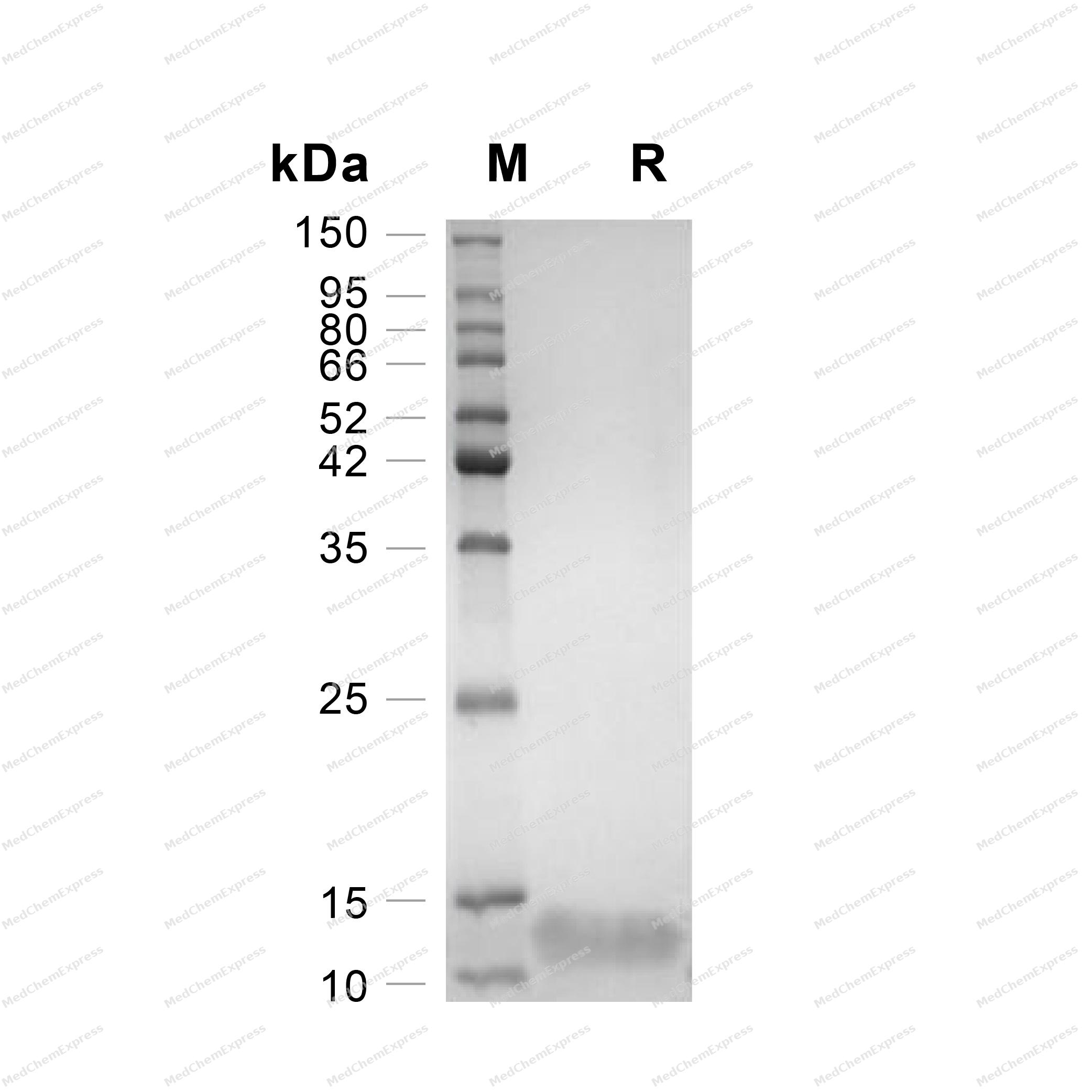
Purity - SDS-PAGE
-
Bioactivity - Cell-Based Assay
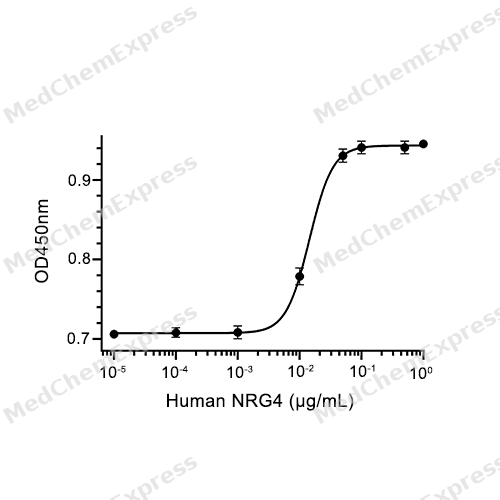
Bioactivity - Cell-Based Assay


Technical Parameters
-
Species Human
-
Source E. coli
-
Tag Tag Free
-
Accession
Q8WWG1 (N-G&P, P2-F62)
-
Molecular Construction
-
N-term
-
Gly-Pro
-
NRG4 (P2-F62)
Accession # Q8WWG1 -
C-term
-
-
Protein Length
Extracellular Domain
-
Synonyms
NRG4; Pro-NRG4; Neuregulin 4; DKFZp779N1944; Pro-Neuregulin-4, Membrane-Bound Isoform; Heregulin 4; HRG4
-
AA Sequence
GPPTDHEEPCGPSHKSFCLNGGLCYVIPTIPSPFCRCVENYTGARCEEVFLPGSSIQTKSNLF
-
Predicted Molecular Mass
6.7 kDa
-
Molecular Weight
Approximately 14 kDa, based on SDS-PAGE under reducing conditions.
-
Purity
≥ 90%, as determined by reducing SDS-PAGE.


Product Properties
Lyophilized powder
1.Lyophilized from a 0.22 μm filtered solution of PBS, pH 7.4, 5% trehalose, 5% mannitol, 0.01% Tween 80.
2.Lyophilized from a 0.22 μm filtered solution of 20 mM PB, 150 mM NaCl, pH 7.4.
Please refer to the lot-specific COA for specific buffer information.
<1 EU/μg, determined by LAL method.
It is not recommended to reconstitute to a concentration less than 100 μg/mL in ddH2O.
Stored at -20°C for 2 years from date of receipt. After reconstitution, it is stable at 4°C for 1 week or -20°C for longer (with carrier protein). It is recommended to freeze aliquots at -20°C or -80°C for extended storage.
Room temperature in continental US; may vary elsewhere.


Documentation
-
Data Sheet (235 KB)
-
SDS (251 KB)
- English - EN (251 KB)
- Français - FR (251 KB)
- Deutsch - DE (251 KB)
- Norwegian - NO (251 KB)
- Español - ES (251 KB)
- Swedish - SV (251 KB)
- Italian - IT (251 KB)
- Korean - KR (251 KB)
- Portuguese - PT (251 KB)
-
Handling Instructions (2659 KB)

Calculators
Concentration (start) × Volume (start) = Concentration (final) × Volume (final)


 Powered by Bioz

