



Prolactin Protein, Human (HEK293, His)
Based on 3 publication(s) in Google Scholar
Prolactin Protein acts on the mammary gland, promoting lactation through its interaction with the receptor PRLR. Prolactin Protein, Human (HEK293, His) is the recombinant human-derived Prolactin protein, expressed by HEK293 , with C-His labeled tag.
- Species: Human
- Source: HEK293
-
Storage:Stored at -20°C for 2 years from date of receipt. After reconstitution, it is stable at 4°C for 1 week or -20°C for longer (with carrier protein). It is recommended to freeze aliquots at -20°C or -80°C for extended storage.


To place orders, for customer services and technical support, please contact: MedChemExpress USA
Tel: 609-228-6898 E-mail: [email protected] [email protected]


-
 Biological Activity
-
Technical Parameters
-
Product Properties
- Documentation
- References
- Help & FAQs




Biological Activity
Description
Prolactin Protein acts on the mammary gland, promoting lactation through its interaction with the receptor PRLR. Prolactin Protein, Human (HEK293, His) is the recombinant human-derived Prolactin protein, expressed by HEK293 , with C-His labeled tag.
Background
Prolactin is a protein that primarily acts on the mammary gland by promoting lactation. It achieves this by interacting with its receptor, PRLR.
In Vitro
Prolactin Protein, Human (10 ng/mL, 1 h-25 days) promotes the proliferation and cytotoxicity of SCID mouse NK cells[1].
In Vivo
Prolactin Protein, Human (10 μg/mouse/day, ip, once daily or every two days, 5 doses) promotes the reconstitution of NK cells after allogeneic bone marrow transplantation in BALB/c mouse transplantation model, prolongs the survival of CT26 tumor-transplanted mice and reduces the number of lung metastases in mouse tumor models[1].
Verified Bioactivity
Measured in a cell proliferation assay using Nb2-11 rat lymphoma cells. The ED50 this effect is 0.1656-0.4161 ng/mL, corresponding to a specific activity is 6.038×10⁶ units/mg.
MCE Validation Data
-
Purity - SDS-PAGE
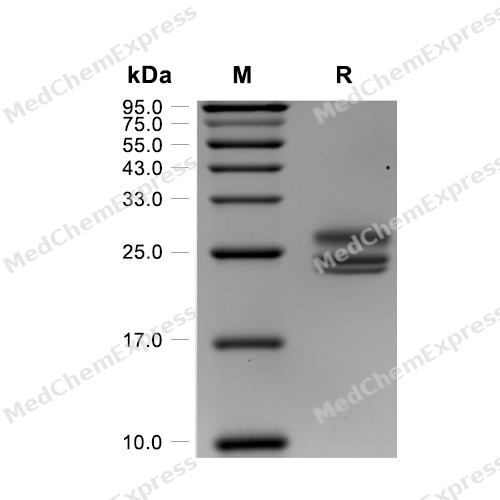
Purity - SDS-PAGE
-
Bioactivity - Cell-Based Assay
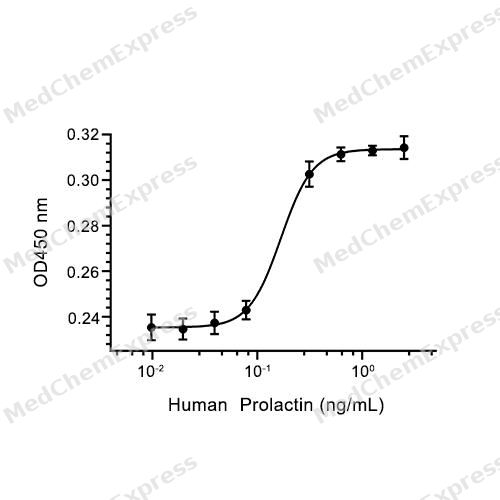
Bioactivity - Cell-Based Assay


Publications (3)
-
Journal Impact Factor
-
Most Recent
-
Int J Mol Sci
The High Level of RANKL Improves IκB/p65/Cyclin D1 Expression and Decreases p-Stat5 Expression in Firm Udder of Dairy Goats. [Abstract]2023 May 16;24(10):8841. PMID: 37240191 -
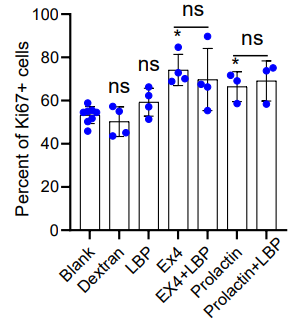
Prolactin Protein, Human (HEK293, His) purchased from MedChemExpress. Usage Cited in: J Funct Foods. 2023 Aug, 107, 105706.
Flow cytometry analysis of the percent of Ki67 positive cells (proliferative cells) from cultured SJ β-cells in response to 0.75 mg/ml dextran, 0.75 mg/ml LBP-60, 40 nM exendin-4, 40 nM exendin-4 plus 0.75 mg/ml LBP-60, 500 ng/ml prolactin, and 500 ng/ml prolactin plus 0.75 mg/ml LBP-60 for 24 h, respectively. Untreated SJ β-cells (Blank) were served as control for each treatment group, except that two groups labeling by the line were compared with each other.
-
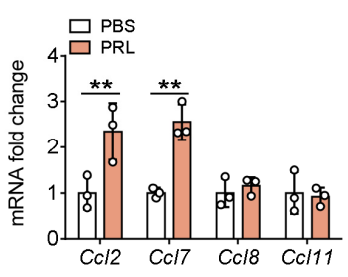
Prolactin Protein, Human (HEK293, His) purchased from MedChemExpress. Usage Cited in: bioRxiv. 2025 Oct 13.
Prolactin Protein, Human (HEK293, His) (100 ng/m; 6 h) pretreated with JAK2/STAT3 inhibitor FLLL32 (10 μM) for 1 h significantly upregulated the mRNA expression of Ccl2 and Ccl7 in NIH-3T3 cells.
Prolactin Protein, Human (HEK293, His) purchased from MedChemExpress. Usage Cited in: bioRxiv. 2025 Oct 13.
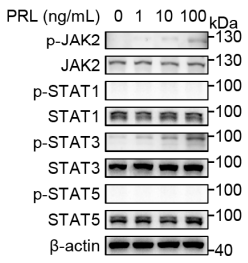
Prolactin Protein, Human (HEK293, His) (0, 1, 10, and 100 ng/mL; 30 min) induced the activation of JAK2 and STAT3, rather than STAT1 and STAT5 in NIH-3T3 cells.
Prolactin Protein, Human (HEK293, His) purchased from MedChemExpress. Usage Cited in: bioRxiv. 2025 Oct 13.
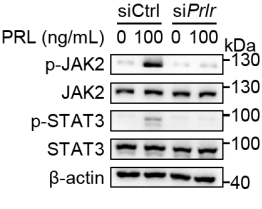
Prolactin Protein, Human (HEK293, His) (100 ng/mL; 30 min)transfected with siRNA targeting Prlr or scrambled control for 24 h showed inhibition of the activation of JAK2 and STAT3 in Prlr knockdown cells.
Prolactin Protein, Human (HEK293, His) purchased from MedChemExpress. Usage Cited in: bioRxiv. 2025 Oct 13.
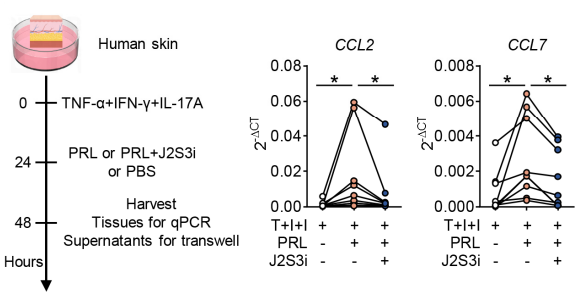
Prolactin Protein, Human (HEK293, His) (100 ng/mL; 24 h) induced CCL2 and CCL7 expression in human skin explant.


Technical Parameters
-
Species Human
-
Source HEK293
-
Tag C-His
-
Accession
P01236 (L29-C227)
-
Molecular Construction
-
N-term
-
Prolactin (L29-C227)
Accession # P01236 -
6*His
-
C-term
-
-
Protein Length
Full Length of Mature Protein
-
Synonyms
PRL; PPRL; Prolactin; GHA1; Luteotropic Hormone; Decidual Prolactin; Prolactin Peptide; Growth Hormone A1; Luteotropin
-
AA Sequence
LPICPGGAARCQVTLRDLFDRAVVLSHYIHNLSSEMFSEFDKRYTHGRGFITKAINSCHTSSLATPEDKEQAQQMNQKDFLSLIVSILRSWNEPLYHLVTEVRGMQEAPEAILSKAVEIEEQTKRLLEGMELIVSQVHPETKENEIYPVWSGLPSLQMADEESRLSAYYNLLHCLRRDSHKIDNYLKLLKCRIIHNNNC
-
Molecular Weight
Approximately 25-30 kDa, based on SDS-PAGE under reducing conditions.
-
Glycosylation
Yes
-
Purity
≥ 95%, as determined by reducing SDS-PAGE.


Product Properties
Lyophilized powder
1.Lyophilized from a 0.22 μm filtered solution of 20 mM PB, 150 mM NaCl, 5% trehalose, 5% mannitol, 0.01% Tween 80, pH 7.4.
2.Lyophilized from a 0.22 μm filtered solution of 50 mM Tris-HCl, 300 mM NaCl, pH 7.4.
3.Lyophilized from a 0.22 μm filtered solution of PBS, pH 7.4, 8% trehalose.
Please refer to the lot-specific COA for specific buffer information.
Note: For SPR assay, please replace the buffer. Primary amine components (e.g., Tris, imidazole) can affect protein-coupled chips.
<1 EU/μg, determined by LAL method.
It is not recommended to reconstitute to a concentration less than 100 μg/mL in ddH2O. For long term storage it is recommended to add a carrier protein (0.1% BSA, 5% HSA, 10% FBS or 5% Trehalose).
Stored at -20°C for 2 years from date of receipt. After reconstitution, it is stable at 4°C for 1 week or -20°C for longer (with carrier protein). It is recommended to freeze aliquots at -20°C or -80°C for extended storage.
Room temperature in continental US; may vary elsewhere.


Documentation
-
Data Sheet (261 KB)
-
SDS (251 KB)
- English - EN (251 KB)
- Français - FR (251 KB)
- Deutsch - DE (251 KB)
- Norwegian - NO (251 KB)
- Español - ES (251 KB)
- Swedish - SV (251 KB)
- Italian - IT (251 KB)
- Korean - KR (251 KB)
- Portuguese - PT (251 KB)
-
Handling Instructions (2659 KB)


References

Calculators
Concentration (start) × Volume (start) = Concentration (final) × Volume (final)


 Powered by Bioz

