



RCN3 Protein, Human (HEK293, His)

Based on 1 Customer Validation
The RCN3 protein is a possible molecular chaperone that contributes to endoplasmic reticulum protein biosynthesis and transport. RCN3 is critical for pulmonary surfactant homeostasis and is required for the correct biosynthesis and transport of SP-A, SP-D, and ABCA3. RCN3 Protein, Human (HEK293, His) is the recombinant human-derived RCN3 protein, expressed by HEK293 , with C-6*His labeled tag.
- Species: Human
- Source: HEK293
-
Storage:Stored at -80°C for 1 year from date of receipt. It is stable at -20°C for 3 months after opening. It is recommended to freeze aliquots at -80°C for extended storage. Avoid repeated freeze-thaw cycles.


To place orders, for customer services and technical support, please contact: MedChemExpress USA
Tel: 609-228-6898 E-mail: [email protected] [email protected]


-
 Biological Activity
-
Technical Parameters
-
Product Properties
- Documentation
- Help & FAQs




Biological Activity
Description
The RCN3 protein is a possible molecular chaperone that contributes to endoplasmic reticulum protein biosynthesis and transport. RCN3 is critical for pulmonary surfactant homeostasis and is required for the correct biosynthesis and transport of SP-A, SP-D, and ABCA3. RCN3 Protein, Human (HEK293, His) is the recombinant human-derived RCN3 protein, expressed by HEK293 , with C-6*His labeled tag.
Background
RCN3 protein is a probable molecular chaperone that assists in protein biosynthesis and transport within the endoplasmic reticulum. It is required for the proper biosynthesis and transport of pulmonary surfactant-associated proteins A/SP-A and D/SP-D, as well as the lipid transporter ABCA3. By regulating the expression and degradation of these proteins through the endoplasmic reticulum-associated protein degradation pathway, RCN3 plays a crucial role in maintaining pulmonary surfactant homeostasis. Additionally, it exhibits anti-fibrotic activity by negatively regulating the secretion of type I and type III collagens. RCN3 is known to transiently associate with immature PCSK6 and is involved in its maturation and secretion.
MCE Validation Data
-
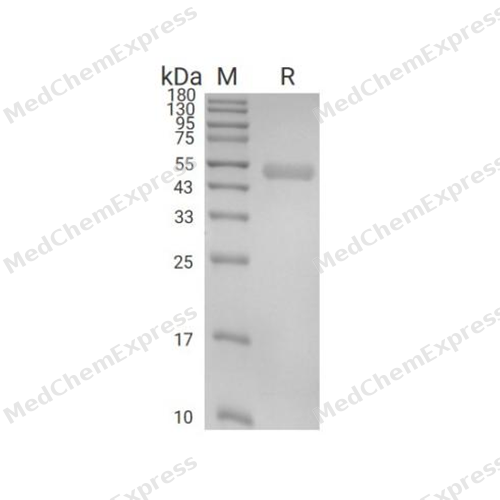
Purity - SDS-PAGE
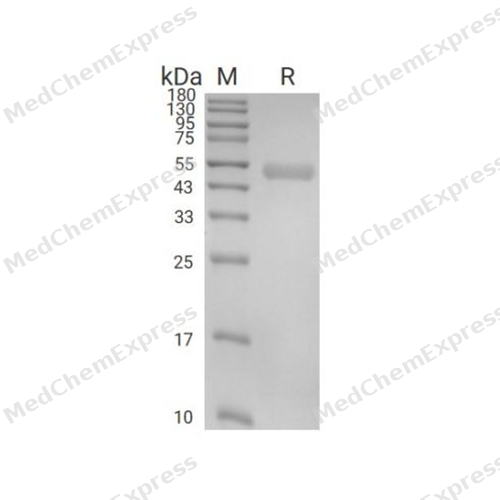
Purity - SDS-PAGE


Technical Parameters
-
Species Human
-
Source HEK293
-
Tag C-6*His
-
Accession
Q96D15 (K21-L328)
-
Molecular Construction
-
N-term
-
RCN3 (K21-L328)
Accession # Q96D15 -
6*His
-
C-term
-
-
Protein Length
Full Length of Mature Protein
-
Synonyms
RCN3; Reticulocalbin 3, EF-Hand Calcium Binding Domain; Reticulocalbin 3; EF-Hand Calcium-Binding Protein RLP49; Reticulocalbin-3; Reticulocabin; RLP49
-
AA Sequence
KPSPDAGPHGQGRVHQAAPLSDAPHDDAHGNFQYDHEAFLGREVAKEFDQLTPEESQARLGRIVDRMDRAGDGDGWVSLAELRAWIAHTQQRHIRDSVSAAWDTYDTDRDGRVGWEELRNATYGHYAPGEEFHDVEDAETYKKMLARDERRFRVADQDGDSMATREELTAFLHPEEFPHMRDIVIAETLEDLDRNKDGYVQVEEYIADLYSAEPGEEEPAWVQTERQQFRDFRDLNKDGHLDGSEVGHWVLPPAQDQPLVEANHLLHESDTDKDGRLSKAEILGNWNMFVGSQATNYGEDLTRHHDEL
-
Predicted Molecular Mass
36.2 kDa
-
Molecular Weight
Approximately 43 kDa, based on SDS-PAGE under reducing conditions.
-
Glycosylation
Yes
-
Purity
≥ 95%, as determined by reducing SDS-PAGE.


Product Properties
Solution
Supplied as a 0.22 μm filtered solution of 20 mM Tris-HCl, 150 mM NaCl, 1 mM DTT, 10% glycerol, pH 7.4.
Note: For SPR assay, please replace the buffer. Primary amine components (e.g., Tris, imidazole) can affect protein-coupled chips.
<1 EU/μg, determined by LAL method.
Stored at -80°C for 1 year from date of receipt. It is stable at -20°C for 3 months after opening. It is recommended to freeze aliquots at -80°C for extended storage. Avoid repeated freeze-thaw cycles.
Shipping with dry ice.


Documentation
-
Data Sheet (237 KB)
-
SDS (251 KB)
- English - EN (251 KB)
- Français - FR (251 KB)
- Deutsch - DE (251 KB)
- Norwegian - NO (251 KB)
- Español - ES (251 KB)
- Swedish - SV (251 KB)
- Italian - IT (251 KB)
- Korean - KR (251 KB)
- Portuguese - PT (251 KB)
-
Handling Instructions (2659 KB)

Calculators
Concentration (start) × Volume (start) = Concentration (final) × Volume (final)


 Powered by Bioz

