



Semaphorin-3A/SEMA3A Protein, Human (HEK293, N-His)
Based on 1 Customer Validation
Semaphorin-3A/SEMA3A proteins are critical for shaping the olfactory system and influence puberty-related neuronal control. SEMA3A is known for inducing neuronal growth cone collapse, which leads to the formation of complex neuronal circuits by guiding the growth cone through a motor inhibitory mechanism. Semaphorin-3A/SEMA3A Protein, Human (HEK293, N-His) is the recombinant human-derived Semaphorin-3A/SEMA3A protein, expressed by HEK293 , with N-6*His labeled tag.
- Species: Human
- Source: HEK293
-
Storage:Stored at -20°C for 2 years from date of receipt. After reconstitution, it is stable at 4°C for 1 week or -20°C for longer (with carrier protein). It is recommended to freeze aliquots at -20°C or -80°C for extended storage.


_3.png&title=MedChemExpress Validation "Click to View Experimental Validation Results")


To place orders, for customer services and technical support, please contact: MedChemExpress USA
Tel: 609-228-6898 E-mail: [email protected] [email protected]


-
 Biological Activity
-
Technical Parameters
-
Product Properties
- Documentation
- Help & FAQs




Biological Activity
Description
Semaphorin-3A/SEMA3A proteins are critical for shaping the olfactory system and influence puberty-related neuronal control. SEMA3A is known for inducing neuronal growth cone collapse, which leads to the formation of complex neuronal circuits by guiding the growth cone through a motor inhibitory mechanism. Semaphorin-3A/SEMA3A Protein, Human (HEK293, N-His) is the recombinant human-derived Semaphorin-3A/SEMA3A protein, expressed by HEK293 , with N-6*His labeled tag.
Background
The Semaphorin-3A/SEMA3A Protein plays a crucial role in the development of the olfactory system and exerts influence over neuronal control of puberty. Known for its capacity to induce the collapse and paralysis of neuronal growth cones, SEMA3A is implicated in guiding specific growth cones through a motility-inhibiting mechanism, thereby contributing to the intricacies of neuronal circuit formation. This protein serves as a ligand by binding to the complex neuropilin-1/plexin-1, underscoring its involvement in transducing signaling cues critical for neuronal guidance. Additionally, SEMA3A interacts with PLXND1, further highlighting its multifaceted role in mediating cellular interactions during the intricate processes of olfactory system development and the regulation of puberty-related neuronal functions.
Verified Bioactivity
1.Measured by its binding ability in a functional ELISA. Immobilized Recombinant Rat Neuropilin-1 (HY-P702534) is immobilized at 2 µg/mL (100 µL/well) can bind Biotinylated Recombinant Human SEMA3A. The ED50 for this effect is 100-300 ng/mL.
2.Measured by its binding ability in a functional ELISA. Immobilized Human SEMA3A at 2 μg/mL (100 μL/well) can bind Human Neuropilin-1 (HY-P78779). The ED50 for this effect is 0.315 μg/mL.
MCE Validation Data
-
Purity - SDS-PAGE
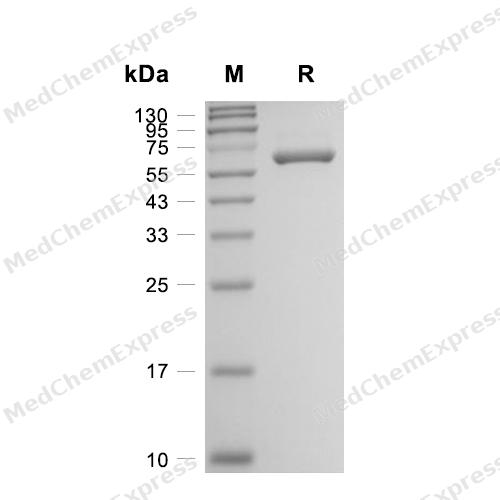
Purity - SDS-PAGE
-
Bioactivity - ELISA
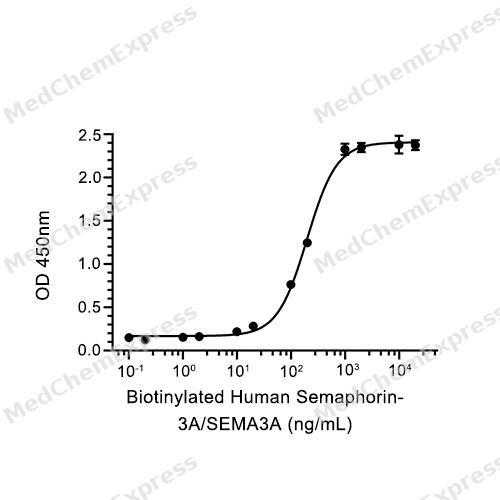
Bioactivity - ELISA
-
Bioactivity - ELISA
_3.png)
Bioactivity - ELISA


Technical Parameters
-
Species Human
-
Source HEK293
-
Tag N-6*His
-
Accession
Q14563 (K26-F546)
-
Molecular Construction
-
N-term
-
6*His
-
SEMA3A (K26-F546)
Accession # Q14563 -
C-term
-
-
Protein Length
Partial
-
Synonyms
SEMA3A; Sema III; Prev. SEMAD; Semaphorin D; Hsema-I; Semaphorin L; Coll-1; Collapsin 1; SEMA1; Hsema-III; SemD; SEMAIII; Sema Domain, Immunoglobulin Domain (Ig), Short Basic Domain, Secreted, (Semaphorin) 3A; COLL1; Semaphorin III; SEMAL; Semaphorin-3A;
-
AA Sequence
KNNVPRLKLSYKEMLESNNVITFNGLANSSSYHTFLLDEERSRLYVGAKDHIFSFDLVNIKDFQKIVWPVSYTRRDECKWAGKDILKECANFIKVLKAYNQTHLYACGTGAFHPICTYIEIGHHPEDNIFKLENSHFENGRGKSPYDPKLLTASLLIDGELYSGTAADFMGRDFAIFRTLGHHHPIRTEQHDSRWLNDPKFISAHLISESDNPEDDKVYFFFRENAIDGEHSGKATHARIGQICKNDFGGHRSLVNKWTTFLKARLICSVPGPNGIDTHFDELQDVFLMNFKDPKNPVVYGVFTTSSNIFKGSAVCMYSMSDVRRVFLGPYAHRDGPNYQWVPYQGRVPYPRPGTCPSKTFGGFDSTKDLPDDVITFARSHPAMYNPVFPMNNRPIVIKTDVNYQFTQIVVDRVDAEDGQYDVMFIGTDVGTVLKVVSIPKETWYDLEEVLLEEMTVFREPTAISAMELSTKQQQLYIGSTAGVAQLPLHRCDIYGKACAECCLARDPYCAWDGSACSRYF
-
Predicted Molecular Mass
60.1 kDa
-
Molecular Weight
Approximately 61 kDa, based on SDS-PAGE under reducing conditions.
-
Glycosylation
Yes
-
Purity
≥ 95%, as determined by reducing SDS-PAGE.


Product Properties
Lyophilized powder
1.Lyophilized from a 0.22 μm filtered solution of PBS, pH 7.4, 8% trehalose.
2.Lyophilized from a 0.22 μm filtered solution of 20 mM PB, 150 mM NaCl, pH 7.4, 8% trehalose.
Please refer to the lot-specific COA for specific buffer information.
<1 EU/μg, determined by LAL method.
It is not recommended to reconstitute to a concentration less than 100 μg/mL in ddH2O.
Stored at -20°C for 2 years from date of receipt. After reconstitution, it is stable at 4°C for 1 week or -20°C for longer (with carrier protein). It is recommended to freeze aliquots at -20°C or -80°C for extended storage.
Room temperature in continental US; may vary elsewhere.


Documentation
-
Data Sheet (239 KB)
-
SDS (252 KB)
- English - EN (252 KB)
- Français - FR (252 KB)
- Deutsch - DE (252 KB)
- Norwegian - NO (252 KB)
- Español - ES (252 KB)
- Swedish - SV (252 KB)
- Italian - IT (252 KB)
- Korean - KR (252 KB)
- Portuguese - PT (252 KB)
-
Handling Instructions (2659 KB)

Calculators
Concentration (start) × Volume (start) = Concentration (final) × Volume (final)


 Powered by Bioz

