



SETD7 Protein, Human (His)

Based on 1 Customer Validation
The SETD7 protein is a histone methyltransferase that specifically monomethylates H3K4, a mark associated with transcriptional activation. Its role in gene activation extends to the collagenase and insulin genes, specifically at the insulin promoter when IPF1/PDX-1 is recruited. SETD7 Protein, Human (His) is the recombinant human-derived SETD7 protein, expressed by E. coli , with N-His labeled tag.
- Species: Human
- Source: E. coli
-
Storage:Stored at -20°C for 2 years from date of receipt. After reconstitution, it is stable at 4°C for 1 week or -20°C for longer (with carrier protein). It is recommended to freeze aliquots at -20°C or -80°C for extended storage.


To place orders, for customer services and technical support, please contact: MedChemExpress USA
Tel: 609-228-6898 E-mail: [email protected] [email protected]


-
 Biological Activity
-
Technical Parameters
-
Product Properties
- Documentation
- Help & FAQs




Biological Activity
Description
The SETD7 protein is a histone methyltransferase that specifically monomethylates H3K4, a mark associated with transcriptional activation. Its role in gene activation extends to the collagenase and insulin genes, specifically at the insulin promoter when IPF1/PDX-1 is recruited. SETD7 Protein, Human (His) is the recombinant human-derived SETD7 protein, expressed by E. coli , with N-His labeled tag.
Background
SETD7 Protein, a histone methyltransferase, demonstrates specificity in monomethylating 'Lys-4' of histone H3. This methylation event serves as a distinctive mark associated with epigenetic transcriptional activation. SETD7 plays a pivotal role in the activation of transcription for genes such as collagenase or insulin. Recruited by IPF1/PDX-1 to the insulin promoter, it leads to the activation of transcription. Beyond histones, SETD7 exhibits methyltransferase activity toward non-histone proteins, including CGAS, p53/TP53, TAF10, and possibly TAF7, recognizing and binding the [KR]-[STA]-K motif in substrate proteins. Monomethylation of 'Lys-189' of TAF10 enhances its affinity for RNA polymerase II. Moreover, SETD7 monomethylates 'Lys-372' of p53/TP53, stabilizing the protein and amplifying p53/TP53-mediated transcriptional activation. Additionally, it monomethylates 'Lys-491' of CGAS, facilitating interaction between SGF29 and CGAS (By similarity).
Verified Bioactivity
Measured by its ability to methylates in histone H1 protein in vitro. that incubate at room temperature for 120minutes. The specific activity is 7.797-10.12 nmol/min/mg.
MCE Validation Data
-
Purity - SDS-PAGE
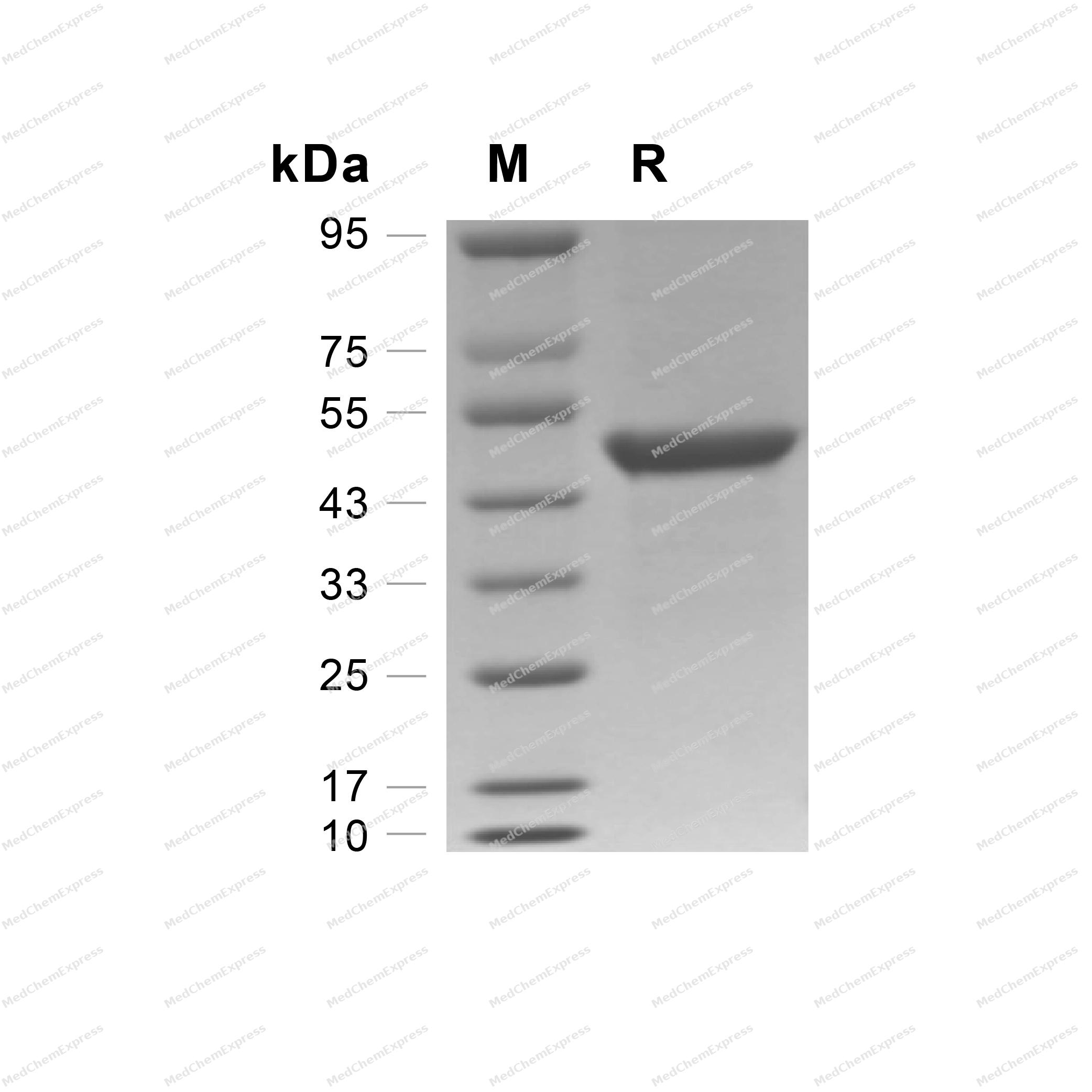
Purity - SDS-PAGE


Technical Parameters
-
Species Human
-
Source E. coli
-
Tag N-His
-
Accession
Q8WTS6/NP_085151.1 (D2-K366)
-
Molecular Construction
-
N-term
-
His
-
SETD7 (D2-K366)
Accession # Q8WTS6/NP_085151.1 -
C-term
-
-
Protein Length
Full Length
-
Synonyms
SETD7; KIAA1717; SET Domain Containing 7, Histone Lysine Methyltransferase; Set9; SET7/9; SET Domain Containing Lysine Methyltransferase 7; SET7; Lysine N-Methyltransferase 7; KMT7; H3-K4-HMTase SETD7; Histone-Lysine N-Methyltransferase SETD7; SET Domain
-
AA Sequence
DSDDEMVEEAVEGHLDDDGLPHGFCTVTYSSTDRFEGNFVHGEKNGRGKFFFFDGSTLEGYYVDDALQGQGVYTYEDGGVLQGTYVDGELNGPAQEYDTDGRLIFKGQYKDNIRHGVCWIYYPDGGSLVGEVNEDGEMTGEKIAYVYPDERTALYGKFIDGEMIEGKLATLMSTEEGRPHFELMPGNSVYHFDKSTSSCISTNALLPDPYESERVYVAESLISSAGEGLFSKVAVGPNTVMSFYNGVRITHQEVDSRDWALNGNTLSLDEETVIDVPEPYNHVSKYCASLGHKANHSFTPNCIYDMFVHPRFGPIKCIRTLRAVEADEELTVAYGYDHSPPGKSGPEAPEWYQVELKAFQATQQK
-
Molecular Weight
Approximately 47-50 kDa, based on SDS-PAGE under reducing conditions, due to the glycosylation.
-
Purity
≥ 95%, as determined by Bis-Tris PAGE.


Product Properties
Lyophilized powder
Lyophilized from a 0.2 μm filtered solution of PBS, pH 7.4.
<1 EU/μg, determined by LAL method.
It is not recommended to reconstitute to a concentration less than 100 μg/mL in ddH2O. For long term storage it is recommended to add a carrier protein (0.1% BSA, 5% HSA, 10% FBS or 5% Trehalose).
Stored at -20°C for 2 years from date of receipt. After reconstitution, it is stable at 4°C for 1 week or -20°C for longer (with carrier protein). It is recommended to freeze aliquots at -20°C or -80°C for extended storage.
Room temperature in continental US; may vary elsewhere.


Documentation
-
Data Sheet (237 KB)
-
SDS (254 KB)
- English - EN (254 KB)
- Français - FR (254 KB)
- Deutsch - DE (254 KB)
- Norwegian - NO (254 KB)
- Español - ES (254 KB)
- Swedish - SV (254 KB)
- Italian - IT (254 KB)
- Korean - KR (254 KB)
- Portuguese - PT (254 KB)
-
Handling Instructions (2659 KB)

Calculators
Concentration (start) × Volume (start) = Concentration (final) × Volume (final)


 Powered by Bioz

