



SMPD1 Protein, Human (sf9, His)
Based on 1 Customer Validation
SMPD1 protein converts sphingomyelin to ceramide in lysosomes and has phospholipase C activity. SMPD1 Protein, Human (sf9, His) is the recombinant human-derived SMPD1 protein, expressed by Sf9 insect cells , with C-His labeled tag.
- Species: Human
- Source: Sf9 insect cells
-
Storage:Stored at -80°C for 1 year from date of receipt. It is stable at -20°C for 3 months after opening. It is recommended to freeze aliquots at -80°C for extended storage. Avoid repeated freeze-thaw cycles.


To place orders, for customer services and technical support, please contact: MedChemExpress USA
Tel: 609-228-6898 E-mail: [email protected] [email protected]


-
 Biological Activity
-
Technical Parameters
-
Product Properties
- Documentation
- Help & FAQs




Biological Activity
Description
SMPD1 protein converts sphingomyelin to ceramide in lysosomes and has phospholipase C activity. SMPD1 Protein, Human (sf9, His) is the recombinant human-derived SMPD1 protein, expressed by Sf9 insect cells , with C-His labeled tag.
Background
SMPD1, a multifaceted enzyme, is instrumental in the dynamic conversion of sphingomyelin to ceramide, a process crucial for diverse cellular functions. This conversion occurs in the lysosomes, where SMPD1 plays a pivotal role in sphingolipid metabolism. Remarkably, SMPD1 exhibits two distinct enzymatic forms resulting from alternative trafficking of a single protein precursor, with one form targeted to the endolysosomal compartment and the other released extracellularly. Under various stress conditions, lysosomal exocytosis emerges as a major source of the secretory form, highlighting the adaptability of SMPD1 in response to cellular cues. In addition to its sphingomyelinase activity, SMPD1 contributes significantly to cholesterol export from intraendolysosomal membranes, demonstrating its involvement in lipid homeostasis. Moreover, SMPD1 showcases phospholipase C activities towards specific substrates, underscoring its versatility in lipid metabolism. Beyond lipid processing, SMPD1 exerts regulatory control over stress-induced apoptosis by modulating ceramide production, adding a layer of complexity to its multifunctional role in cellular processes.
Verified Bioactivity
Measured by its ability to cleave 2-N-Hexadecanoylamino-4-nitrophenylphosphorylcholine (HNPPC). The specific activity is ≥1735 pmol/min/μg, as measured under the described conditions.
MCE Validation Data
-
Purity - SDS-PAGE
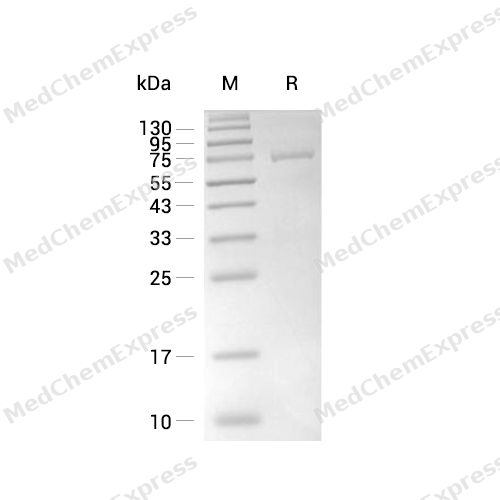
Purity - SDS-PAGE


Technical Parameters
-
Species Human
-
Source Sf9 insect cells
-
Tag C-His
-
Accession
P17405 (M1-P628)
-
Molecular Construction
-
N-term
-
SMPD1 (M1-P628)
Accession # P17405 -
His
-
C-term
-
-
Protein Length
Partial
-
Synonyms
SMPD1; Niemann-Pick Type A/B; Sphingomyelin Phosphodiesterase 1; Sphingomyelin Phosphodiesterase 1 Isoform 7; Acid Sphingomyelinase; SMPD1 Protein; ASM; ASMASE; Sphingomyelin Phosphodiesterase; ASMase; Sphingomyelin Phosphodiesterase 1, Acid Lysosomal; NP
-
AA Sequence
MPRYGASLRQSCPRSGREQGQDGTAGAPGLLWMGLVLALALALALALALSDSRVLWAPAEAHPLSPQGHPARLHRIVPRLRDVFGWGNLTCPICKGLFTAINLGLKKEPNVARVGSVAIKLCNLLKIAPPAVCQSIVHLFEDDMVEVWRRSVLSPSEACGLLLGSTCGHWDIFSSWNISLPTVPKPPPKPPSPPAPGAPVSRILFLTDLHWDHDYLEGTDPDCADPLCCRRGSGLPPASRPGAGYWGEYSKCDLPLRTLESLLSGLGPAGPFDMVYWTGDIPAHDVWHQTRQDQLRALTTVTALVRKFLGPVPVYPAVGNHESTPVNSFPPPFIEGNHSSRWLYEAMAKAWEPWLPAEALRTLRIGGFYALSPYPGLRLISLNMNFCSRENFWLLINSTDPAGQLQWLVGELQAAEDRGDKVHIIGHIPPGHCLKSWSWNYYRIVARYENTLAAQFFGHTHVDEFEVFYDEETLSRPLAVAFLAPSATTYIGLNPGYRVYQIDGNYSGSSHVVLDHETYILNLTQANIPGAIPHWQLLYRARETYGLPNTLPTAWHNLVYRMRGDMQLFQTFWFLYHKGHPPSEPCGTPCRLATLCAQLSARADSPALCRHLMPDGSLPEAQSLWPRP
-
Predicted Molecular Mass
66.5 kDa
-
Molecular Weight
Approximately 67-70 kDa, based on SDS-PAGE under reducing conditions, due to the glycosylation.
-
Glycosylation
Yes
-
Purity
≥ 95%, as determined by reducing SDS-PAGE.


Product Properties
Solution
Supplied as a 0.22 μm filtered solution of 20 mM Tris, 500 mM NaCl, 25 % glycerol, pH 7.5.
Note: For SPR assay, please replace the buffer. Primary amine components (e.g., Tris, imidazole) can affect protein-coupled chips.
<1 EU/μg, determined by LAL method.
Stored at -80°C for 1 year from date of receipt. It is stable at -20°C for 3 months after opening. It is recommended to freeze aliquots at -80°C for extended storage. Avoid repeated freeze-thaw cycles.
Shipping with dry ice.


Documentation
-
Data Sheet (239 KB)
-
SDS (251 KB)
- English - EN (251 KB)
- Français - FR (251 KB)
- Deutsch - DE (251 KB)
- Norwegian - NO (251 KB)
- Español - ES (251 KB)
- Swedish - SV (251 KB)
- Italian - IT (251 KB)
- Korean - KR (251 KB)
- Portuguese - PT (251 KB)
-
Handling Instructions (2659 KB)

Calculators
Concentration (start) × Volume (start) = Concentration (final) × Volume (final)


 Powered by Bioz

