



TROP-2 Protein, Human (248a.a, HEK293, His)
Based on 2 publication(s) in Google Scholar
The TROP-2 protein emerged as a potential growth factor receptor, implying involvement in cellular processes related to growth and signaling. As a putative receptor, TROP-2 may play a crucial role in transducing signals that regulate cell growth and proliferation. TROP-2 Protein, Human (248a.a, HEK293, His) is the recombinant human-derived TROP-2 protein, expressed by HEK293 , with C-6*His labeled tag.
- Species: Human
- Source: HEK293
-
Storage:Stored at -20°C for 2 years from date of receipt. After reconstitution, it is stable at 4°C for 1 week or -20°C for longer (with carrier protein). It is recommended to freeze aliquots at -20°C or -80°C for extended storage.


To place orders, for customer services and technical support, please contact: MedChemExpress USA
Tel: 609-228-6898 E-mail: [email protected] [email protected]


-
 Biological Activity
-
Technical Parameters
-
Product Properties
- Documentation
- Help & FAQs






Biological Activity
Description
The TROP-2 protein emerged as a potential growth factor receptor, implying involvement in cellular processes related to growth and signaling. As a putative receptor, TROP-2 may play a crucial role in transducing signals that regulate cell growth and proliferation. TROP-2 Protein, Human (248a.a, HEK293, His) is the recombinant human-derived TROP-2 protein, expressed by HEK293 , with C-6*His labeled tag.
Background
The TROP-2 protein emerges as a potential growth factor receptor, suggesting its involvement in cellular processes related to growth and signaling. As a putative receptor, TROP-2 may play a crucial role in transducing signals that regulate cell growth, proliferation, and potentially other cellular functions. The specific ligands and downstream pathways associated with TROP-2-mediated growth factor signaling remain areas for further investigation. Unraveling the detailed molecular mechanisms and functional implications of TROP-2 in growth factor signaling will contribute to a comprehensive understanding of its role in cellular physiology and may open avenues for therapeutic interventions targeting this receptor.
Verified Bioactivity
1.Measured by the ability of the immobilized protein to support the adhesion of U937 human histiocytic lymphoma cells. When 5x10⁴ cells/well are added to Recombinant Human TROP-2 coated plates (10 µg/mL with 100 µL/well), >27% cells will adhere after 1 hour incubation.
2.Loaded Sacituzumab (HY-P99045) on AHC2 biosensor, can bind TROP-2 Protein, Human (248a.a, HEK293, His) with an affinity constant of 8.077E-10 M as determined in BLI assay.
3.Measured by its binding ability in a functional ELISA. Immobilized TROP-2 at 1 μg/mL can bind Sacituzumab (HY-P99045). The ED50 for this effect is 2.783 ng/mL.
4.Measured by its binding ability in a functional ELISA. Immobilized TROP-2 at 1 μg/mL can bind Sacituzumab tirumotecan (HY-164789). The ED50 for this effect is 2.250 ng/mL.
MCE Validation Data
-
Purity - SDS-PAGE
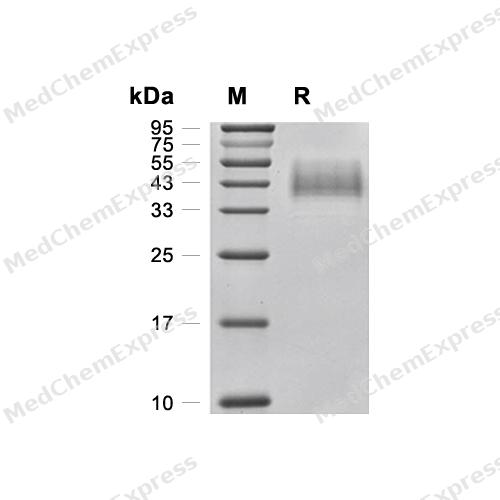
Purity - SDS-PAGE
-
Bioactivity - BLI
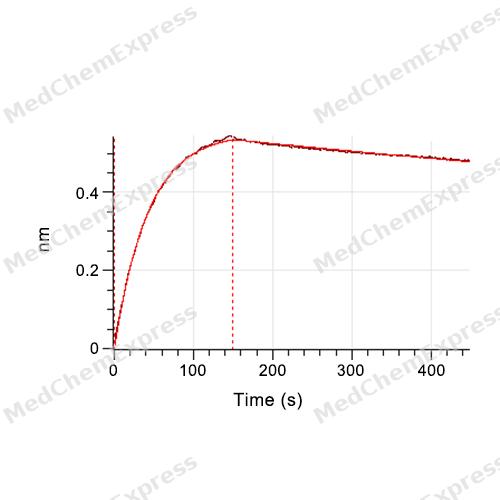
Bioactivity - BLI


Publications (2)
-
Journal Impact Factor
-
Most Recent
-
Int J Biol Macromol
Selection of trophoblast cell surface antigen 2-targeted aptamer for the development of cytotoxic aptamer-drug conjugate. [Abstract]2024 Nov;279(Pt 4):135456. PMID: 39250993 -
Cell Biochem Biophys
2025 Aug 8. PMID: 40779128


Technical Parameters
-
Species Human
-
Source HEK293
-
Tag C-6*His
-
Accession
P09758 (H27-T274)
-
Molecular Construction
-
N-term
-
TROP-2 (H27-T274)
Accession # P09758 -
6*His
-
C-term
-
-
Protein Length
Extracellular Domain
-
Synonyms
TACSTD2; Epithelial Glycoprotein-1; Prev. M1S1; Membrane Component, Chromosome 1, Surface Marker 1; GA733-1; Gastrointestinal Tumor-Associated Antigen GA7331; TROP2; Pancreatic Carcinoma Marker Protein GA7331; Tumor-Associated Calcium Signal Transducer 2; Cell Surface Glycoprotein TROP2; EGP-1; Truncated TACSTD2; Membrane Component Chromosome 1 Surface Marker 1; GA7331; Pancreatic Carcinoma Marker Protein GA733-1; EGP1; Trophoblast Cell Surface Antigen 2; GP50; Cell Surface Glycoprotein Trop-2; Tumor Associated Calcium Signal Transducer 2; 40kD Glycoprotein, Identified By Monoclonal Antibody GA733
-
AA Sequence
HTAAQDNCTCPTNKMTVCSPDGPGGRCQCRALGSGMAVDCSTLTSKCLLLKARMSAPKNARTLVRPSEHALVDNDGLYDPDCDPEGRFKARQCNQTSVCWCVNSVGVRRTDKGDLSLRCDELVRTHHILIDLRHRPTAGAFNHSDLDAELRRLFRERYRLHPKFVAAVHYEQPTIQIELRQNTSQKAAGDVDIGDAAYYFERDIKGESLFQGRGGLDLRVRGEPLQVERTLIYYLDEIPPKFSMKRLT
-
Predicted Molecular Mass
28.9 kDa
-
Molecular Weight
Approximately 40-50 kDa, based on SDS-PAGE under reducing conditions.
-
Glycosylation
Yes
-
Purity
≥ 95%, as determined by reducing SDS-PAGE.


Product Properties
Lyophilized powder
Lyophilized from a 0.2 μm filtered solution of PBS, pH 7.4.
<1 EU/μg, determined by LAL method.
It is not recommended to reconstitute to a concentration less than 100 μg/mL in ddH2O. For long term storage it is recommended to add a carrier protein (0.1% BSA, 5% HSA, 10% FBS or 5% Trehalose).
Stored at -20°C for 2 years from date of receipt. After reconstitution, it is stable at 4°C for 1 week or -20°C for longer (with carrier protein). It is recommended to freeze aliquots at -20°C or -80°C for extended storage.
Room temperature in continental US; may vary elsewhere.


Documentation
-
Data Sheet (238 KB)
-
SDS (252 KB)
- English - EN (252 KB)
- Français - FR (252 KB)
- Deutsch - DE (252 KB)
- Norwegian - NO (252 KB)
- Español - ES (252 KB)
- Swedish - SV (252 KB)
- Italian - IT (252 KB)
- Korean - KR (252 KB)
- Portuguese - PT (252 KB)
-
Handling Instructions (2659 KB)

Calculators
Concentration (start) × Volume (start) = Concentration (final) × Volume (final)


 Powered by Bioz

