



Wnt3a Surrogate Protein, Human (HEK293, C-hFc)
Based on 3 publication(s) in Google Scholar
Wnt3a Surrogate protein is a Wnt recombination protein that plays an important role in embryonic development, adult tissue homeostasis and injury repair. Wnt3a Surrogate protein, consisting of the domain and Fc portion of Wnt3a, helps organoids expand and maintain a source of Wnt. Organoids are a rapidly evolving model system for tissue development, and Wnt3a is considered as the essential protein for organoid growth. Wnt3a or the small molecule glycogen synthase kinase 3 (GSK3) inhibitor CHIR are commonly used as Wnt sources in experiments. However, the application of Wnt3a is hampered by Wnt lipidation, and cross-reactivity with Wnt frizzled (Fzd). Therefore, Wnt3a Surrogate protein was used instead of Wnt3a, as a water-soluble and Fzd-specific alternative Wnt agonist. And the Wnt3a Surrogate protein exhibits tissue selectivity consistent with Fzd isoform specificity. Wnt3a Surrogate Protein, Human (HEK293, C-hFc) is the recombinant human-derived Wnt3a Surrogate, expressed by HEK293, with C-hFc labeled tag.
- Species: Human
- Source: HEK293
-
Storage:Stored at -20°C for 2 years from date of receipt. After reconstitution, it is stable at 4°C for 1 week or -20°C for longer (with carrier protein). It is recommended to freeze aliquots at -20°C or -80°C for extended storage.


To place orders, for customer services and technical support, please contact: MedChemExpress USA
Tel: 609-228-6898 E-mail: [email protected] [email protected]


-
 Biological Activity
-
Technical Parameters
-
Product Properties
- Documentation
- References
- Help & FAQs


-
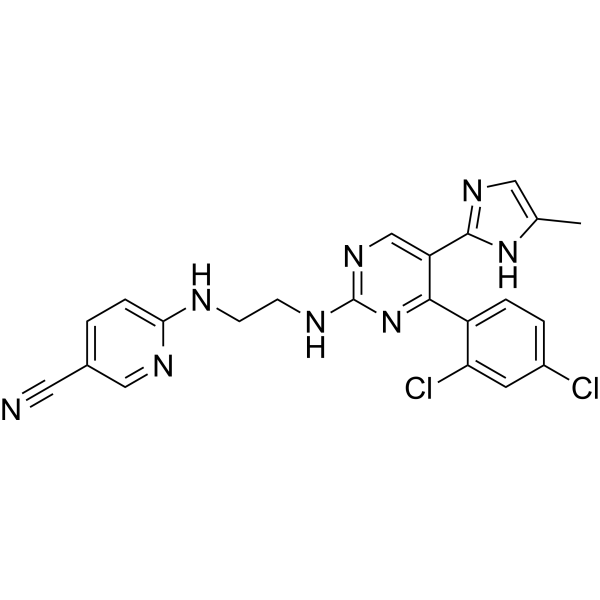
HY-10182
Laduviglusib -
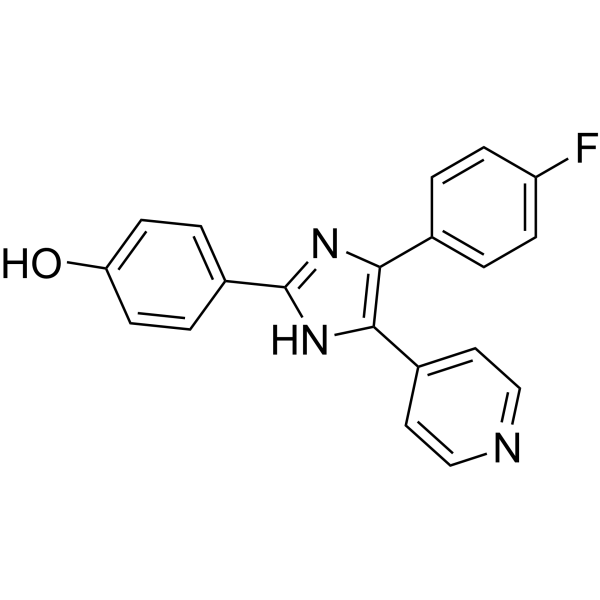
HY-10295
SB 202190 -
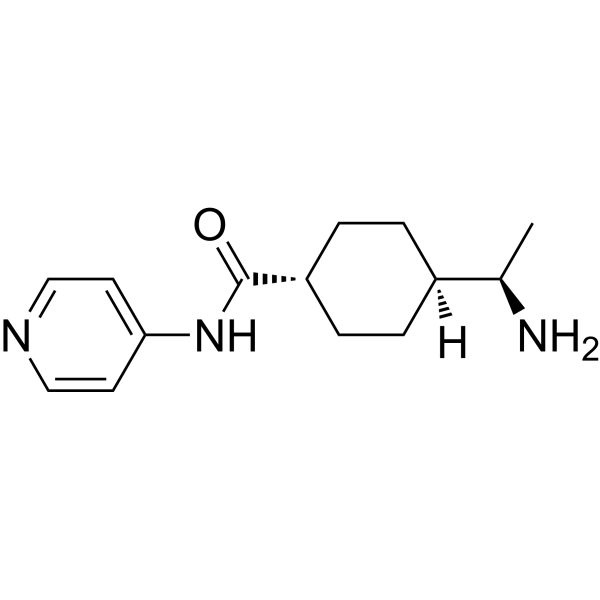
HY-10071
Y-27632 -

HY-P7114
RSPO1/R-spondin-1 Protein, Human (CHO, His) -
HY-P7051A
Noggin Protein, Human (CHO) -
HY-P7048
KGF-2/FGF-10 Protein, Human (169a.a) -
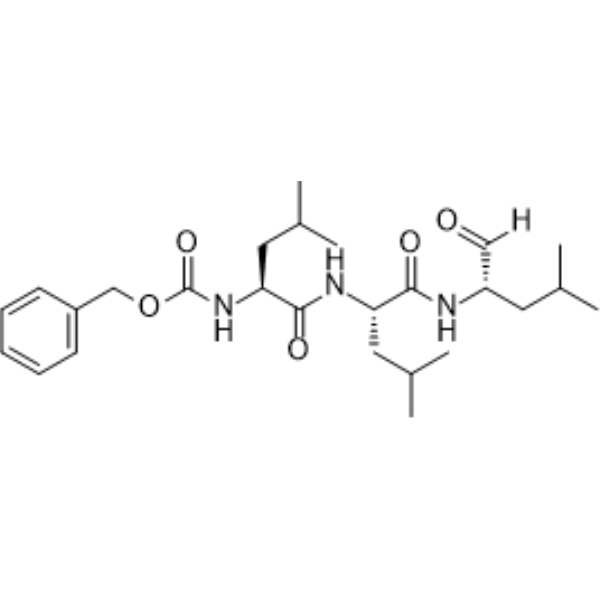
HY-13259
MG-132 -
HY-P72784A
RSPO1/R-spondin-1 Protein, Human (125a.a, HEK293, His) -
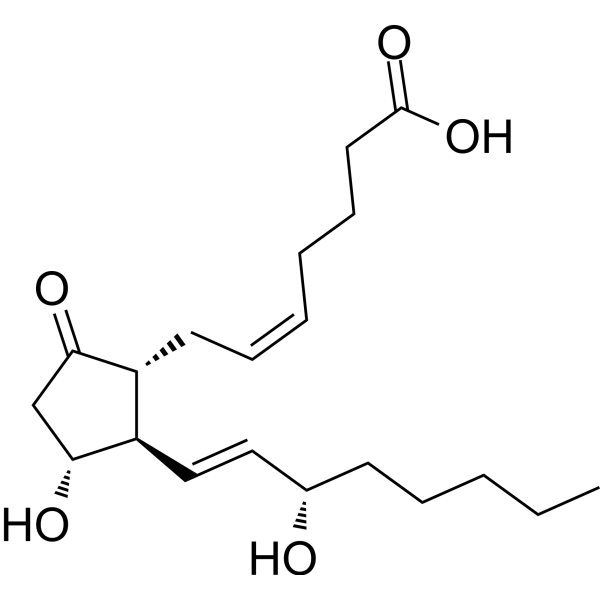
HY-101952
Prostaglandin E2 -
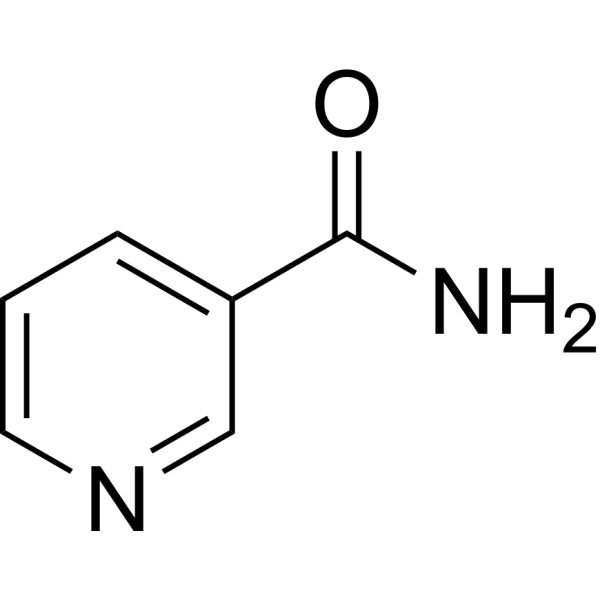
HY-B0150
Nicotinamide -
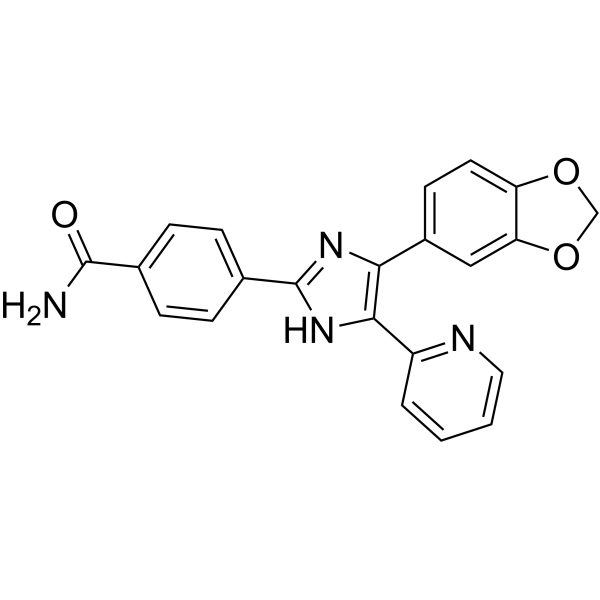
HY-10431
SB-431542 -
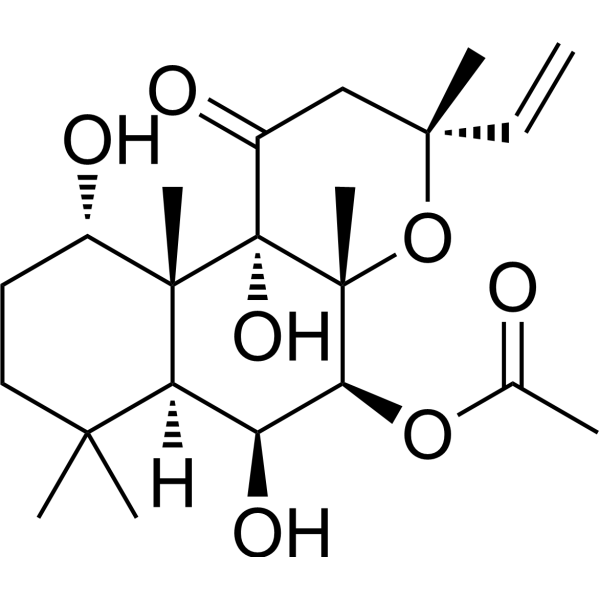
HY-15371
Forskolin


Biological Activity
Description
Wnt3a Surrogate protein is a Wnt recombination protein that plays an important role in embryonic development, adult tissue homeostasis and injury repair. Wnt3a Surrogate protein, consisting of the domain and Fc portion of Wnt3a, helps organoids expand and maintain a source of Wnt. Organoids are a rapidly evolving model system for tissue development, and Wnt3a is considered as the essential protein for organoid growth. Wnt3a or the small molecule glycogen synthase kinase 3 (GSK3) inhibitor CHIR are commonly used as Wnt sources in experiments. However, the application of Wnt3a is hampered by Wnt lipidation, and cross-reactivity with Wnt frizzled (Fzd). Therefore, Wnt3a Surrogate protein was used instead of Wnt3a, as a water-soluble and Fzd-specific alternative Wnt agonist. And the Wnt3a Surrogate protein exhibits tissue selectivity consistent with Fzd isoform specificity[1][2][3]. Wnt3a Surrogate Protein, Human (HEK293, C-hFc) is the recombinant human-derived Wnt3a Surrogate, expressed by HEK293, with C-hFc labeled tag.
Background
Wnt is a secreted glycoprotein comprising 19 human proteins that signal through both canonical and non-canonical pathways. Wnts are involved in developmental morphology, stem cell maintenance, and wound healing, and can travel long distances or attach to the surface of exosomes. Among them, Wnt3a is an important molecule that can activate the Wnt/β-catenin signaling pathway and participate in various physiological and pathological processes, such as embryonic development, tissue repair, and tumor progression. Wnt3a also plays a role in cardiomyogenesis, skeletal muscle development, nervous system formation, and migration and invasion of trophoblast cells[4][5].
1. The Wnt family includes: Wnt1, Wnt2, Wnt2b (Wnt13), Wnt3, Wnt3a, Wnt4, Wnt5a, Wnt5b, Wnt6, Wnt7a, Wnt7b, Wnt8a, Wnt8b, Wnt9a (Wnt14), Wnt9b (Wnt14b), Wnt10a, Wnt10b, Wnt11 and Wnt16.
2. Wnt canonical pathway: also known as Wnt/β-catenin pathway.
3. Wnt non-canonical pathway: including Wnt-planar cell polarity pathway (Wnt-PCP pathway) and Wnt-calcium pathway (Wnt-Ca2+ pathway).
4. Introduction to Wnt3a: It is an important molecule in the process of cell signal transduction and development, and is highly conserved. Wnt3a interacts with Frizzled receptors, induces the accumulation of β-catenin, and activates the Wnt/β-catenin signaling pathway. Wnt3a also stimulates migration and invasion of trophoblasts.
Wnt3a function: In embryonic development, Wnt3a is involved in the formation of embryonic axis and directed cell differentiation; in adult tissues, Wnt3a is related to the regulation of stem cell self-renewal and cell fate determination, and is also related to the occurrence and development of certain tumors. For example, Wnt3a promotes or inhibits tumor progression through the canonical Wnt signaling pathway. Wnt3a is also associated with post-injury remodeling and cell expansion, and upregulation of WNT3a improves repair. Wnt3a also plays an important role in organ formation. It can promote cardiomyogenesis by increasing T cell-specific transcription factor (TCF)-dependent transcription and inducing cardiac-specific markers, bone morphogenetic proteins (BMPs) and myosin heavy chain (MHC). Studies have shown that Wnt3a induces myogenesis in differentiated body muscle groups, activates myogenic differentiation antigen (MyoD) expression, and promotes skeletal muscle development. Wnt3a activates the atypical protein kinase Cloys (pKCiota) and induces a punctate distribution of pKCiota in neurites and cytoplasm, with a particularly strong signal at the centrosome. Wnt3a plays a crucial role in the maintenance and differentiation of neuromesoderm stem cells. Thus, Wnt3a is involved in the formation of the nervous system.
Verified Bioactivity
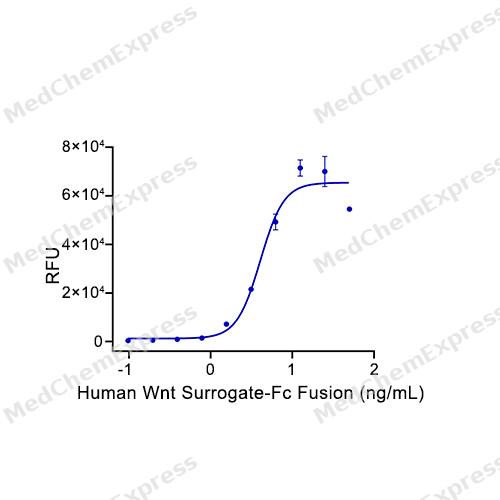
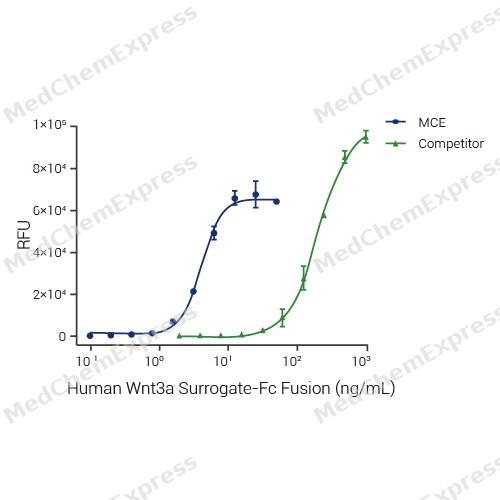
Measured by its ability to induce Topflash reporter activity in HEK293T human embryonic kidney cells. The ED50 for this effect is 2.0-9.4 ng/mL.
MCE Validation Data
-
Bioactivity - Cell-Based Assay
Bioactivity - Cell-Based Assay
-
Bioactivity - Cell-Based Assay
Bioactivity - Cell-Based Assay


Publications (3)
-
Journal Impact Factor
-
Most Recent
-
Cell Rep Med
A human patient-derived organoid biobank to model tumor heterogeneity and therapeutic vulnerability for oral squamous cell carcinoma. [Abstract]2026 Feb 17;7(2):102622. PMID: 41707653 -
J Asthma Allergy
PP2A Promotes Epithelial-Mesenchymal Transition in Chronic Rhinosinusitis with Nasal Polyps via Wnt/β-Catenin Pathway: A Novel Insight. [Abstract]2025 Nov 4:18:1505-1522. PMID: 41209327 -


Technical Parameters
-
Species Human
-
Source HEK293
-
Tag C-hFc
-
Accession
Sequence information is not available or disclosed for this product.
-
Gene ID/
-
Synonyms
WNT3A; Wnt Family Member 3A; Wingless-Type MMTV Integration Site Family, Member 3A; Protein Wnt-3a
-
AA Sequence
/
-
Predicted Molecular Mass
58.5 kDa
-
Molecular Weight
Approximately 60-75 kDa, based on SDS-PAGE under reducing conditions, due to the glycosylation.
-
Glycosylation
Yes
-
Purity
≥ 95%, as determined by Bis-Tris PAGE.


Product Properties
Lyophilized powder
Lyophilized from a 0.22 μm filtered solution of PBS, pH 7.4, 8% trehalose.
<1 EU/μg, determined by LAL method.
It is not recommended to reconstitute to a concentration less than 100 μg/mL in ddH2O.
Stored at -20°C for 2 years from date of receipt. After reconstitution, it is stable at 4°C for 1 week or -20°C for longer (with carrier protein). It is recommended to freeze aliquots at -20°C or -80°C for extended storage.
Room temperature in continental US; may vary elsewhere.


Documentation
-
Data Sheet (264 KB)
-
SDS (252 KB)
- English - EN (252 KB)
- Français - FR (252 KB)
- Deutsch - DE (252 KB)
- Norwegian - NO (252 KB)
- Español - ES (252 KB)
- Swedish - SV (252 KB)
- Italian - IT (252 KB)
- Korean - KR (252 KB)
- Portuguese - PT (252 KB)
-
Handling Instructions (2659 KB)


References
[1]. Janda CY, et al. Surrogate Wnt agonists that phenocopy canonical Wnt and β-catenin signalling. Nature. 2017 May 11;545(7653):234-237. [Content Brief]
[2]. Chen H, et al. Development of Potent, Selective Surrogate WNT Molecules and Their Application in Defining Frizzled Requirements. Cell Chem Biol. 2020 May 21;27(5):598-609.e4. [Content Brief]
[3]. Miao Y, et al. Next-Generation Surrogate Wnts Support Organoid Growth and Deconvolute Frizzled Pleiotropy In Vivo. Cell Stem Cell. 2020 Nov 5;27(5):840-851.e6. [Content Brief]
[4]. He S, et al. Wnt3a: functions and implications in cancer. Chin J Cancer. 2015 Sep 14;34(12):554-62. [Content Brief]
[5]. Thomas BL, et al. WNT3A-loaded exosomes enable cartilage repair. J Extracell Vesicles. 2021 May;10(7):e12088. [Content Brief]

Calculators
Concentration (start) × Volume (start) = Concentration (final) × Volume (final)


 Powered by Bioz

