



ROS-IN-2
Based on 1 publication(s) in Google Scholar
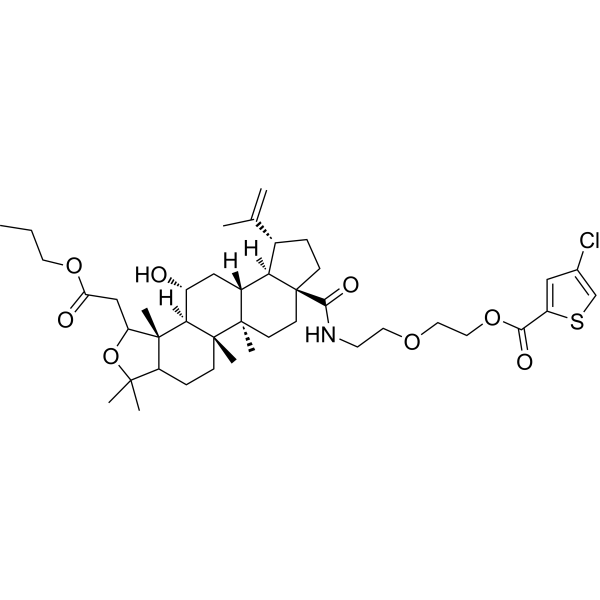
ROS-IN-2 (compound 85) is a seco-lupane triterpenoid derivative. ROS-IN-2 blocks ROS production and protects mitochondria from damage by inhibiting excessive production of oxidative stressors. ROS-IN-2 can be used for myocardial ischemia/reperfusion (MI/R) injury research.
Nur für Forschungszwecke. Wir verkaufen nicht an Patienten.
- Formel: C42H62ClNO8S
- Molecular Weight:776.46
-
Speicherung:
Please store the product under the recommended conditions in the Certificate of Analysis.

To place orders, for customer services and technical support, please contact: MedChemExpress USA
Tel: 609-228-6898 E-mail: [email protected] [email protected]


-
 Biologische Aktivität
-
Chemical Information
- Protokoll
- Reinheit & Dokumentation
- Verweise
-
 Help & FAQs


Publications Citing Use of MedChemExpress (MCE) ROS-IN-2
More

Biologische Aktivität
Beschreibung


Chemical Information
-
Molecular Weight 776.46
-
Formel C42H62ClNO8S
-
SMILES
O=C(OCCC)CC1[C@]2(C)[C@]3([H])[C@@]([C@@](CC[C@]4(C(NCCOCCOC(C5=CC(Cl)=CS5)=O)=O)[C@]6([H])[C@H](C(C)=C)CC4)(C)[C@]6([H])C[C@H]3O)(C)CCC2C(C)(C)O1
-
Versand
Room temperature in continental US; may vary elsewhere.
-
Speicherung
Please store the product under the recommended conditions in the Certificate of Analysis.


Publications (1)
-
Journal Impact Factor
-
Most Recent
-
Small
2025 Jun;21(25):e2501645. PMID: 40345978


Reinheit & Dokumentation
Verweise

Calculators
Konzentration (Stammlösung) × Volumen (Stammlösung) = Konzentration (Ziellösung) × Volumen (Ziellösung)


ROS-IN-2 Related Classifications
HY-149586 Related Classifications
 Powered by Bioz