31 Results for "

Micrococcus Luteus

" in MedChemExpress (MCE) Product Catalog:
Products (31)

31 Results for "Micrococcus Luteus" in MCE Product Catalog:

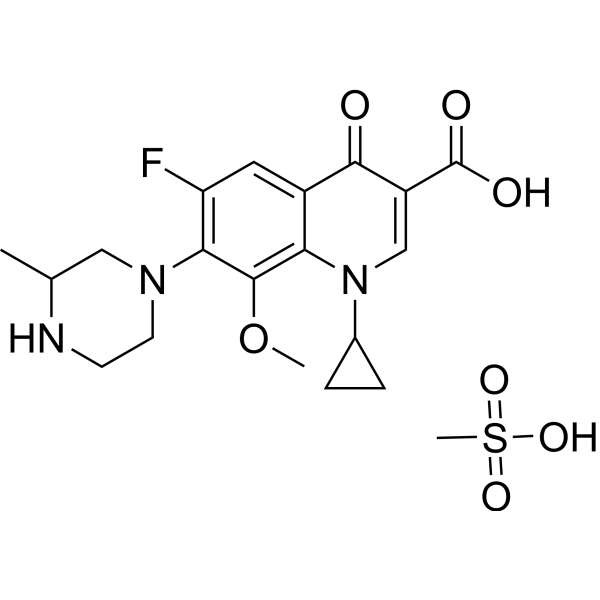
Cat. No.: HY-10581B
CAS No.: 316819-28-0
Synonyms: AM-1155 mesylate; BMS-206584 mesylate; PD135432 mesylate
Research Areas:  

Infection

Gatifloxacin mesylate (AM-1155; BMS-206584; PD135432) is a potent fluoroquinolone antibiotic with broad-spectrum antibacterial activity. Gatifloxacin mesylate inhibits bacterial type II topoisomerases (IC50=13.8 μg/ml for S. aureus topoisomerase IV) and E. coli DNA gyrase (IC50 = 0.109 μg/ml) . Gatifloxacin mesylate can be used to treat bacterial conjunctivitis in vivo.
loading...
    loading...
Cat. No.: HY-P2124R
CAS No.: 20829-55-4
Research Areas:  

Infection

L-Isoleucine (Standard) is the analytical standard of L-Isoleucine. This product is intended for research and analytical applications. L-Isoleucine is an orally active branched chain amino acid, which is the L-enantiomer of isoleucine. L-Isoleucine has a role as a Saccharomyces cerevisiae metabolite, an Escherichia coli metabolite, a plant metabolite, a human metabolite, an algal metabolite and a mouse metabolite. L-Isoleucine regulates the inflammatory response to protect against pathogens in vivo and in vitro .
loading...
    loading...
Cat. No.: HY-P10134
CAS No.: 335080-41-6
Target:  

Bacterial

Research Areas:  

Infection

Salivaricin B is a broad-spectrum bacteriocin produced by Lactobacillus M7. Salivaricin B reduces cell wall thickness, induces abnormal septum formation, and exerts rapid bactericidal activity against susceptible Gram-positive bacteria without disrupting cytoplasmic membrane integrity or dissipating membrane potential. Salivaricin B inhibits the growth of oral, upper respiratory tract and food-related Gram-positive pathogens, spoilage bacteria, lactobacilli, and SboB-non-producing Streptococcus salivarius strains. Its activity is strain-dependent, and it has no effect on Gram-negative bacteria. Salivaricin B can be used in studies related to bacterial infections .
loading...
    loading...
Cat. No.: HY-149456
CAS No.: 265652-71-9
Xanthoangelol F is a prenylated (geranylated) chalcone and Antibacterial agent. Xanthoangelol F can be isolated from Angelica keiskei. Xanthoangelol F inhibits the growth of Gram-positive bacteria Bacillus subtilis, Staphylococcus epidermidis, and Micrococcus luteus, with an MIC of 64 μg/mL .
loading...
    loading...
Cat. No.: HY-W142294
CAS No.: 26117-27-1
Synonyms: N2-Acetyl-D-asparagine
Research Areas:  

Others

Ac-D-Asn-OH (N2-Acetyl-D-asparagine) is the N2-acetylated derivative of D-Asparagine (HY-W010378). Ac-D-Asn-OH serves as an intermediate for peptide synthesis in relevant research .
loading...
    loading...
Cat. No.: HY-164999
CAS No.: 30414-15-4
Target:  

Endogenous Metabolite

Research Areas:  

Cancer

N,N'-Bis(2,3-Dihydroxybenzoyl)-O-L-seryl-L-serine is a enterochelin hydrolyzed product. N,N'-Bis(2,3-Dihydroxybenzoyl)-O-L-seryl-L-serine can inhibit the invasion of murine colon cancer cells 26-L5 with an IC50 of 2.7 μM, and has anti-tumor effect. In addition, N,N'-Bis(2,3-Dihydroxybenzoyl)-O-L-seryl-L-serine has no appreciable antimicrobial activities against Micrococcus luteus, Escherichia coli and Candida albicans .
loading...
    loading...
Cat. No.: HY-N21818
CAS No.: 172854-76-1
Cacospongionolide B is an orally active sesterterpene compound that can be isolated from Fasciospongia cavernosa. Cacospongionolide B is a secreted phospholipase A2 (sPLA2) inhibitor with an IC50 of 4.3 μM. Cacospongionolide B exhibits antibacterial activity. Cacospongionolide B downregulates the expression of iNOS, COX-2 and TNF-α by inhibiting NF-κB nuclear translocation and its DNA binding, and simultaneously selectively and irreversibly inhibits sPLA2 enzymatic activity. Cacospongionolide B can be used in studies related to bacterial infection and adjuvant arthritis .
loading...
    loading...
Cat. No.: HY-P11862
CAS No.: 2097822-76-7
Synonyms: MBJ-0173
Category:  

Microorganisms

Malpinin A (MBJ-0173) is a dehydrohexapeptide biosurfactant with significant anthelmintic activity. Malpinin A specifically accumulates in the nematode digestive tract, thereby effectively inhibiting nematode feeding and proliferation without causing paralysis. Malpinin A can be used in studies related to plant-parasitic nematode infection .
loading...
    loading...
Cat. No.: HY-122301
CAS No.: 11031-47-3
Sarcinaxanthin is a carotenoid present in various bacteria with antioxidant activity. Sarcinaxanthin scavenges singlet oxygen, thereby inhibiting oxidative degradation in the β-carotene/linoleic acid system. Sarcinaxanthin acts as a photoprotective agent against UVB radiation that induces erythema. Sarcinaxanthin can be applied in studies related to antioxidation and radiation resistance .
loading...
    loading...
Cat. No.: HY-125362
CAS No.: 133705-26-7
Target:  

Bacterial Fungal

Research Areas:  

Infection

Nannochelin C is a citrate-hydroxamate siderophore and iron chelator found in Nannocystis exedens strain Na e485. The MIC of Nannochelin C against Brevibacterium ammoniagenes is 0.39 μg/mL, and it exhibits weak growth inhibitory activity against some Gram-positive bacteria. The antimicrobial effect of Nannochelin C may be associated with its metal chelating activity. Nannochelin C can be used in studies related to siderophores, microbial iron metabolism and antimicrobial activity .
loading...
    loading...
Cat. No.: HY-P0307B
CAS No.: 393511-85-8
Research Areas:  

Neurological Disease

Penetratin-Cys is a cell-penetrating peptide derived from Antennapedia Peptide (HY-P0307) via C-terminal cysteine modification. Penetratin-Cys acts as a cytotoxin and reduces the viability of differentiated neuronal cells. Penetratin-Cys localizes to the perinuclear region and binds to the Golgi apparatus. Penetratin-Cys can be used in research related to neurological disorders .
loading...
    loading...

