



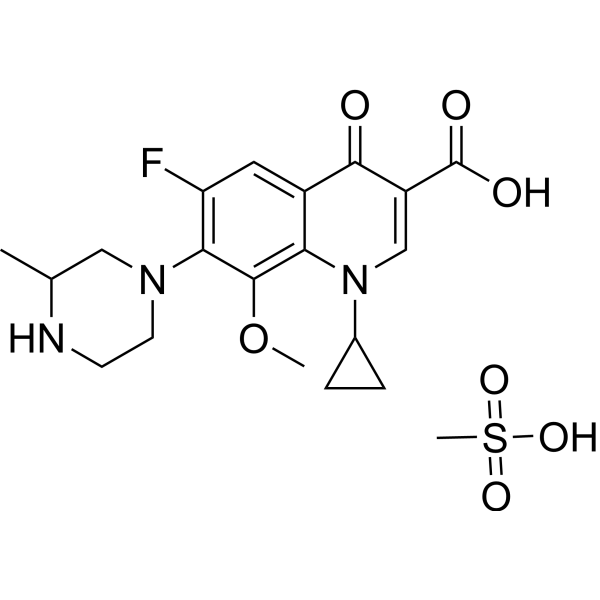
Gatifloxacin mesylate
Based on 4 publication(s) in Google Scholar
Gatifloxacin mesylate (AM-1155; BMS-206584; PD135432) is a potent fluoroquinolone antibiotic with broad-spectrum antibacterial activity. Gatifloxacin mesylate inhibits bacterial type II topoisomerases (IC50=13.8 μg/ml for S. aureus topoisomerase IV) and E. coli DNA gyrase (IC50 = 0.109 μg/ml). Gatifloxacin mesylate can be used to treat bacterial conjunctivitis in vivo.
For research use only. We do not sell to patients.
- CAS No.: 316819-28-0
- Formula: C20H26FN3O7S
- Molecular Weight:471.50
-
Storage:
Please store the product under the recommended conditions in the Certificate of Analysis.

To place orders, for customer services and technical support, please contact: MedChemExpress USA
Tel: 609-228-6898 E-mail: [email protected] [email protected]


-
 Biological Activity
-
Chemical Information
- Purity & Documentation
- References
-
 Help & FAQs


Publications Citing Use of MedChemExpress (MCE) Gatifloxacin mesylate
MoreAll Topoisomerase Isoforms
MoreAll Antibiotic Isoforms
More

Biological Activity
Description
IC50 & Target
[1]|
Quinolone |
Topoisomerase II 36.7 μM (IC50) |
In Vitro
Gatifloxacin mesylate is against S. aureus MS5935 topoisomerase IV, E. coli NIHJ JC-2 DNA gyrase and HeLa cell topoisomerase II with IC50 values of 13.8 μg/ml, 0.109 μg/ml, and 265 μg/ml, respectively[1].Gatifloxacin mesylate is against S. aureus MS5935 topoisomerase IV, E. coli NIHJ JC-2 DNA gyrase and HeLa cell topoisomerase II with MIC values of 0.05 μg/ml, 0.0063 μg/ml, and 122 μg/ml, respectively[1].Gatifloxacin mesylate exhibits antibacterial activities for wild-type strains (MS5935, MS5952, MR5867 and MR6009) the first-, second-, third-, and fourth-step mutants with MIC values of 0.05 to 0.10 μg/ml, 0.20 μg/ml, 1.56 to 3.13 μg/ml, 1.56 to 6.25 μg/ml, and 50 to 200 μg/ml, respectively. Gatifloxacin mesylate displays the most potent activity against the second- and third-step mutants (MS5952, MR5867 and MR6009) except for the second-step mutant of strain MS5935[2]. Gatifloxacin mesylate has potent activity against norA transformant NY12 (MIC, 0.39 μg/ml)[2].Gatifloxacin mesylate (20-100 μM; 72 hours) significantly decreases insulin content to 60% at Day 1, and continues to be reduced to 50.1% and 44.7% at Day 3 by 20 μM and 100 μM Gatifloxacin mesylate, respectively[3].
MedChemExpress (MCE) has not independently confirmed the accuracy of these methods. They are for reference only.
In Vivo
MedChemExpress (MCE) has not independently confirmed the accuracy of these methods. They are for reference only.
-
Animal Model:Female BALB/c mice with Nocardia brasiliensis in the right hind footpad.
-
Dosage:100 mg/kg
-
Administration:Subcutaneous injection; 3 times a day; 30 days
-
Result:Reduced the production of lesions in mice.


Chemical Information
-
CAS No. 316819-28-0
-
Molecular Weight 471.50
-
Formula C20H26FN3O7S
-
SMILES
CC1NCCN(C2=C(F)C=C3C(N(C4CC4)C=C(C(O)=O)C3=O)=C2OC)C1.O=S(C)(O)=O
-
Synonyms
AM-1155 mesylate; BMS-206584 mesylate; PD135432 mesylate
-
Shipping
Room temperature in continental US; may vary elsewhere.
-
Storage
Please store the product under the recommended conditions in the Certificate of Analysis.


Publications (4)
-
Journal Impact Factor
-
Most Recent
-
J Appl Toxicol
Reactive metabolite of trovafloxacin activates inflammasomes: Implications for trovafloxacin-induced liver injury. [Abstract]2024 Jun;44(6):846-852. PMID: 38291012 -
Ghent university
-
-


Purity & Documentation
References
[1]. Takei M, et al. Inhibitory activities of Gatifloxacin mesylate (AM-1155), a newly developed fluoroquinolone, against bacterial and mammalian type II topoisomerases.Antimicrob Agents Chemother. 1998 Oct;42(10):2678-81. [Content Brief]
[2]. Fukuda H, et al. Antibacterial activity of Gatifloxacin mesylate (AM-1155, CG5501, BMS-206584), a newly developed fluoroquinolone, against sequentially acquired quinolone-resistant mutants and the norA transformant of Staphylococcus aureus. Antimicrob Agents Chemother. 1998 Aug;42(8):1917-22. [Content Brief]
[3]. Yamada C, et al. Gatifloxacin mesylate acutely stimulates insulin secretion and chronically suppresses insulin biosynthesis. Eur J Pharmacol. 2006 Dec 28;553(1-3):67-72. Epub 2006 Sep 28. [Content Brief]
[4]. Daw-Garza A, et al. In vivo therapeutic effect of Gatifloxacin mesylate on BALB/c mice infected with Nocardia brasiliensis.Antimicrob Agents Chemother. 2008 Apr;52(4):1549-50. [Content Brief]

Calculators
Concentration (start) × Volume (start) = Concentration (final) × Volume (final)


Gatifloxacin mesylate Related Classifications
HY-10581B Related Classifications
 Powered by Bioz
Keywords