48 Results for "

Sensory Neuron

" in MedChemExpress (MCE) Product Catalog:
Products (48)

48 Results for "Sensory Neuron" in MCE Product Catalog:

Cat. No.: HY-115877
CAS No.: 1984824-54-5
Target:  

TRP Channel

Research Areas:  

Others

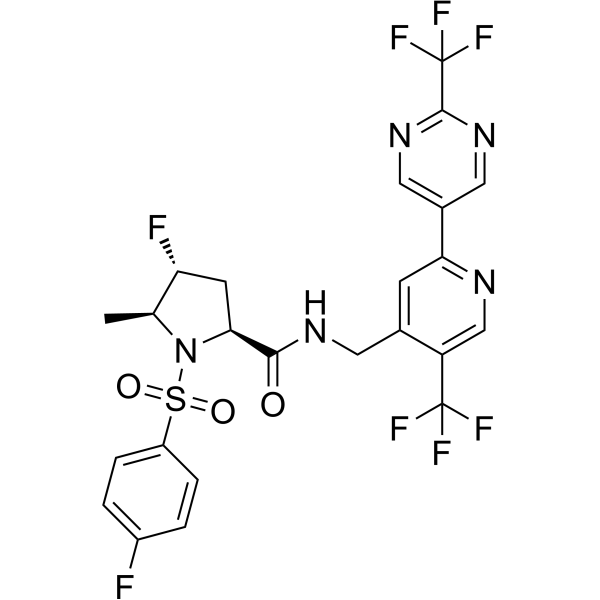
GDC-0334 is a selective TRPA1 antagonist. GDC-0334 inhibits TRPA1 function on airway smooth muscle and sensory neurons by decreasing cough and allergic airway inflammation in rats and guinea pigs. GDC-0334 can be used for TRPA1-mediated diseases research, such as pain or asthma .
loading...
    loading...
Cat. No.: HY-167862
CAS No.: 2411412-36-5
Target:  

Endogenous Metabolite

Research Areas:  

Neurological Disease

UCM-05194 is a selective LPA1 receptor agonist with activity to improve neuropathic pain. UCM-05194 is a LPA1 agonist that exhibits potent and selective properties in its pharmacologically similar properties. UCM-05194 triggers LPA1-mediated cellular effects and leads to internalization of the receptor, resulting in functional inactivation in primary sensory neurons. UCM-05194 effectively reduces pain perception in in vivo models. UCM-05194 can be used to conduct research on progressive systemic diseases .
loading...
    loading...
Cat. No.: HY-175340
CAS No.: 1361107-81-4
Target:  

Potassium Channel TSPO

Research Areas:  

Neurological Disease

Kv7.2/Kv7.3 activator-3 (GRT-X) is an orally active Kv7.2/Kv7.3 and TSPO activator. Kv7.2/Kv7.3 activator-3 activates Kv7.2/Kv7.3, Kv7.4, and Kv7.5 with EC50 values of 0.37, 2.06, and 0.75 μM, respectively, and binds to TSPO with Ki values of 0.07 μM (rat membrane) and 4.60 μM (human U-118 MG cells). Kv7.2/Kv7.3 activator-3 prevents motor neuron degeneration in mice and humans conditioned by ALS/FTD astrocytes. Kv7.2/Kv7.3 activator-3 stimulates dorsal root ganglion axonal growth through TSPO and Kv7.2/3 activation. Kv7.2/Kv7.3 activator-3 has anti-epileptic effects in epileptic seizure models. Kv7.2/Kv7.3 activator-3 reduces pain hypersensitivity in patients with diabetic neuropathy, promotes neuronal survival and regeneration after cervical neuropathy in rats, and accelerates the recovery of normal function of sensory and motor neurons .
loading...
    loading...
Cat. No.: HY-172166B
TRITC-lysine-dextran (MW 70kDa) is a fluorescent label prepared by the conjugation of TRITC (HY-D0791), lysine and dextran. TRITC-lysine-dextran (MW 70kDa) serves multiple functions as an axonal tracer, non-viral nanocarrier and fixable fluorescent clonal marker. TRITC-lysine-dextran (MW 70kDa) undergoes anterograde and retrograde transport within axons of sensory neurons, and acts as a non-viral delivery system to precisely deliver biomolecules to neurons. TRITC-lysine-dextran (MW 70kDa) remains stably retained during histological preparation, thereby supporting continuous observation in live or fixed samples .
loading...
    loading...
Cat. No.: HY-136820S1
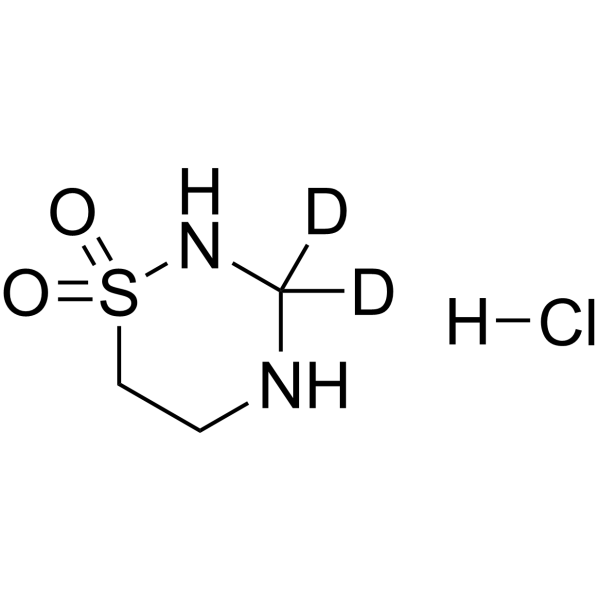
Taurultam-d2 hydrochloride is the d2-labeled Taurultam (HY-136820) hydrochloride. Taurultam is the major active hydrolytic metabolite of Taurolidine (HY-W011522), which selectively activates hTRPA1 to trigger effects in sensory neurons. Taurultam exhibits activity against SARS-CoV-2 variants, influenza A viruses (H1N1, H3N2) and influenza B viruses. Taurultam induces mild tracheal sensory nerve stimulation and CGRP release in mice. Taurultam can be used in studies related to SARS-CoV-2 infection, influenza virus infection, and co-infection with SARS-CoV-2 and influenza A virus.
loading...
    loading...
Cat. No.: HY-P10690
Target:  

Inhibitory Antibodies

Research Areas:  

Neurological Disease

CCHa1 peptide is a signaling peptide that plays a role in inhibiting sleep arousal. It is produced by enteroendocrine cells in the gut and modulates the animal's response to sensory inputs such as mechanical vibrations by acting on specific dopamine neurons in the brain, thereby helping to suppress arousal responses. CCHa1 peptide holds potential for research in fields related to sleep quality and sensory adaptation .
loading...
    loading...
Cat. No.: HY-106935A
CAS No.: 113240-27-0
Target:  

Drug Derivative

Research Areas:  

Neurological Disease

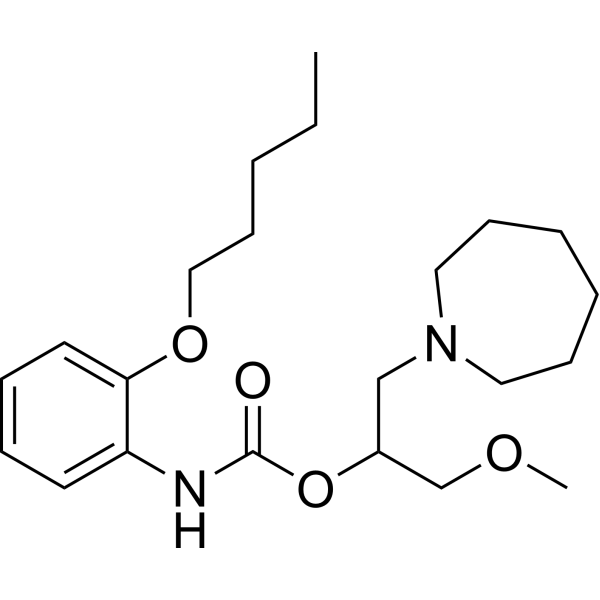
CGP 29030A is an orally effective and specific analgesic agent. CGP 29030A inhibits nociceptive spinal cord neurons without affecting normal sensory functions. CGP 29030A also inhibits gamma motor neurons, which may be beneficial for studying pain disorders that occur concurrently due to increased motor activity (such as cramp, spasm) .
loading...
    loading...
Cat. No.: HY-116072
CAS No.: 105919-73-1
Target:  

Calcium Channel

Research Areas:  

Cardiovascular Disease

Antiarrhythmic agent-2 is a nonspecific Ca 2+ inward current blocker that inhibits ionic currents in sensory neuron membranes. Antiarrhythmic agent-2 can be used in the study of cardiovascular diseases, such as arrhythmias .
loading...
    loading...
Cat. No.: HY-121406
CAS No.: 206449-93-6
Synonyms: (Z)-FRG-8813
Target:  

Histamine Receptor

Research Areas:  

Inflammation/Immunology

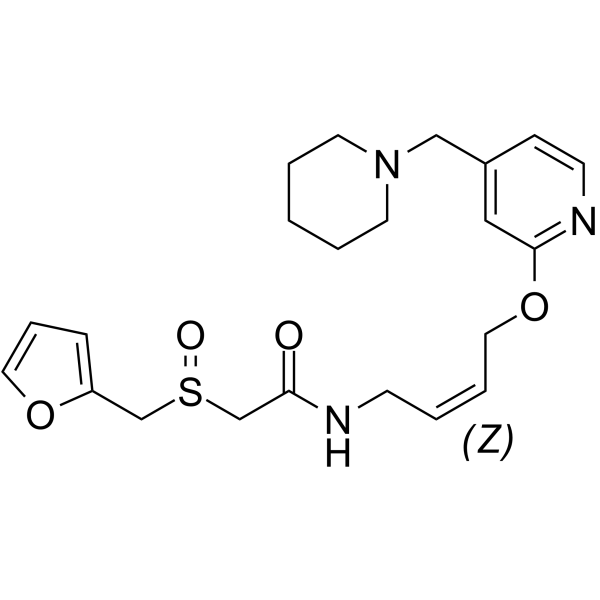
(Z)-Lafutidine ((Z)-FRG-8813) is a potent histamine H2 receptor antagonist. (Z)-Lafutidine shows anti-secretory and gastroprotective activities .
loading...
    loading...
Cat. No.: HY-108576
CAS No.: 113168-57-3
Synonyms: DuP 996 dihydrochloride
Target:  

TRP Channel

Research Areas:  

Neurological Disease

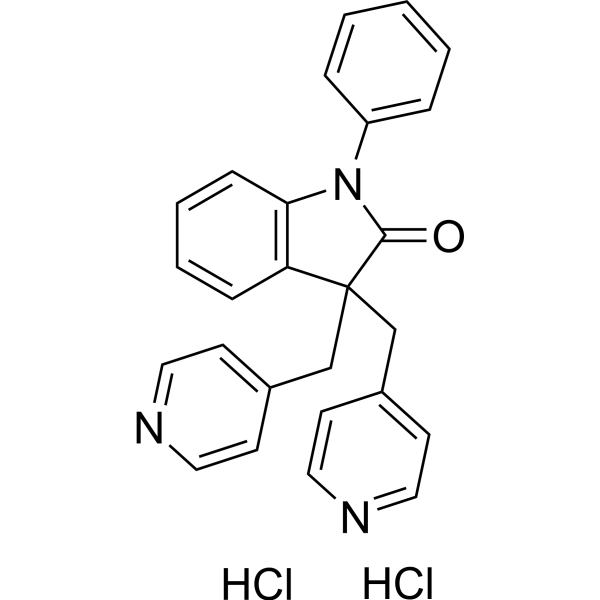
Linopirdine dihydrochloride is a agonist of capsaicin receptor TRPV1. Linopirdine increases the intracellular calcium concentration in HEK293 cells. Linopirdine dihydrochloride exerts an excitatory action on mammalian nociceptors .
loading...
    loading...
Cat. No.: HY-P1241A
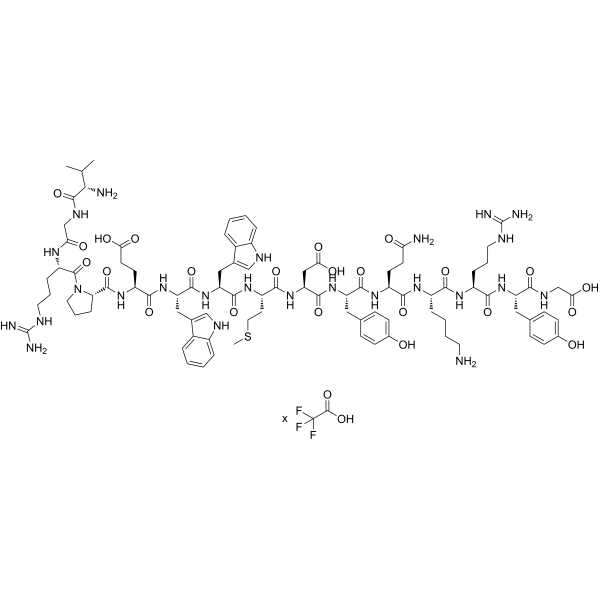
BAM(8-22) TFA, a proteolytically cleaved product of proenkephalin A and sensory neuron-specific receptor (SNSR) agonist, is a potent activator of Mas-related G-protein-coupled receptors (Mrgprs), MrgprC11 and hMrgprX1. BAM(8-22) TFA induces scratching in mice in an Mrgpr-dependent manner. In addition, BAM(8-22) TFA has an analgesic effect and can also inhibit the activation of microglia .
loading...
    loading...
Cat. No.: HY-168166
CAS No.: 2489231-47-0
Target:  

Endogenous Metabolite

Research Areas:  

Neurological Disease

CHET3 is a sex-selective activator with potent analgesic activity. CHET3 was discovered to be a highly selective omnidirectional modulator of TASK-3-containing K2P channels, including TASK-3 homologues and TASK-3/TASK-1 heterologues. CHET3 exhibited significant analgesic effects in multiple acute and chronic pain models in mice, which could be abolished by pharmacological means or genetic knockout of TASK-3. CHET3 is able to functionally modulate the membrane excitability of specific small sensory neurons, which supports its analgesic effects on thermal hypersensitivity and mechanical hyperalgesia in chronic pain .
loading...
    loading...
Cat. No.: HY-P11702
Target:  

Bacterial

Research Areas:  

Others

f-MFFINTLTL is a formylated nonapeptide and a natural ligand from mitochondria or bacteria. f-MFFINTLTL serves as a tool chemical stimulant for the specific activation of sensory neurons expressing the specific vomeronasal receptor (V2rf2) .
loading...
    loading...
Cat. No.: HY-P11701
CAS No.: 681020-80-4
Target:  

MHC

Research Areas:  

Others

SEIDLILGY is a nonapeptide identified as a peptide ligand derived from mouse major histocompatibility complex class I (MHC). SEIDLILGY serves as a tool chemical stimulant for the specific activation of sensory neurons expressing the particular vomeronasal receptor (V2rf2) .
loading...
    loading...
Cat. No.: HY-187355
Target:  

mAChR

Research Areas:  

Neurological Disease

VU6077564 is a reversible competitive antagonist of M1 mAChR, with an IC50 of 31 nM in human (CHO cells) and 39.5 nM in rats. VU6077564 promotes axon growth of sensory neurons from adult rat dorsal root ganglia cultured in vitro. VU6077564 can be used for the research of peripheral neuropathy .
loading...
    loading...
Cat. No.: HY-P11700
Target:  

MHC

Research Areas:  

Inflammation/Immunology

AAPDARETA is a mutated MHC-associated peptide with reduced binding affinity to H-2D b MHC molecules. AAPDARETA activates subsets of mouse main olfactory epithelium sensory neurons and induces Ca 2+ transients .
loading...
    loading...
Cat. No.: HY-181998
CAS No.: 2902706-25-4
CN016 is a neuroprotective agent. CN016 inhibits the elevation of pro-inflammatory cytokines G-CSF, GM-CSF and IL-6 induced by Oxaliplatin (HY-17371). CN016 suppresses Paclitaxel (HY-B0015)-induced inflammatory responses and immune cell infiltration into sensory neurons. CN016 protects neurons from Paclitaxel (HY-B0015)-induced neurotoxic damage. CN016 protects mice against Oxaliplatin-induced peripheral neuropathy .
loading...
    loading...
Cat. No.: HY-136820
CAS No.: 38668-01-8
Taurultam is the major active hydrolytic metabolite of Taurolidine (HY-W011522), which selectively activates hTRPA1 to trigger effects in sensory neurons. Taurultam exhibits activity against SARS-CoV-2 variants, influenza A viruses (H1N1, H3N2) and influenza B viruses. Taurultam induces mild tracheal sensory nerve stimulation and CGRP release in mice. Taurultam can be used in studies related to SARS-CoV-2 infection, influenza virus infection, and co-infection with SARS-CoV-2 and influenza A virus.
loading...
    loading...
Cat. No.: HY-P11704
f-MKKFRW is a selective mouse formyl peptide receptor 3 (Fpr3) activator and bacterial MgrB-derived peptide motif. f-MKKFRW activates Fpr3 to trigger downstream signaling and calcium responses in Fpr3-expressing cells. f-MKKFRW stimulates a subset of mouse vomeronasal sensory neurons in the accessory olfactory system to evoke calcium responses. f-MKKFRW drives innate avoidance behavior in mice via nasal contact .
loading...
    loading...
Cat. No.: HY-182539
CAS No.: 1202877-06-2
Target:  

CGRP Receptor

Research Areas:  

Others Neurological Disease

DD04107 is a neuronal exocytosis inhibitor with a rat Syt1-C2B domain binding Kd of 2.4 μM. DD04107 interferes with synaptobrevin-syntaxin-SNAP-25 complex formation and Syt1-SNARE complex interaction to block α-calcitonin gene-related peptide (α-CGRP) exocytotic release from primary sensory neurons. DD04107 blocks inflammatory ion channel recruitment to nociceptor plasma membranes. DD04107 can be used for the research of chronic inflammatory pain, neuropathic pain, osteosarcoma pain, chemotherapy-induced peripheral neuropathy, diabetic neuropathy, inflammatory pain .
loading...
    loading...

