



BAM(8-22) TFA
Based on 2 publication(s) in Google Scholar
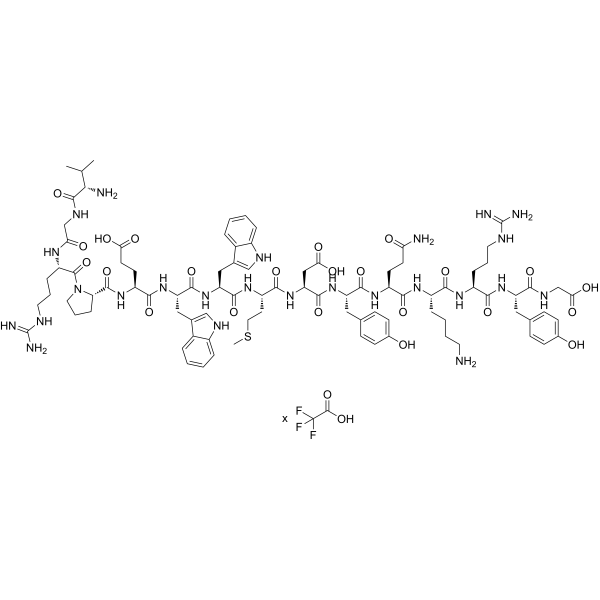
BAM(8-22) TFA, a proteolytically cleaved product of proenkephalin A and sensory neuron-specific receptor (SNSR) agonist, is a potent activator of Mas-related G-protein-coupled receptors (Mrgprs), MrgprC11 and hMrgprX1. BAM(8-22) TFA induces scratching in mice in an Mrgpr-dependent manner. In addition, BAM(8-22) TFA has an analgesic effect and can also inhibit the activation of microglia.
For research use only. We do not sell to patients.
- Formula: C91H127N25O23S.xC2HF3O2
-
Storage:
Please store the product under the recommended conditions in the Certificate of Analysis.

To place orders, for customer services and technical support, please contact: MedChemExpress USA
Tel: 609-228-6898 E-mail: [email protected] [email protected]


-
 Biological Activity
-
Chemical Information
-
Solvent & Solubility
- Protocols
- Purity & Documentation
- References
-
 Help & FAQs


Publications Citing Use of MedChemExpress (MCE) BAM(8-22) TFA
More Customer Validation & Images

-
Histological Imaging/Staining

-
WB


Biological Activity
Description


Chemical Information
-
Formula C91H127N25O23S.xC2HF3O2
-
Sequence Shortening
VGRPEWWMDYQKRYG
-
Shipping
Room temperature in continental US; may vary elsewhere.
-
Storage
Please store the product under the recommended conditions in the Certificate of Analysis.


Publications (2)
-
Journal Impact Factor
-
Most Recent
-
Appl Biochem Biotechnol
Berbamine Attenuates Chronic Kidney Disease-Associated Pruritus by Targeting MRGPRX1/MrgprC11 Signaling. [Abstract]2025 Dec 26. PMID: 41452414
BAM(8-22) TFA purchased from MedChemExpress. Usage Cited in: Appl Biochem Biotechnol. 2025 Dec 26. [Abstract]
BAM(8-22) (50μM; 10μL). Kidney histopathology was evaluated using HE staining.
BAM(8-22) TFA purchased from MedChemExpress. Usage Cited in: Appl Biochem Biotechnol. 2025 Dec 26. [Abstract]
BAM(8-22) (50μM; 10μL). Kidney histopathology was evaluated using HE staining.
-


Solvent & Solubility
In Vitro
H2O
Peptide Solubility and Storage Guidelines:
1. Calculate the length of the peptide.
2. Calculate the overall charge of the entire peptide according to the following table:
| Contents | Assign value | |
|---|---|---|
| Acidic amino acid | Asp (D), Glu (E), and the C-terminal -COOH. | -1 |
| Basic amino acid | Arg (R), Lys (K), His (H), and the N-terminal -NH2 | +1 |
| Neutral amino acid | Gly (G), Ala (A), Leu (L), Ile (I), Val (V), Cys (C), Met (M), Thr (T), Ser (S), Phe (F), Tyr (Y), Trp (W), Pro (P), Asn (N), Gln (Q) | 0 |
3. Recommended solution:
| Overall charge of peptide | Details |
|---|---|
| Negative (<0) |
1. Try to dissolve the peptide in water first. 2. If water fails, add NH4OH (<50 μL). 3. If the peptide still does not dissolve, add DMSO (50-100 μL) to solubilize the peptide. |
| Positive (>0) |
1. Try to dissolve the peptide in water first. 2. If water fails, try dissolving the peptide in a 10%-30% acetic acid solution. 3. If the peptide still does not dissolve, try dissolving the peptide in a small amount of DMSO. |
| Zero (=0) |
1. Try to dissolve the peptide in organic solvent (acetonitrile, methanol, etc.) first. 2. For very hydrophobic peptides, try dissolving the peptide in a small amount of DMSO, and then dilute the solution with water to the desired concentration. |

Protocols
-
Phagocytosis Functional Assay
A phagocytosis functional assay measures the ability of phagocytic cells, such as neutrophils, macrophages, monocytes, or microglia/macrophages, to bind and internalize particulate targets including bacteria, yeast particles, beads, or myelin particles. Fluorescent flow-cytometry assays detect target uptake as fluorescence associated with gated phagocytes, while pH-sensitive dyes such as pHrodo increase signal in acidic phagosomal compartments and therefore preferentially report internalized particles rather than particles remaining outside the cell. Microscopy or high-content imaging can be used to confirm intracellular localization and, in some protocols, to follow uptake kinetics.


Purity & Documentation
References

Calculators
Concentration (start) × Volume (start) = Concentration (final) × Volume (final)


BAM(8-22) TFA Related Classifications
HY-P1241A Related Classifications
 Powered by Bioz