62 Results for "

formaldehyde

" in MedChemExpress (MCE) Product Catalog:
Products (62)

62 Results for "formaldehyde" in MCE Product Catalog:

Cat. No.: HY-Y1155S
CAS No.: 51219-90-0
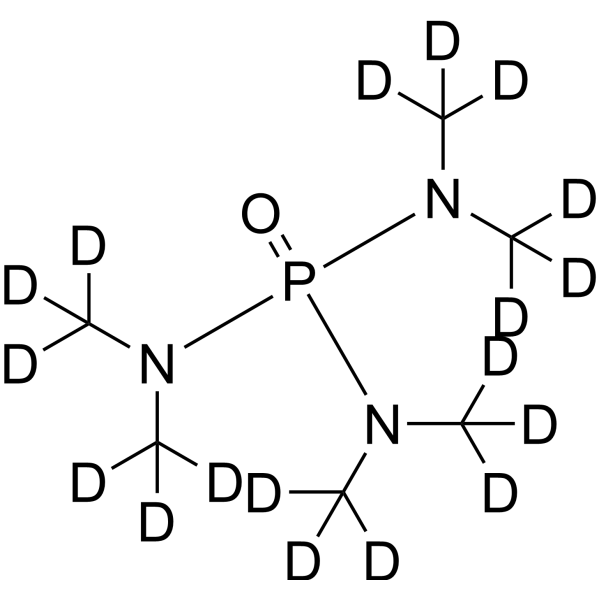
Hexamethylphosphoramide-d18 is the deuterium labeled Hexamethylphosphoramide (HY-Y1155). Hexamethylphosphoramide is an orally active polar aprotic solvent, flame retardant additive, and carcinogen. Hexamethylphosphoramide undergoes cytochrome P-450-mediated N-demethylation to Formaldehyde. Hexamethylphosphoramide induces DNA-protein crosslinks. Hexamethylphosphoramide has been linked to nasal tumors (squamous cell carcinoma, adenoid squamous cell carcinoma), squamous metaplasia, rhinitis, tracheitis, and reversible and irreversible infertility .
loading...
    loading...
Cat. No.: HY-B1158R
CAS No.: 39236-46-9
Imidazolidinyl urea (Standard) is the analytical standard of Imidazolidinyl urea. This product is intended for research and analytical applications. Imidazolidinyl urea is a commonly used antibacterial preservative in cosmetics and pharmaceuticals that releases formaldehyde through decomposition. Imidazolidinyl urea can also be used in the preparation of multifunctional hydrogels for the care of infectious wounds. Imidazolidinyl urea has broad-spectrum antibacterial activity, which mainly inhibits the reproduction of gram-negative bacteria and gram-positive bacteria, and restricts the growth of yeast and mold to a certain extent. Imidazolidinyl urea can induce non-histaminergic allergy by MRGPRX2 activation of mast cells .
loading...
    loading...
Cat. No.: HY-D2765
CAS No.: 757156-70-0
BP Fluor 405 Cadaverine is a carbonyl-reactive building block used to modify carboxylic groups in the presence of activators (e.g. EDC or DCC) or activated esters (e.g. NHS esters) through a stable amide bond. Another common application for BP Fluor 405 Cadaverine is cell fixing by treatment with formaldehyde or glutaraldehyde. BP Fluor 405 is a water-soluble, blue-fluorescent dye that is often used in multi-color applications, including flow cytometry and super-resolution microscopy using STORM. Its excitation is ideally suited for the 407 nm spectral line of the krypton laser or the 408 nm violet laser diode.
loading...
    loading...
Cat. No.: HY-E71866
Research Areas:  

Others

4-Methylaminobutanoate oxidase (formaldehyde-forming) (EC 1.5.3.19) is an oxidoreductase that can convert 4-(methylamino)butanoate, O2 and H2O into 4-aminobutanoate, formaldehyde and H2O2.
loading...
    loading...
Cat. No.: HY-W456398
CAS No.: 1262331-04-3
Synonyms: 4‘-(1,2,2-Triphenylethenyl)biphenyl-4-formaldehyde
Target:  

MOFs

Research Areas:  

Others

4'-(1,2,2-Triphenylvinyl)-[1,1'-biphenyl]-4-carbaldehyde(4‘-(1,2,2-Triphenylethenyl)biphenyl-4-formaldehyde) is a metal-organic framework (MOF).
loading...
    loading...
Cat. No.: HY-W040536
CAS No.: 6440-58-0
Synonyms: Dimethyloldimethyl hydantoin
DMDM hydantoin (Dimethyloldimethyl hydantoin) is a hydantoin-derived formaldehyde-releasing preservative and allergen. DMDM hydantoin releases formaldehyde via hydrolysis in water, including under physiological pH conditions, and the release amount is affected by pH, concentration, composition, temperature and storage duration. DMDM hydantoin exerts bactericidal effects by mediating the cross-linking of proteins, RNA and DNA through the released formaldehyde, thereby inhibiting metabolism and cell division. DMDM hydantoin can induce allergic contact dermatitis directly, via the released formaldehyde, or through both pathways simultaneously. DMDM hydantoin is skin-irritating, and the released formaldehyde brings toxicological risks including carcinogenicity, mutagenicity and reproductive toxicity after entering the body. DMDM hydantoin can be used in studies related to allergic contact dermatitis .
loading...
    loading...
Cat. No.: HY-E72008
Research Areas:  

Others

7-Methylxanthine demethylase (EC 1.14.13.128) is an oxidoreductase that can catalyze multiple reactions, including reaction 1: convert 7-methylxanthine, NADPH, O2 and H + into xanthine, formaldehyde, NADP + and H2O; reaction 2: convert 7-methylxanthine, NADH, O2 and H + into xanthine, formaldehyde, NAD + and H2O.
loading...
    loading...
Cat. No.: HY-W070554
CAS No.: 116-25-6
Target:  

Drug Metabolite

Research Areas:  

Others

1-(Hydroxymethyl)-5,5-dimethylhydantoin is a degradation product of 1,3-dimethylol-5,5-dimethylhydantoin, which is a formaldehyde-releasing antimicrobial preservative.
loading...
    loading...
Cat. No.: HY-E71433
Research Areas:  

Others

2,4-Dinitroanisole O-demethylase (EC 3.3.2.14) is involved in the degradation of 2,4-dinitroanisole; it does not require oxygen or an electron donor and produces methanol instead of formaldehyde.
loading...
    loading...
Cat. No.: HY-182667
Research Areas:  

Others

Citrate Antigen Retrieval Solution, 50× is a commonly used antigen retrieval solution that can be used for antigen retrieval in paraffin sections, frozen sections, and other samples fixed with paraformaldehyde, formaldehyde, or other aldehyde reagents.
loading...
    loading...
Cat. No.: HY-E71863
Research Areas:  

Others

4-Methoxybenzoate monooxygenase (O-demethylating) (EC 1.14.99.15) is an oxidoreductase that can convert 4-methoxybenzoate, AH2 and O2 into 4-hydroxybenzoate, formaldehyde, A and H2O.
loading...
    loading...
Cat. No.: HY-E71898
Research Areas:  

Others

5,6,7,8-Tetrahydromethanopterin hydro- lyase (EC 4.2.1.147) is a lyase that can convert 5,6,7,8-tetrahydromethanopterin and formaldehyde into 5,10-methylenetetrahydromethanopterin and H2O.
loading...
    loading...
Cat. No.: HY-D3424
Target:  

Fluorescent Dye

Research Areas:  

Others

AM3-25 is a lipophilic styrene fluorescent dye commonly used as a fixable probe for nerve endings and cell membranes. AM3‑25 bears an amino group at its hydrophilic end, enabling it to cross‑link with proteins during formaldehyde or glutaraldehyde fixation and thereby immobilizing the stained label.
loading...
    loading...
Cat. No.: HY-182668
EDTA Antigen Retrieval Solution, 50× is a commonly used antigen retrieval solution that can effectively remove cross-links between proteins caused by aldehyde fixation reagents, fully exposing antigenic epitopes in samples such as paraffin sections. It can be used for antigen retrieval in samples such as paraffin sections and frozen sections after fixation with paraformaldehyde, formaldehyde, or other aldehyde reagents.
loading...
    loading...
Cat. No.: HY-W175598
CAS No.: 5625-90-1
Synonyms: N,N'-Methylene-bis-morpholine
Research Areas:  

Infection

Bis(4-morpholinyl)methane (N,N'-Methylene-bis-morpholine) is a broad-spectrum, slow-release formaldehyde-based fungicide. Bis(4-morpholinyl)methane inhibits the growth and reproduction of microorganisms, and prevents spoilage and odor generation in humid environments. Bis(4-morpholinyl)methane serves as a preservative for natural rubber latex .
loading...
    loading...
Cat. No.: HY-14520R
CAS No.: 135-16-0
Synonyms: L-5,6,7,8-Tetrahydrofolic acid (Standard); L-Tetrahydrofolic acid (Standard)
Tetrahydrofolic acid (Standard) is the analytical standard of Tetrahydrofolic acid (HY-14520). This product is intended for research and analytical applications. Tetrahydrofolic acid (L-5,6,7,8-Tetrahydrofolic acid) is the biologically active vitamin B9 folate derivative. Tetrahydrofolic acid is a donor of one-carbon groups for amino acids, nucleic acids, and lipids. Tetrahydrofolic acid serves as an acceptor of free formaldehyde, producing 5,10-methylenetetrahydrofolate-Tetrahydrofolic acid .
loading...
    loading...
Cat. No.: HY-182698
Tris Antigen Retrieval Solution, 10×, pH 9.0, is composed of Tris, trace amounts of Tween20, etc. It can effectively remove cross-links between proteins caused by aldehyde fixation reagents, fully expose antigenic epitopes in paraffin sections and other samples, and can be used for antigen retrieval after paraffin sections, frozen sections and other samples are fixed with paraformaldehyde, formaldehyde or other aldehyde reagents.
loading...
    loading...
Cat. No.: HY-116235
CAS No.: 140-95-4
Synonyms: Dimethylolurea
Research Areas:  

Others

Oxymethurea (Dimethylolurea) is a formaldehyde-releasing protein modification reagent. Under acidic conditions, Oxymethurea promotes nucleophilic substitution of tyrosine via protonation of its hydroxymethyl group, while under alkaline conditions, it promotes protein crosslinking by converting the phenolic hydroxyl group of tyrosine into a more nucleophilic phenoxide ion. Oxymethurea can be used in studies related to protein chemical modification, protein crosslinking, protein protection and genotoxicity .
loading...
    loading...
Cat. No.: HY-W108862
CAS No.: 66204-44-2
Target:  

Bacterial

Research Areas:  

Infection

3,3'-Methylenebis[5-methyloxazolidine] is a bisoxazolidine-based hydrogen sulfide scavenger and fungicide derived from monoisopropanolamine (MIPA). 3,3'-Methylenebis[5-methyloxazolidine] exists as a mixture of structural isomers. 3,3'-Methylenebis[5-methyloxazolidine] is oil-soluble and serves as an oil-soluble alternative to hydrated hexahydrotriazine-based scavengers. 3,3'-Methylenebis[5-methyloxazolidine] can scavenge hydrogen sulfide and methanethiol via chemical reactions, and its scavenging efficiency increases after hydrolysis to MIPA-triazine in water .
loading...
    loading...
Cat. No.: HY-P702823
Purity:  ≥ 90%, as determined by reducing SDS-PAGE.
Synonyms: ADH5; S-Nitrosoglutathione Reductase; Prev. FDH; Alcohol Dehydrogenase 5; ADHX; HEL-S-60p; Glutathione-Dependent formaldehyde Dehydrogenase; GSH-FDH; S-(Hydroxymethyl)Glutathione Dehydrogenase; FALDH; Alcohol Dehydrogenase Class-III; Alcohol Dehydrogenase
Species:  
Human
Source:  
E. coli
loading...
    loading...

