72 Results for "

glucuronidation

" in MedChemExpress (MCE) Product Catalog:
Products (72)

72 Results for "glucuronidation" in MCE Product Catalog:

Cat. No.: HY-19581R
CAS No.: 102280-35-3
Baquiloprim (Standard) is the analytical standard of Baquiloprim (HY-19581). This product is intended for research and analytical applications. Baquiloprim is an orally active Antibiotic and selective inhibitor of Bacterial Dihydrofolate reductase (DHFR), with an IC50 of 19 nM against E. coli and an IC50 of 190 μM against rat liver dihydrofolate reductase. Baquiloprim is a bacteriostatic broad-spectrum antibacterial agent that acts against Gram-negative and Gram-positive bacteria. Baquiloprim inhibits glucuronidation in cultured hepatocytes. Baquiloprim can be used in research related to Pasteurella haemolytica infection, bacterial infection, Escherichia coli diarrhea, bacterial infection in pigs, and pneumonic pasteurellosis .
loading...
    loading...
Cat. No.: HY-128749AR
CAS No.: 5793-89-5
Synonyms: Calcium D-glucarate tetrahydrate (Standard)
D-Glucaric acid tetrahydrate (Standard) (Calcium D-glucarate tetrahydrate (Standard)) is the analytical standard of D-Glucaric acid tetrahydrate (HY-128749A). This product is intended for research and analytical applications. D-Glucaric acid tetrahydrate (Calcium D-glucarate tetrahydrate) is an orally active end product of the mammalian D-glucuronidation pathway. D-Glucaric acid tetrahydrate is found in a variety of fruits and vegetables. D-Glucaric acid tetrahydrate induces cell Apoptosis. D-Glucaric acid tetrahydrate reduces the expression of hippocampal myelin-related genes (Mbp, Plp1). D-Glucaric acid tetrahydrate has cholesterol-lowering and anti-tumor activities. D-Glucaric acid tetrahydrate can be used in the research of neurological diseases .
loading...
    loading...
Cat. No.: HY-W101415R
CAS No.: 698-87-3
Synonyms: Benzylmethylcarbinol (Standard)
1-Phenyl-2-propanol (Standard) is the analytical standard of 1-Phenyl-2-propanol. This product is intended for research and analytical applications. 1-Phenyl-2-propanol (Benzylmethylcarbinol) is a chiral secondary alcohol and a metabolite of n-propylbenzene .
loading...
    loading...
Cat. No.: HY-N0757R
CAS No.: 6926-14-3
8-O-Acetylharpagide (Standard) is the analytical standard of 8-O-Acetylharpagide. This product is intended for research and analytical applications. 8-O-Acetylharpagide is an iridoid glycoside compound. 8-O-Acetylharpagide exhibits anti-aging activity at low doses and anticancer activity at high doses. 8-O-Acetylharpagide induces late-stage apoptosis and necrosis-like death in cancer cells, and downregulates anti-apoptotic proteins such as Akt, p-Akt and Bcl-2. 8-O-Acetylharpagide is mainly metabolized in rats via demethylation, hydrolysis and glucuronidation, and its active metabolites downregulate the AKT/NF-κB/MMP9 signaling axis. 8-O-Acetylharpagide exerts vasoconstrictive effects by activating vascular α-adrenoceptor.
loading...
    loading...
Cat. No.: HY-N3989
CAS No.: 5876-17-5
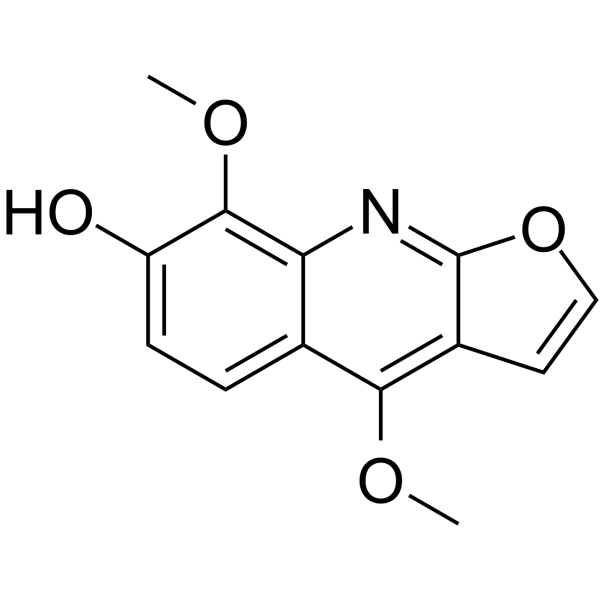
Haplopine is a substance with anti-inflammatory, antioxidant and photoactivated antibacterial activities. It also acts as an inhibitor of UGT1A7 and a photoactivated restriction endonuclease inhibitor. Haplopine inhibits the mRNA/protein expression of IL-6, TSLP, GM-CSF, G-CSF, IL-4, IL-13 and COX-2, while upregulating the mRNA/protein expression of SOD, CAT and HO-1. Haplopine inhibits the glucuronidation reaction catalyzed by UGT1A7 through competitive hydrophobic binding. Haplopine exerts photoactivated restriction endonuclease inhibitory effects by binding to DNA. Haplopine exhibits photoactivated activity against methicillin-resistant Staphylococcus aureus. Haplopine alleviates symptoms of atopic dermatitis. Haplopine can be used in research related to atopic dermatitis and methicillin-resistant Staphylococcus aureus infections .
loading...
    loading...
Cat. No.: HY-100516R
CAS No.: 265114-23-6
Synonyms: UR-8880 (Standard)
Cimicoxib (Standard) is the analytical standard of Cimicoxib. This product is intended for research and analytical applications. Cimicoxib (UR-8880) is an orally active, blood-brain barrier-permeable COX-2 inhibitor that also exerts targeted inhibition on CYP2D15. It has an IC50 of 66 nM against hCOX-2, an IC50 of 1.6 μM against canine CYP2D15, and an IC50 of 0.056 μM against feline CYP2D15. By inhibiting the COX-2 pathway to reduce the production of thromboxane B2 and prostaglandin E2, Cimicoxib exerts antipyretic, anti-inflammatory and analgesic effects. Cimicoxib is metabolized by CYP2D15 to form demethyl-cimicoxib, undergoes glucuronidation via UDP-glucuronosyltransferases, and exhibits biphasic elimination kinetics in beagle dogs. Cimicoxib is widely used in studies of inflammatory diseases, osteoarthritis, and perioperative pain associated with orthopedic or soft tissue surgeries .
loading...
    loading...
Cat. No.: HY-E72114
Target:  

UGT

Research Areas:  

Others

Human UGT2B15 is a UDP-glucuronosyltransferase. Human UGT2B15 stereoselectively catalyzes the glucuronidation of S-Oxazepam. Human UGT2B15 does not mediate the glucuronidation of R-Oxazepam .
loading...
    loading...
Cat. No.: HY-W006081
CAS No.: 4920-77-8
Target:  

UGT

Research Areas:  

Others

3-Methyl-2-nitrophenol is a UDP-glucuronyltransferase (EC 2.4.1.17) acceptor substrate that can be confirmed to undergo glucuronidation catalyzed by the enzyme to form a glucuronide conjugate. 3-Methyl-2-nitrophenol functions as a substrate for conjugation, with glucuronidation forming a glucuronide conjugate that eliminates the parent compound’s characteristic yellow color. 3-Methyl-2-nitrophenol has higher lipid solubility that contributes to high glucuronidation conversion rate, and exhibits lower absorbance at 340 nm to act as a less interfering substrate for the NADH-NAD +-linked UDP-glucuronyltransferase assay .
loading...
    loading...
Cat. No.: HY-W1058220
CAS No.: 19817-91-5
Synonyms: UDP sodium
Uridine-5'-diphosphate (UDP) sodium is an important nucleotide made of uracil, ribose, and a pyrophosphate group. Uridine-5'-diphosphate sodium is a potent, selective human P2Y6 receptor native agonist (EC50 = 300 nM; pEC50 = 6.52). Uridine-5'-diphosphate sodium, an endogenous metabolite, catalyzes the glucuronidation of a wide array of substrates and is used in nucleic acid (RNA) biosynthesis .
loading...
    loading...
Cat. No.: HY-E72105
Target:  

UGT

Research Areas:  

Others

Human UGT1A1 is a uridine diphosphate glucuronosyltransferase (UGT). Human UGT1A1 participates in the glucuronidation pathway, which can convert small lipophilic molecules such as steroids, bilirubin, hormones and drugs into water-soluble, excretable metabolites .
loading...
    loading...
Cat. No.: HY-129565
CAS No.: 613-37-6
Target:  

Cytochrome P450

Research Areas:  

Others

4-Methoxybiphenyl is a cytochrome P450-dependent microsomal monooxygenase system substrate and metabolite precursor. 4-Methoxybiphenyl undergoes O-demethylation to generate 4-hydroxybiphenyl. 4-Methoxybiphenyl undergoes sulphation and glucuronidation conjugation; inhibition of sulphation shifts metabolism toward increased glucuronidation and unconjugated 4-hydroxybiphenyl accumulation. 4-Methoxybiphenyl serves as a model substrate for studying phase II metabolic conjugation pathway balance in rat isolated hepatocytes .
loading...
    loading...
Cat. No.: HY-E72109
Target:  

UGT

Research Areas:  

Cancer

Human UGT1A7 is a UDP-glucuronosyltransferase. UGT1A7 catalyzes the glucuronidation of hydrophobic substrates, polycyclic aromatic hydrocarbons, dietary heterocyclic amines, and 1-Hydroxypyrene (HY-W014075). Human UGT1A7 is applicable to research related to sporadic colorectal cancer .
loading...
    loading...
Cat. No.: HY-E72115
Target:  

UGT

Research Areas:  

Others

Human UGT2B17 is a UDP-glucuronosyltransferase. Human UGT2B17 catalyzes the glucuronidation of Testosterone at the 17β-OH position, binds Epitestosteron with comparable affinity, but cannot catalyze its glucuronidation .
loading...
    loading...
Cat. No.: HY-E72112
Target:  

UGT

Research Areas:  

Cancer

Human UGT1A10 is a UDP-glucuronosyltransferase. UGT1A10 catalyzes the glucuronidation of Mycophenolic acid (HY-B0421). Human UGT1A10 mediates glucuronidation modification of 34 out of 42 tested bioflavonoids. Human UGT1A10 is applicable to relevant research on colorectal cancer .
loading...
    loading...
Cat. No.: HY-113083A
Synonyms: APAP-glu potassium
Target:  

Drug Metabolite

Research Areas:  

Others

Acetaminophen glucuronide potassium (APAP-glu potassium) is the inactive glucuronide metabolite of Acetaminophen (HY-66005). Acetaminophen glucuronide potassium can be used as a biomarker to measure glucuronidation activity or hepatic drug metabolism capacity .
loading...
    loading...
Cat. No.: HY-W718401
CAS No.: 1486471-13-9
Synonyms: Belinostat G
Target:  

Drug Metabolite

Research Areas:  

Others

Belinostat glucuronide (Belinostat G) is the major metabolite formed via UGT1A1-catalyzed O-glucuronidation of Belinostat (HY-10225), and exhibits no activity against cancer cells .
loading...
    loading...
Cat. No.: HY-W777236
CAS No.: 18430-06-3
N-Acetyl serotonin β-D-glucuronide is a glucuronidated metabolite of N-acetylserotonin (HY-107854) and a probe metabolite for UGT1A6 activity assays.N-Acetyl serotonin β-D-glucuronide forms from N-acetyl serotonin via glucuronidation catalyzed by a UGT enzyme .
loading...
    loading...
Cat. No.: HY-FL15781
CAS No.: 92478-27-8
Target:  

Bacterial

Research Areas:  

Infection

Morinidazole solution is mainly composed of Morinidazole (HY-15781). Morinidazole is an orally active and 5-nitroimidazole antimicrobial agent that undergoes extensive metabolism in humans via N +-glucuronidation and sulfation. Morinidazole can be used for bacterial infections research including appendicitis and pelvic inflammatory disease (PID) caused by anaerobic bacteria .
loading...
    loading...
Cat. No.: HY-E72108
Target:  

UGT

Research Areas:  

Cancer

Human UGT1A6 is a UDP-glucuronosyltransferase. UGT1A6 catalyzes the glucuronidation of 5-hydroxytryptamine (HY-B1473A), 1-Naphthol (HY-Y1309), and Acetaminophen (HY-66005). Human UGT1A6 can be used in studies related to the pathogenesis of bladder cancer .
loading...
    loading...
Cat. No.: HY-D3180
CAS No.: 1201643-01-7
CDr20 is a fluorescent chemical probe capable of crossing the blood-brain barrier. CDr20 undergoes glucuronidation catalyzed by the UDP-glucuronosyltransferase Ugt1a7c, which triggers a fluorescence turn-on response. CDr20 enables visualization of live microglial cells. CDr20 can be used for research on Alzheimer's disease, stroke, and autism .
loading...
    loading...

