164 Results for "

stable complex

" in MedChemExpress (MCE) Product Catalog:
Products (164)

164 Results for "stable complex" in MCE Product Catalog:

Cat. No.: HY-W691498
CAS No.: 13007-85-7
Sodiumα-glucoheptonate, 97% is a multifunctional chelating agent capable of forming stable complexes with various metal ions.
loading...
    loading...
Cat. No.: HY-117314
CAS No.: 886970-80-5
Research Areas:  

Others

CyMe4BTBP is an efficient extractant that can form stable complexes with a variety of metal ions, especially for actinides .
loading...
    loading...
Cat. No.: HY-115853A
Research Areas:  

Others

Pyclen dihydrochloride forms kinetically and thermodynamically stable nine-coordinate Ln (III) complexes, as well as Mn (II)-based MRI contrast agents. Pyclen-Based Mn(II) Complexes can be used for liver-specific MRI .
loading...
    loading...
Cat. No.: HY-W140537
CAS No.: 304675-80-7
EDTA diammonium salt hydrate, 97% is a derivative of ethylenediaminetetraacetic acid (EDTA), commonly used as a chelating agent in various applications due to its ability to bind with various metal ions and form stable complexes.
loading...
    loading...
Cat. No.: HY-171561
Research Areas:  

Others

DOTAM-Maleimide triTFA is a bifunctional chelator, combining the DOTAM structure with a maleimide group for efficient thiol coupling. DOTAM-Maleimide triTFA forms stable complexes with radiometals, promising for applications in molecular imaging and radiotherapy .
loading...
    loading...
Cat. No.: HY-163025
Target:  

Hapten

Research Areas:  

Inflammation/Immunology

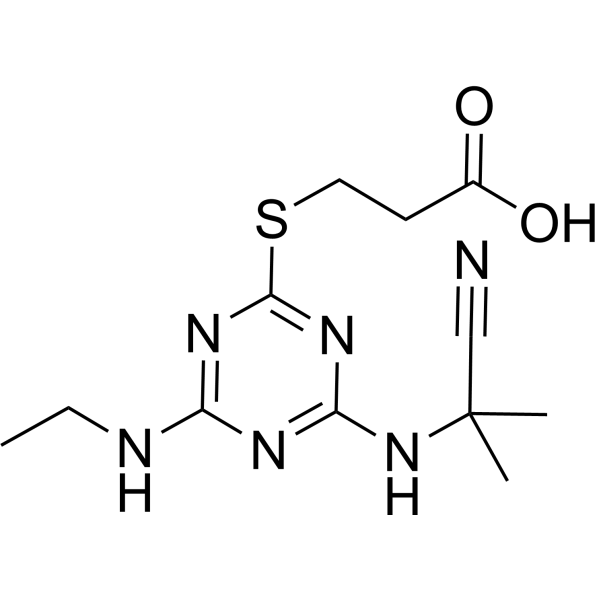
Cyanazine-3-mercaptopropanoic acid (compound 6), a coating hapten, is a stable carrier-hapten complex. Polyclonal antibody obtained were with a high titer, with the IC50 of 10.2 ng/mL for Cyanazine-3-mercaptopropanoic acid .
loading...
    loading...
Cat. No.: HY-126565
CAS No.: 75956-68-2
Research Areas:  

Others

Licam-C is a promising radiological decontaminant agent. Acting as a chelating agent, LICAM-C forms stable complexes with radioactive elements such as Plutonium (Pu) and Americium (Am). Licam-C is employed in research addressing the remediation of radioactive nucleotide contamination .
loading...
    loading...
Cat. No.: HY-W540023
CAS No.: 1493802-95-1
Target:  

ADC Linkers

Research Areas:  

Cancer

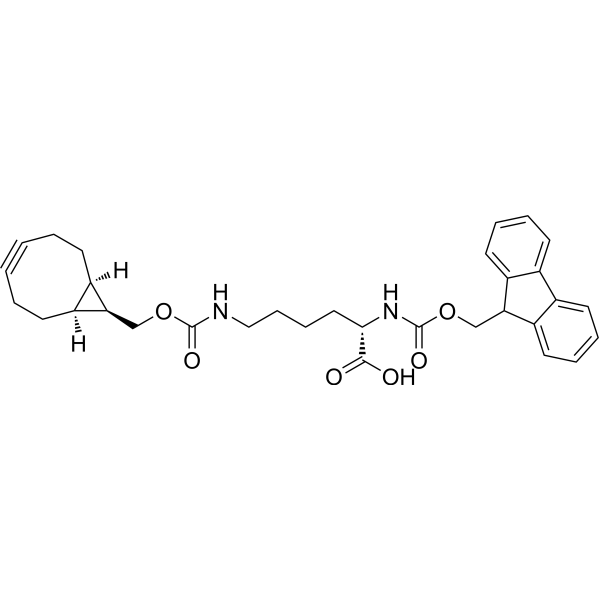
Endo-BCN-Fmoc-L-Lysine is a linker containing the lyophilic bidentate macrocyclic ligand endo-BCN, which can further synthesize macrocyclic complexes. In click chemistry, endo-BCN can react with molecules containing azide groups to form stable triazoles in the absence of catalysts.
loading...
    loading...
Cat. No.: HY-124357
CAS No.: 127685-30-7
Synonyms: S-Norfluoxetine hydrochloride; LY 215229 hydrochloride
Target:  

Dopamine Receptor

Research Areas:  

Neurological Disease

Seproxetine (S-Norfluoxetine) hydrochloride is a selective serotonin reuptake inhibitor (SSRI) that enhances serotonin levels in the brain by specifically inhibiting the serotonin uptake carrier. Seproxetine hydrochloride exhibits strong charge transfer interactions with π-electron acceptors, forming stable complexes that enhance its binding affinity to multiple receptors, including serotonin and dopamine receptors. Seproxetine hydrochloride demonstrates improved biological activity when interacting with charge transfer complexes, leading to increased stability and efficacy in therapeutic applications.
loading...
    loading...
Cat. No.: HY-W540926
CAS No.: 75006-64-3
Synonyms: Biacetyl dioxime sodium hydrate
Research Areas:  

Neurological Disease

Dimethylglyoxime sodium hydrate (Biacetyl dioxime sodium hydrate) is an oxime compound. Dimethylglyoxime sodium hydrate selectively coordinates with divalent nickel ions Ni 2+ to form stable complexes, and can also coordinate with copper ions Cu 2+, but does not coordinate with iron, selenium or zinc. Dimethylglyoxime sodium hydrate inhibits the aggregation of human β-amyloid 40 peptide in vitro. Dimethylglyoxime sodium hydrate is used in the research of Alzheimer's disease .
loading...
    loading...
Cat. No.: HY-W129533
CAS No.: 819850-13-0
Research Areas:  

Others

tert-Butyl 1H-indol-4-ylcarbamate is a nucleophilic reagent. tert-Butyl 1H-indol-4-ylcarbamate induces the formation of the stable triple hydrogen-bonded complex A-TS-Re. tert-Butyl 1H-indol-4-ylcarbamate undergoes Friedel-Crafts reactions with β,γ-unsaturated α-ketiminoesters .
loading...
    loading...
Cat. No.: HY-N14351
CAS No.: 114550-08-2
Ferrocin A is a lipopeptide compound that targets the SARS-CoV-2 RNA-dependent RNA polymerase (nsp12). Ferrocin A can stably bind to nsp12, and as an iron-chelating peptide, it reduces the concentration of free iron in the environment via complexation, thereby inhibiting bacterial growth by repressing the acquisition of essential metal cations. As an iron-chelating antiviral molecule, Ferrocin A may be used in studies related to COVID-19 and bacterial infections .
loading...
    loading...
Cat. No.: HY-149619
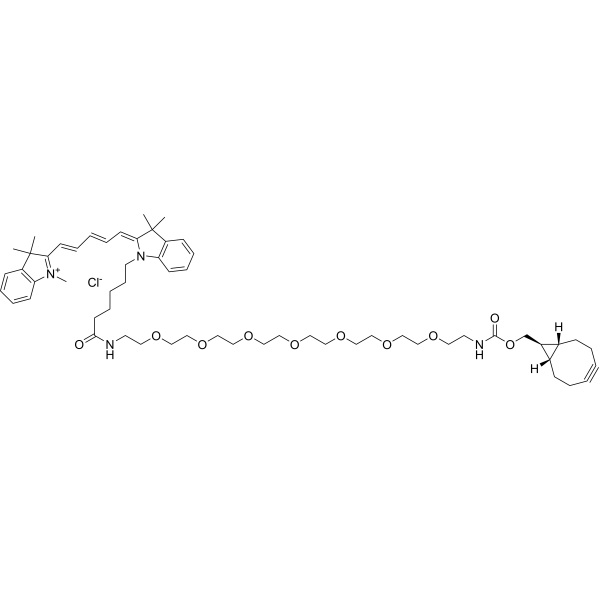
Cy5-PEG7-endo-BCN is a dye derivative of Cyanine 5 (Cy5) (HY-D0821) containing 7 PEG units. Cy5-PEG7-endo-BCN contains the lyophilic bidentate macrocyclic ligand endo-BCN, which can further synthesize macrocyclic complexes. In click chemistry, endo-BCN can react with molecules containing azide groups to form stable triazoles in the absence of catalysts.
loading...
    loading...
Cat. No.: HY-181085
Target:  

DYRK

RD0448 is a potent inhibitor of DYRK1A, DYRK1B, and DYRK2. RD0448 selectively targets the non-native (folded intermediate) state of DYRK1A and DYRK1B. The binding site of RD0448 is hidden in the native state of DYRK1A and DYRK1B, and as a stabilizing binder, it binds tightly to both DYRK1A and DYRK1B, forming a stable complex with slow dissociation kinetics. In contrast, RD0448 targets the native state of DYRK2 without selectivity between its native and non-native states, acting as a weak binder with weaker binding affinity to DYRK2 and forming a rapidly dissociating complex .
loading...
    loading...
Cat. No.: HY-181193
Research Areas:  

Infection

PROTAC SARS-CoV-2 Mpro degrader-7 is a SARS-CoV-2 main protease (Mpro) PROTAC degrader with a DC50 of 0.985 μM. PROTAC SARS-CoV-2 Mpro degrader-7 promotes K48-linked polyubiquitination of SARS-CoV-2 Mpro, leading to proteasome-dependent degradation via the ubiquitin-proteasome system.PROTAC SARS-CoV-2 Mpro degrader-7 forms a ternary complex with SARS-CoV-2 Mpro and CRBN E3 ubiquitin ligase to enable viral protease ubiquitination.PROTAC SARS-CoV-2 Mpro degrader-7 exhibits a high selectivity index, and induces dose-dependent degradation of SARS-CoV-2 Mpro in stable cells expressing the viral protease.PROTAC SARS-CoV-2 Mpro degrader-7 can be used for the research of COVID-19 .
loading...
    loading...
Cat. No.: HY-115853B
CAS No.: 129135-03-1
Research Areas:  

Others

Pyclen sulfate forms kinetically and thermodynamically stable nine-coordinate Ln (III) complexes, as well as Mn (II)-based MRI contrast agents. Pyclen-Based Mn(II) Complexes can be used for liver-specific MRI .
loading...
    loading...
Cat. No.: HY-156939
CAS No.: 65229-17-6
Research Areas:  

Cancer

ZnDTPA is an orally effective chelating agent, which belongs to the class of amino carboxylic acid chelating agents and is mainly used to form stable complexes with metal ions. DTPA (diethylenetriaminepentaacetic acid) itself is a polydentate ligand that can form stable cyclic or chain-like complexes with a variety of metal ions. ZnDTPA can be used to reduce the long-term toxicity of 239Pu to rats and reduce the incidence of osteosarcoma, breast cancer, etc. in rats .
loading...
    loading...
Cat. No.: HY-DY1106
CAS No.: 69898-45-9
Ferrozine (solution) is a spectrophotometric reagent for iron ions, can react with divalent Fe to form a stable magenta complex species. The complex has an absorption peak at 562 nm . Ferrozine-based colorimetric assays can quantify iron in cells
Solvent and concentration: ddH2O: 10 mM
loading...
    loading...
Cat. No.: HY-183600
SCN-PYTA is a bifunctional chelator for trivalent radiometals. After conjugation with monoclonal antibodies, SCN-PYTA forms a stable complex with 225Ac to achieve efficient radiolabeling. SCN-PYTA can be used in cancer research .
loading...
    loading...
Cat. No.: HY-N20729
CAS No.: 99633-12-2
Eucommin A is a natural polyphenolic antioxidant. Eucommin A forms stable complexes with EGFR and MAPK8 via hydrogen bonding and hydrophobic interactions, and regulates osteoarthritis-related Autophagy. Eucommin A is applicable to research related to oxidative stress, such as osteoarthritis .
loading...
    loading...

