80 Results for "

bivalent

" in MedChemExpress (MCE) Product Catalog:
Products (80)

80 Results for "bivalent" in MCE Product Catalog:

Cat. No.: HY-Y0682R
CAS No.: 60-00-4
Synonyms: EDTA (Standard)
Ethylenediaminetetraacetic acid (Standard) is the analytical standard of Ethylenediaminetetraacetic acid. This product is intended for research and analytical applications. Ethylenediaminetetraacetic acid (EDTA) is a kind of metal chelating agent (binds to bivalent and trivalent metal cations, including calcium). Ethylenediaminetetraacetic acid has antibacterial, anti-inflammatory, antioxidant, anti-hypercalcemia and anticoagulant activities. Ethylenediaminetetraacetic acid decreases the metal ion-catalyzed oxidative damage to proteins, and allows maintenance of reducing environment during protein purification. Ethylenediaminetetraacetic acid can alleviate the liver fibrosis. Ethylenediaminetetraacetic acid can be used for coronary artery disease and neural system disease research [4] .
loading...
    loading...
Cat. No.: HY-150683
CAS No.: 3031654-46-0
Research Areas:  

Cancer

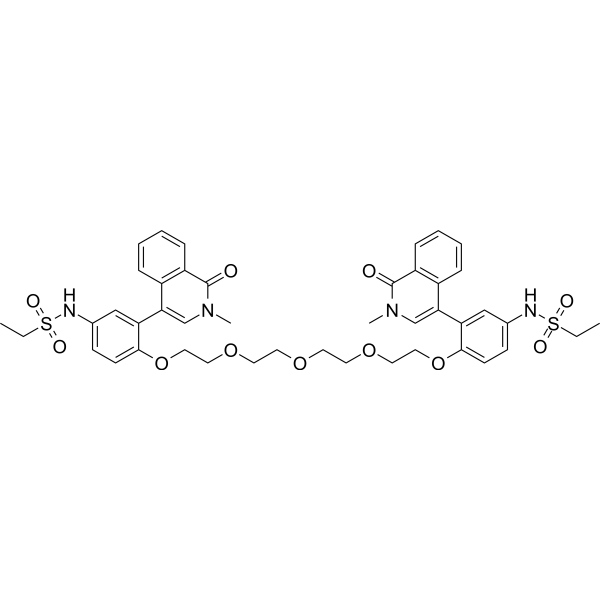
NC-III-49-1 is a potent bivalent bromodomain and extraterminal domain (BET) inhibitor. NC-III-49-1 shows binding potential for BRD4-1, BRD4-2, BRD4-T, BRDT-1, BRDT-2, BRDT-T with Kd values of 0.095, 0.32, 0.29, 0.089, 5.5, 0.058 nM, respectively. NC-III-49-1 shows antiproliferative activity. NC-III-49-1 decreases the expression of c-Myc .
loading...
    loading...
Cat. No.: HY-W777365
CAS No.: 1215408-17-5
Synonyms: EDTA-13C4
Ethylenediaminetetraacetic acid- 13C4 (EDTA- 13C4) is the 13C-labeled Ethylenediaminetetraacetic acid (HY-Y0682). Ethylenediaminetetraacetic acid (EDTA) is a kind of metal chelating agent (binds to bivalent and trivalent metal cations, including calcium). Ethylenediaminetetraacetic acid has antibacterial, anti-inflammatory, antioxidant, anti-hypercalcemia and anticoagulant activities. Ethylenediaminetetraacetic acid decreases the metal ion-catalyzed oxidative damage to proteins, and allows maintenance of reducing environment during protein purification. Ethylenediaminetetraacetic acid can alleviate the liver fibrosis. Ethylenediaminetetraacetic acid can be used for coronary artery disease and neural system disease research .
loading...
    loading...
Cat. No.: HY-149521
Target:  

PI3K

Research Areas:  

Cancer

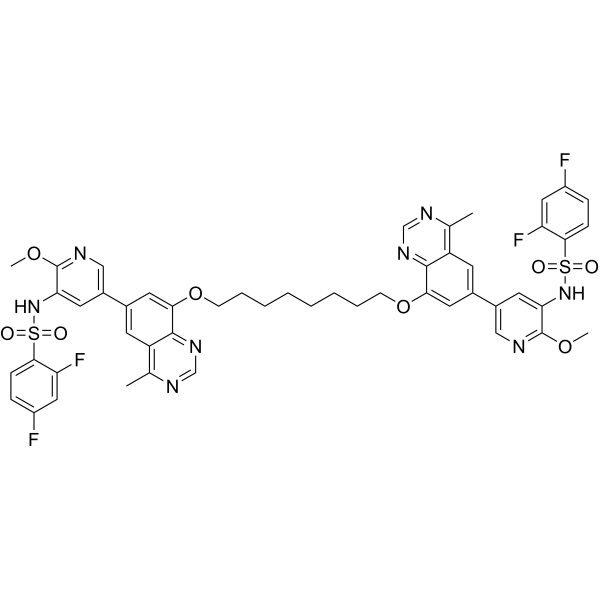
PI3K-IN-47 (Compound 27) is a bivalent PI3K inhibitor (IC50: 0.44 nM for PI3Kα, 7.18 nM, 13.92 nM, 22.83 nM for PI3Kβ, PI3Kγ, PI3Kδ). PI3K-IN-47 induces cell cycle arrest in G1 phase, inhibits colony formation and cell migration. PI3K-IN-47 inhibits tumor growth in HGC-27 xenograft mice .
loading...
    loading...
Cat. No.: HY-Y0682AR
CAS No.: 6381-92-6
Synonyms: EDTA disodium dihydrate (Standard)
Ethylenediaminetetraacetic acid (disodium dihydrate) (Standard) is the analytical standard of Ethylenediaminetetraacetic acid (disodium dihydrate). This product is intended for research and analytical applications. Ethylenediaminetetraacetic acid (EDTA) disodium dehydrate is a kind of metal chelating agent (binds to bivalent and trivalent metal cations, including calcium). Ethylenediaminetetraacetic acid disodium dehydrate has antibacterial, anti-inflammatory, antioxidant, anti-hypercalcemia and anticoagulant activities. Ethylenediaminetetraacetic acid disodium dehydrate decreases the metal ion-catalyzed oxidative damage to proteins, and allows maintenance of reducing environment during protein purification. Ethylenediaminetetraacetic acid disodium dehydrate can alleviate the liver fibrosis. Ethylenediaminetetraacetic acid disodium dehydrate can be used for coronary artery disease and neural system disease research [4] .
loading...
    loading...
Cat. No.: HY-130711C
CAS No.: 2564467-25-8
Synonyms: VH032-C3-NH2 dihydrochloride
Research Areas:  

Cancer

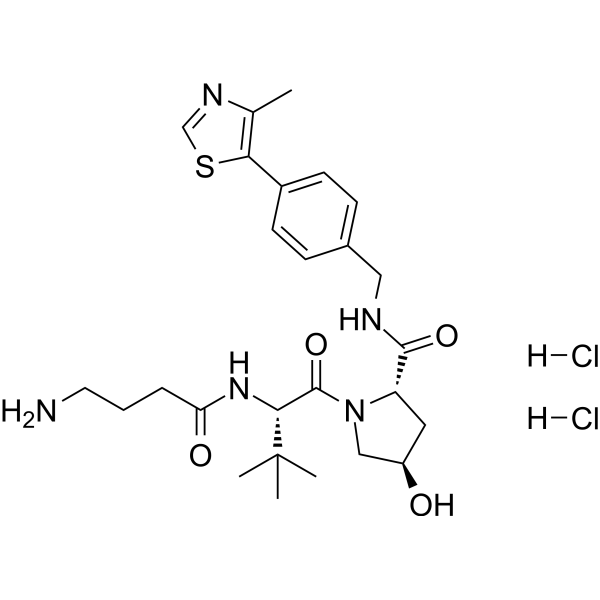
(S,R,S)-AHPC-C3-NH2 (dihydrochloride) is the dihydrochloride form of (S,R,S)-AHPC-C3-NH2 (HY-130711). (S,R,S)-AHPC-C3-NH2 (VH032-C3-NH2) is a synthesized E3 ligase ligand-linker conjugate that incorporates the VH032 based VHL ligand and a linker used in PROTAC technology. (S,R,S)-AHPC-C3-NH2 can be used in the synthesis of a series of PROTACs, such as UNC6852 (HY-130708). UNC6852 is an EED-targeted bivalent chemical degrader .
loading...
    loading...
Cat. No.: HY-180435
CAS No.: 160037-48-9
Research Areas:  

Cancer

Janus-DOTA is a bivalent hapten, can be used for drug delivery .
loading...
    loading...
Cat. No.: HY-187077
CAS No.: 3060729-96-3
UNC0642-C3-COOH is a bivalent G9a/GLP ligand that can be used for the synthesis of PROTACs, such as MS8709 (HY-162362) .
loading...
    loading...
Cat. No.: HY-E70953
Research Areas:  

Metabolic Disease

Pyruvate Kinase/Lactic Dehydrogenase enzymes, Rabbit catalyzes an ATP-dependent phosphorylation of glycolate to yield 2-phosphoglycolate. Pyruvate kinase requires bivalent and monovalent cations such as Mg 2+ and K + respectively for activation to occur.
loading...
    loading...
Cat. No.: HY-181003
CAS No.: 3125088-67-4
Research Areas:  

Cancer

GSK785 is a BRD2/4-selective, BRD3-sparing bivalent BET inhibitor. GSK785 inhibits production of the MCP1 cytokine in human whole blood. GSK785 can be used for the research of cancer .
loading...
    loading...
Cat. No.: HY-183936
Target:  

SHP2 p38 MAPK ERK

Research Areas:  

Cancer

SDUY127 is a bivalent SHP2 inhibitor with an IC50 value of 16 nM. SDUY127 binds simultaneously to the tunnel allosteric site and latch allosteric site of SHP2 at a 1:1 stoichiometric ratio, stabilizes the protein in an inactive conformation, and induces sustained inhibition of the MAPK signaling pathway. SDUY127 can be used in research related to leukemia and hepatocellular carcinoma .
loading...
    loading...
Cat. No.: HY-185693
Research Areas:  

Others

DBCO2-PEG24 is a non-targeting bivalent DBCO-functionalized shielding agent with a PEG24 spacer, which can be used as a surface shielding control. DBCO2-PEG24 binds to the surface of lipid oligomer-modified siRNA lipopolymer nanoparticles via copper-free click reaction (SPAAC) .
loading...
    loading...
Cat. No.: HY-P992359
Synonyms: SHR-1905

Target:  

Inhibitory Antibodies

Research Areas:  

Inflammation/Immunology

GSK5784283 (SHR-1905) is a bivalent antibody against TSLP, which is applicable to research related to asthma. GSK5784283 has two Fab arms and is a humanized IgG1κ monoclonal antibody. GSK5784283 effectively reduces the levels of eosinophils, FeNO, TARC and eotaxin-3. GSK5784283 regulates FEV1 (forced expiratory volume in one second) .
loading...
    loading...
Cat. No.: HY-185694
CAS No.: 2304536-81-8
Research Areas:  

Cancer

DBCO2-SS2-PEG24 is a bivalent shielding agent containing dibenzocyclooctyne (DBCO) and PEG24 domains, synthesized for copper-free click reaction-mediated postmodification of azide-bearing siRNA lipo-polyplexes.DBCO2-SS2-PEG24 can be used for the research of cervical carcinoma, hepatocellular carcinoma .
loading...
    loading...
Cat. No.: HY-108350R
CAS No.: 1454920-20-7
Research Areas:  

Cancer

MI-2-2 (Standard) is the analytical standard of MI-2-2 (HY-108350). This product is intended for research and analytical applications. MI-2-2 is a potent menin-MLL inhibitor. MI-2-2 binds to menin with low nanomolar affinity (Kd=22nM) and very effectively disrupts the bivalent protein-protein interaction between menin and MLL. MI-2-2 has specific and very pronounced activity in MLL leukemia cells, including inhibition of cell proliferation, down-regulation of Hoxa9 expression, and differentiation .
loading...
    loading...
Cat. No.: HY-16591R
CAS No.: 1260251-31-7
Synonyms: TL32711 (Standard)
Research Areas:  

Infection Cancer

Birinapant (Standard) is the analytical standard of Birinapant (HY-16591). This product is intended for research and analytical applications. Birinapant (TL32711), a bivalent Smac mimetic, is a potent antagonist for XIAP and cIAP1 with Kds of 45 nM and less than 1 nM, respectively. Birinapant (TL32711) induces the autoubiquitylation and proteasomal degradation of cIAP1 and cIAP2 in intact cells, which results in formation of a RIPK1: caspase-8 complex, caspase-8 activation, and induction of tumor cell death. Birinapant (TL32711) targets TRAF2-associated cIAPs and abrogates TNF-induced NF-κB activation.
loading...
    loading...
Cat. No.: HY-P992339

Research Areas:  

Cancer

cT84.66 is a highly efficient tumor-targeting agent against carcinoembryonic antigen (CEA). cT84.66 engages in bivalent binding with CEA via variable region antigen-binding sites, enabling precise targeting of CEA-producing tumor cells for delivery of therapeutic radiation. cT84.66 exhibits high tumor uptake rate, rapid clearance rate, and excellent tumor-to-blood ratio. With dual functions as an imaging agent and an antibody-directed radiotherapy agent, cT84.66 is widely used in studies of colorectal cancer and metastatic CEA-positive malignancies .
loading...
    loading...
Cat. No.: HY-Y0682S2
CAS No.: 15251-22-6
Synonyms: EDTA-d4
Ethylenediaminetetraacetic acid-d4 (EDTA-d4) is the deuterium labeled Ethylenediaminetetraacetic acid (HY-Y0682). Ethylenediaminetetraacetic acid (EDTA) is a kind of metal chelating agent (binds to bivalent and trivalent metal cations, including calcium). Ethylenediaminetetraacetic acid has antibacterial, anti-inflammatory, antioxidant, anti-hypercalcemia and anticoagulant activities. Ethylenediaminetetraacetic acid decreases the metal ion-catalyzed oxidative damage to proteins, and allows maintenance of reducing environment during protein purification. Ethylenediaminetetraacetic acid can alleviate the liver fibrosis. Ethylenediaminetetraacetic acid can be used for coronary artery disease and neural system disease research .
loading...
    loading...
Cat. No.: HY-P992434

Research Areas:  

Cancer

OSE-279 is a high-affinity humanized monoclonal bivalent antibody targeting PD-1, the recommended isotype control is HY-P99003. OSE-279 blocks PD-1 ligand binding, inhibits PDL1-induced SHP1 phosphorylation, restores T cell activation, and promotes reactivation of primary T cell effector functions. OSE-279 binds hFcRn receptor, predicts long half-life, induces CD4 and CD8 T cell proliferation, and promotes interleukin 2 and interferon gamma secretion. OSE-279 can be used for the research of advanced malignancies, colon cancer, hepatocarcinoma, mesothelioma .
loading...
    loading...
Cat. No.: HY-P11280A
Target:  

Melanocortin Receptor

Research Areas:  

Cancer

PRAME peptide (425-433) acetate is a proteasome-degraded peptide derived from the cancer-testis antigen PRAME (Preferentially Expressed Antigen in Melanoma). PRAME peptide (425-433) acetate is restricted by HLA-A*02:01 and can serve as a target for bispecific T cell engager therapy in the context of major histocompatibility complex I presentation. PRAME peptide (425-433) acetate shows application potential in various malignant tumors and is widely suitable for research related to solid tumors, melanoma, ovarian cancer, endometrial cancer, and lung cancer (including lung adenocarcinoma and lung squamous cell carcinoma). PRAME peptide (425-433) acetate can be used to explore disease of triple-negative breast cancer, diffuse large B-cell lymphoma, and head and neck squamous cell carcinoma .
loading...
    loading...

