80 Results for "

bivalent

" in MedChemExpress (MCE) Product Catalog:
Products (80)

80 Results for "bivalent" in MCE Product Catalog:

Cat. No.: HY-153459
CAS No.: 2684292-71-3
Purity:  98.83%
Research Areas:  

Cancer

IBG1 is a bivalent molecular glue degrader targeting BRD2/BRD4, with IC50 values of 12.8 nM and 462 nM, respectively, and an EC50 of 44 nM. By binding to the adjacent BD1 and BD2 bromodomains of BRD2 and BRD4, IBG1 stabilizes the ternary complex formed with DCAF16, thereby driving CRL-mediated ubiquitination and proteasomal degradation. IBG1 induces cancer cell apoptosis and inhibits cancer cell growth in a DCAF16-dependent manner, and downregulates MYC expression through DCAF16-independent BET bromodomain inhibition. IBG1 can be used in research of various cancers including prostate cancer .
loading...
    loading...
Cat. No.: HY-173552
CAS No.: 3067681-36-8
Synonyms: KAT-TCIP
Research Areas:  

Cancer

TCIP3 is a bivalent molecular glue degrader that binds dually to p300/CBP and BCL6. TCIP3 redirects p300 and CBP, thereby activating programmed cell death genes that are normally repressed by the oncogenic driver gene BCL6. TCIP3 induces acetylation of BCL6 and histone tails, inhibits c-MYC transcription. TCIP3 can be used for the research of diffuse large B-cell lymphoma (DLBCL) .
loading...
    loading...
Cat. No.: HY-155218
CAS No.: 2488892-09-5
Target:  

PROTACs CDK

Research Areas:  

Cancer

TMX-2172 is a selective bivalent cereblon-recruiting PROTAC-based dual CDK2 and CDK5 degrader with IC50 values of 6.5 nM and 6.8 nM, respectively. TMX-2172 shows selectivity for CDK2 and CDK5 over other cell cycle CDKs (CDK1, CDK4, and CDK6) and transcriptional CDKs (CDK7 and CDK9). TMX-2172 inhibits CDK2/CDK5 enzymatic activity, induces their proteasomal degradation, reduces ASCL1 protein levels and half-life, induces cancer cell death, and exerts antiproliferative effects. TMX-2172 can be used for the research of ovarian cancer and small cell lung cancer .
loading...
    loading...
Cat. No.: HY-122702
CAS No.: 77855-76-6
Purity:  ≥95.0%
Target:  

PROTAC Linkers

Research Areas:  

Others

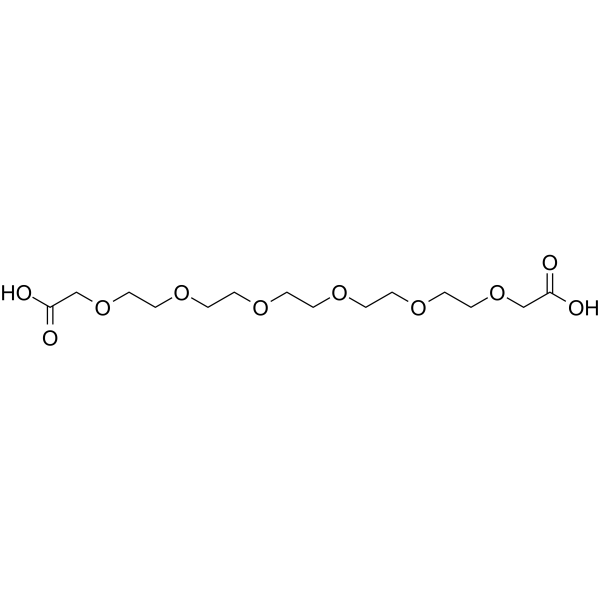
PEG6-(CH2CO2H)2 is a symmetric PEG PROTAC linker, for the synthesis of Homo-PROTACs which is bivalent small-molecule dimerizers of the VHL E3 ubiquitin ligase to induce self-degradation .
loading...
    loading...
Cat. No.: HY-W017588
CAS No.: 1585-90-6
Research Areas:  

Cancer

N-(2-Hydroxyethyl) maleimide is a maleimide-based spacer used to esterify Bendamustine (HY-13567) and Melphalan (HY-17575) for the synthesis of bivalent anticancer conjugates. N-(2-Hydroxyethyl) maleimide enhances the hydrolytic stability and in vitro cytotoxicity of Bendamustine. N-(2-Hydroxyethyl) maleimide can be used in the research of breast cancer .
loading...
    loading...
Cat. No.: HY-P99903
CAS No.: 2378862-90-7
Synonyms: IBI-322

Target:  

PD-1/PD-L1 CD47

Research Areas:  

Inflammation/Immunology Cancer

Simridarlimab (IBI-322) is a bispecific antibody targeting PD-L1 and CD47. Simridarlimab attenuates CD47 activity in monovalent binding and blockes PD-L1 activity in bivalent binding. Simridarlimab selectively binds to CD47+PD-L1+ tumor cells, effectively inhibits CD47-SIRPα signal and triggered strong tumor cell phagocytosis in vitro .
loading...
    loading...
Cat. No.: HY-162152
Target:  

Keap1-Nrf2

Research Areas:  

Inflammation/Immunology

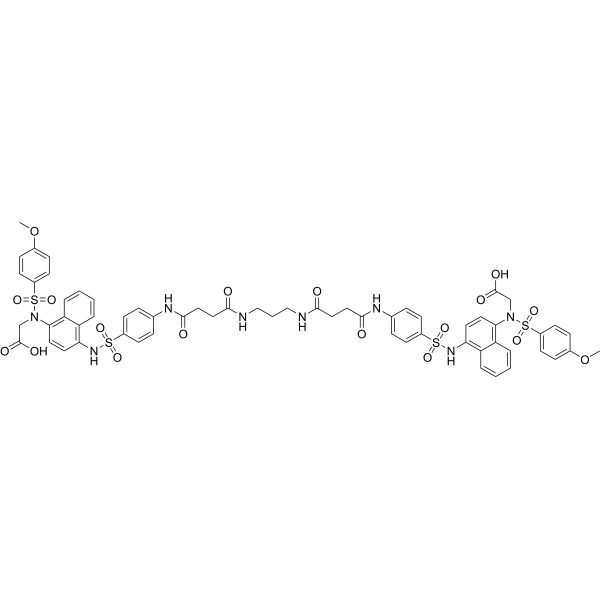
biKEAP1 (compound 3) is an inhibitor targeting the dimerKEAP1. biKEAP1 binds to cellular KEAP1 dimers and releases the NRF2 protein sequestered by KEAP1, resulting in immediate activation of NRF2. biKEAP1 also promotes nuclear translocation of NRF2 and directly inhibits proinflammatory cytokine transcription. biKEAP1 can reduce acute inflammation and reduce inflammatory damage in acute inflammation models .
loading...
    loading...
Cat. No.: HY-176508
CAS No.: 2757728-47-3
Target:  

Casein Kinase

Research Areas:  

Cancer

KDX1381 is a bivalent CK2α inhibitor (IC50: 17 nM, KD: 54 nM). KDX1381 has antitumor activity in mouse 786-O and A375 tumor xenograft models. KDX1381 combined with VEGFR inhibitors or DNA damaging agents enhances antitumor efficacy in mouse hepatocellular carcinoma and glioma models .
loading...
    loading...
Cat. No.: HY-P991708
CAS No.: 3034664-43-9
Synonyms: REGN-4336

Target:  

PSMA CD3

Research Areas:  

Cancer

Olsutamig is a bivalent humanized IgG4κ monoclonal antibody inhibitor targeting FOLH1/PSMA and CD3E. Olsutamig simultaneously binds to PSMA on the tumor cell surface and CD3E on the T cell surface, markedly activating T cells and thereby specifically killing prostate cancer cells .
loading...
    loading...
Cat. No.: HY-123626
CAS No.: 2059110-46-0
Research Areas:  

Cancer

BiBET is a chemical probe of BET/BRD4 and is able to bind to two bromodomains simultaneously in a bivalent and cis-binding mode .
loading...
    loading...
Cat. No.: HY-178980
CAS No.: 2830619-57-1
Target:  

Casein Kinase

Research Areas:  

Cancer

APL-5125 (Compound 61f) is a potent, selective and orally active ATP-competitive CK2α inhibitor with an IC50 of 0.348 nM and a Ki of 0.095 nM. APL-5125 binds to CK2α in a bivalent manner, simultaneously interacting with the ATP-binding site and the αD pocket. APL-5125 exhibits antitumor activity and can be used for the research of cancer, such as colon cancer .
loading...
    loading...
Cat. No.: HY-178235
CAS No.: 873573-64-9
Target:  

Opioid Receptor

Research Areas:  

Neurological Disease

MDAN-21 is a bivalent opioid ligand that contains both μ-opioid receptor agonists and δ-opioid receptor antagonists. MDAN-21 has a strong analgesic effect and does not produce tolerance in mouse studies. MDAN-21 can effectively inhibit the withdrawal of morphine dependent monkeys and alleviate abnormal pain in the study of rhesus monkeys. MDAN-21 can be used for the study of allodynia .
loading...
    loading...
Cat. No.: HY-169387
Target:  

AUTOTACs

Research Areas:  

Cancer

YT 6-2-PEG3-C2-NH2 is the p62/SQSTM1 targeting, autophagy-targeting ligand-linker conjugate of AUTOTAC ATC-324 (HY-169385), which is an bivalent AR (Androgen Receptor) degrader. ATC-324 can reduce nuclear AR levels and downregulate target gene expression of AR and AR-v7, and also has a degradation effect on common AR mutants in PCa .
loading...
    loading...
Cat. No.: HY-P99391A
CAS No.: 1781223-80-0
Synonyms: ABT-700 (powder)

Target:  

c-Met/HGFR Apoptosis

Research Areas:  

Cancer

Telisotuzumab (ABT-700) (powder) is a bivalent humanized IgG1 anti-c-Met monoclonal antibody. Telisotuzumab (powder) binds cellular c-Met and disrupts its productive dimerization and activation induced by HGF or by the high density of c-Met on the cell surface independent of ligand. Telisotuzumab (powder) induces apoptosis. Telisotuzumab (powder) can be used for the study of cancers harboring amplified MET, such as gastric and lung cancers .
loading...
    loading...
Cat. No.: HY-169388
CAS No.: 2409959-90-4
Target:  

AUTACs

Research Areas:  

Cancer

YT 6-2 is the p62/SQSTM1 targeting, autophagy-targeting ligand (ATL) of AUTOTAC ATC-324 (HY-169385), which is an bivalent AR (Androgen Receptor) degrader. ATC-324 can reduce nuclear AR levels and downregulate target gene expression of AR and AR-v7, and also has a degradation effect on common AR mutants in PCa .
loading...
    loading...
Cat. No.: HY-P991720
CAS No.: 2985643-31-8

Target:  

Interleukin Related

Research Areas:  

Inflammation/Immunology

Tepilukimig is a bivalent humanized IgG1κ monoclonal antibody inhibitor targeting TSLP-IL7Rα and TSLP-CRLF2. Tepilukimig inhibits the binding of TSLP to its receptors (IL7Rα and CRLF2) on the cell surface, thereby completely interrupting the inflammatory signaling pathway driven by TSLP. Tepilukimig can be used for allergic and inflammatory diseases like atopic dermatitis and asthma research .
loading...
    loading...
Cat. No.: HY-174350
Target:  

Casein Kinase SARS-CoV

Research Areas:  

Infection

CK2-IN-15 (Compound Biv5) is a selective and potent bivalent protein kinase CK2 inhibitor with an IC50 value of 51 pM. CK2-IN-15 significantly reduces the replication of SARS-CoV-2 in HEK-ACE2-TMPRSS2 and Vero cells, and also reduces viral replication in an ex vivo model of human nasal epithelial cells. CK2-IN-15 is promising for research of β-coronavirus infection-related diseases .
loading...
    loading...
Cat. No.: HY-123853
CAS No.: 2101206-81-7
Target:  

Casein Kinase

Research Areas:  

Cancer

CAM4066 is a potent CK2α inhibitor, with an IC50 value of 300 nM. CAM4066 exhibits high selectivity, with IC50 values of 22.35, 43.55, and > 50 μM for HIPK3, DAPK3, and CLK2, respectively. CAM4066 shows no cell activity. CAM4066 can be used for the development of highly potent CK2 inhibitors .
loading...
    loading...
Cat. No.: HY-B1009R
CAS No.: 150-38-9
Synonyms: EDTA trisodium salt (Standard); Trisodium EDTA (Standard)
Ethylenediaminetetraacetic acid (trisodium salt) (Standard) is the analytical standard of Ethylenediaminetetraacetic acid (trisodium salt). This product is intended for research and analytical applications. Ethylenediaminetetraacetic acid trisodium salt (EDTA trisodium salt; Trisodium EDTA) is a kind of metal chelating agent (binds to bivalent and trivalent metal cations, including calcium). Ethylenediaminetetraacetic acid trisodium salt has antibacterial, anti-inflammatory, antioxidant, anti-hypercalcemia and anticoagulant activities. Ethylenediaminetetraacetic acid trisodium salt decreases the metal ion-catalyzed oxidative damage to proteins, and allows maintenance of reducing environment during protein purification. Ethylenediaminetetraacetic acid trisodium salt can alleviate the liver fibrosis. Ethylenediaminetetraacetic acid can be used for coronary artery disease and neural system disease research .
loading...
    loading...
Cat. No.: HY-161708
CAS No.: 3075001-08-7
Target:  

PROTACs CDK FLT3

Research Areas:  

Cancer

PROTAC FLT3/CDKs degrader-1 is a PROTAC degrader targeting CDKs and FLT3. PROTAC FLT3/CDKs degrader-1 degrades CDK2, CDK4, CDK6, CDK9 and FLT3 proteins via a ubiquitin-proteasome-dependent bivalent mechanism, with a DC50 of 18.73 nM against CDK2. PROTAC FLT3/CDKs degrader-1 promotes myeloid cell differentiation. PROTAC FLT3/CDKs degrader-1 inhibits leukemia cell proliferation. PROTAC FLT3/CDKs degrader-1 can be used for the research of acute myeloid leukemia .
loading...
    loading...