151 Results for "

lung function

" in MedChemExpress (MCE) Product Catalog:
Products (151)

151 Results for "lung function" in MCE Product Catalog:

Cat. No.: HY-14299D
CAS No.: 1000160-96-2
Indacaterol acetate is an orally active ultra-long-acting β2 adrenergic receptor (ADRB2) agonist. Indacaterol acetate inhibits NF-κB activity in a β-arrestin2-dependent manner, preventing further lung damage and improving lung function in COPD (chronic obstructive pulmonary disorder). Indacaterol acetate can also be used in cardiovascular disease research .
loading...
    loading...
Cat. No.: HY-14299C
CAS No.: 1000160-97-3
Target:  

Adrenergic Receptor

Research Areas:  

Inflammation/Immunology

Indacaterol xinafoate is an orally active long-acting β2-adrenergic agonist (LABA) with bronchodilatory effect. Indacaterol inhibits NF-κB activity in a β-arrestin2-dependent manner, preventing further lung damage and improving lung function in COPD (chronic obstructive pulmonary disorder). Indacaterol xinafoate can be utilized in asthma research .
loading...
    loading...
Cat. No.: HY-W839203
CAS No.: 37070-48-7
Synonyms: 1,2-Didocosanoyl-sn-glycero-3-phosphocholine; PC(22:0/22:0)
Target:  

Endogenous Metabolite

Research Areas:  

Others

22:0 PC (1,2-Didocosanoyl-sn-glycero-3-phosphocholine), a type of phosphatidylcholine, functions as a lung surfactant and is characterized as an amphipathic molecule predominantly found in the outer leaflets of biological membrane bilayers.
loading...
    loading...
Cat. No.: HY-157796
Target:  

Adrenergic Receptor

Research Areas:  

Metabolic Disease

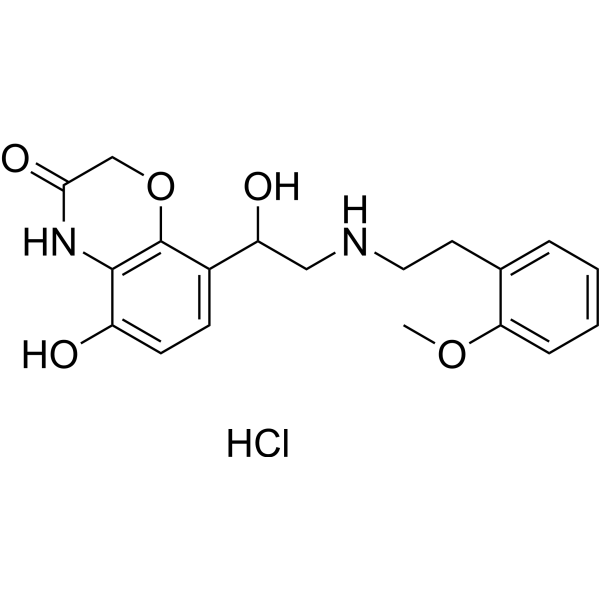
β2AR agonist 4 (compound A19) is a potent and selective β2-Adrenoceptor agonist with an EC50 of 3.7 pM. β2AR agonist 4 suppresses the inflammatory cytokines and leukocytes upregulation and improves lung function in COPD rat model .
loading...
    loading...
Cat. No.: HY-E70642
Research Areas:  

Cancer

Anaplastic lymphoma kinase (ALK) is a receptor tyrosine kinase in the insulin receptor superfamily. ALK can be used for the study of non-small cell lung carcinoma (NSCLC). ALK has multiple mutants. ALK C1156Y Recombinant Human Active Protein Kinase is a recombinant ALK C1156Y protein that can be used to study ALK C1156Y-related functions .
loading...
    loading...
Cat. No.: HY-E70644
Research Areas:  

Cancer

Anaplastic lymphoma kinase (ALK) is a receptor tyrosine kinase in the insulin receptor superfamily. ALK can be used for the study of non-small cell lung carcinoma (NSCLC). ALK has multiple mutants. ALK F1174S Recombinant Human Active Protein Kinase is a recombinant ALK F1174S protein that can be used to study ALK F1174S-related functions .
loading...
    loading...
Cat. No.: HY-E70645
Research Areas:  

Cancer

Anaplastic lymphoma kinase (ALK) is a receptor tyrosine kinase in the insulin receptor superfamily. ALK can be used for the study of non-small cell lung carcinoma (NSCLC). ALK has multiple mutants. ALK G1202R Recombinant Human Active Protein Kinase is a recombinant ALK G1202R protein that can be used to study ALK G1202R-related functions .
loading...
    loading...
Cat. No.: HY-E70646
Research Areas:  

Cancer

Anaplastic lymphoma kinase (ALK) is a receptor tyrosine kinase in the insulin receptor superfamily. ALK can be used for the study of non-small cell lung carcinoma (NSCLC). ALK has multiple mutants. ALK L1196M Recombinant Human Active Protein Kinase is a recombinant ALK L1196M protein that can be used to study ALK L1196M-related functions .
loading...
    loading...
Cat. No.: HY-E70713
Research Areas:  

Cancer

EML4-ALK is a fusion-type protein tyrosine kinase produced through gene rearrangement. EML4-ALK is a potential molecular target in non-small cell lung carcinoma (NSCLC). EML4 ALK Recombinant Human Active Protein Kinase is a recombinant EML4 ALK protein that can be used to study EML4 ALK-related functions .
loading...
    loading...
Cat. No.: HY-E70720
Target:  

FGFR

Research Areas:  

Cancer

FGFR3 activating mutations are drivers of malignancy in several human tissues, including bladder, lung, cervix, and blood. FGFR3 K650M is a mutant of FGFR3. FGFR3 K650M Recombinant Human Active Protein Kinase is a recombinant FGFR3 K650M protein that can be used to study FGFR3 K650M-related functions .
loading...
    loading...
Cat. No.: HY-173493
CAS No.: 3043840-25-8
Research Areas:  

Cancer

ALK-IN-31 (Compound Ld-10) is an orally active ALK inhibitor (IC50: 1135 nM). ALK-IN-31 exhibits excellent antiproliferative activity against lung cancer H2228 cells with an IC50 value of 1.35 μM. ALK-IN-31 induces apoptosis and arrests cell proliferation in the G0/G1 phase by affecting mitochondrial function. ALK-IN-31 exerts its anti-tumor effect by downregulating the expression of p-AKT and p-mTOR in the PI3K-AKT-mTOR signaling pathway downstream of ALK. ALK-IN-31 can be used in the study of non-small cell lung cancer (NSCLC) .
loading...
    loading...
Cat. No.: HY-165603
CAS No.: 3006860-57-4
Si5-N14 is a key component of siloxane-incorporated lipid nanoparticles (SiLNP), possessing pro-vascular repair and anti-tumor activities. In the transgenic GFP mouse model, Si5-N14 can mediate CRISPR-Cas9 editing. In the Lewis lung carcinoma (LLC) tumor-bearing mouse model, Si5-N14 can knock out the expression of Vascular Endothelial Growth Factor Receptor 2 (VEGFR2) to exert an anti-tumor effect. In a mouse model of lung injury induced by viral infection, the delivery of Fibroblast Growth Factor-2 (FGF-2) mRNA via Si5-N14 can promote vascular repair, increase blood oxygen levels, and improve lung function. Si5-N14 shows promise for research in the fields of oncology, pneumonia, and cardiovascular diseases .
loading...
    loading...
Cat. No.: HY-E70693
Research Areas:  

Cancer

Discoidin domain receptor 2 (DDR2) is a sensor for collagen and by participating in migration, proliferation, and extracellular matrix remodeling. DDR2 N456S is a DDR2 mutation that may be present in non-small cell lung cancer. DDR2 N456S Recombinant Human Active Protein Kinase is a recombinant DDR2 N456S protein that can be used to study DDR2 N456S-related functions .
loading...
    loading...
Cat. No.: HY-E70719
Target:  

FGFR

Research Areas:  

Cancer

FGFR3 activating mutations are drivers of malignancy in several human tissues, including bladder, lung, cervix, and blood. FGFR3 K650E is a mutant of FGFR3 that may be present in multiple myeloma cell lines. FGFR3 K650E Recombinant Human Active Protein Kinase is a recombinant FGFR3 K650E protein that can be used to study FGFR3 K650E-related functions .
loading...
    loading...
Cat. No.: HY-P991458

Research Areas:  

Cancer

hu3S193 is a human IgG monoclonal antibody (mAb) targeting Lewis Y. hu3S193 has excellent immune effector function (complement-dependent cytotoxicity) (IC50: 1.0 μg/ml) and antibody-dependent cellular cytotoxicity (IC50: 5.0 μg/ml). hu3S193 can be used in small cell lung cancer (SCLC) research. Recommended isotype control: Human IgG1 kappa, Isotype Control (HY-P99001) .
loading...
    loading...
Cat. No.: HY-101083A
CAS No.: 142645-19-0
Target:  

Bcl-2 Family

Research Areas:  

Cancer

(Rac)-BDA-366 (example 2) is the despinner of BDA-366 (HY-101083). BDA-366 is a potent Bcl-2 antagonist (Ki=3.3 nM), binding Bcl-2-BH4 domain with high affinity and selectivity. BDA-366 induces conformational change in Bcl-2 that abrogates its antiapoptotic function, converting it from a survival molecule to a cell death inducer. BDA-366 suppresses growth of lung cancer cells .
loading...
    loading...
Cat. No.: HY-P10226
CAS No.: 2717490-36-1
Target:  

Chloride Channel CFTR

Research Areas:  

Endocrinology

PGD97 is a selective cyclic peptide inhibitor against CAL/CFTR interactions, with a KD value of 6 nM towards the CAL PDZ domain for its desulfide cyclized form. PGD97 (desulfide cyclized form) has selectivity ≥ 130-fold compared to NHERF1/2 PDZ domains. PGD97 is capable of stabilizing F508del-CFTR at the cell membrane and improving CFTR function required for proper fluid homeostasis in tne lung. PGD97 can be used for the research of cystic fibrosis .
loading...
    loading...
Cat. No.: HY-162538
CAS No.: 3053823-69-8
Target:  

PROTACs IRAK NF-κB

Research Areas:  

Inflammation/Immunology

LC-MI-3 is an orally active IRAK4 PROTAC degrader with an IC50 of 57.2 nM and high selectivity among human protein kinases. LC-MI-3 eliminates IRAK4 kinase and scaffolding functions via the cereblon E3 ubiquitin ligase and ubiquitin-proteasome systems. LC-MI-3 inhibits downstream nuclear factor-κB and IRAK4-mediated inflammatory signaling pathways. LC-MI-3 can be used for the research of acute lung injury, sepsis, psoriasis, and inflammatory diseases .
loading...
    loading...
Cat. No.: HY-109187AR
CAS No.: 2095064-06-3
Synonyms: PTI-801 sodium (Standard)
Research Areas:  

Inflammation/Immunology

Posenacaftor sodium (Standard) is the analytical standard of Posenacaftor (sodium) (HY-109187A). This product is intended for research and analytical applications. Posenacaftor (PTI-801) sodium is a cystic fibrosis transmembrane regulator (CFTR) protein modulator that corrects the folding and trafficKing of CFTR protein. Posenacaftor sodium is used for the research of cystic fibrosis (CF) .
loading...
    loading...
Cat. No.: HY-109187BR
CAS No.: 2095064-09-6
Synonyms: (R)-PTI-801 sodium (Standard)
Research Areas:  

Inflammation/Immunology

(R)-Posenacaftor sodium (Standard) is the analytical standard of (R)-Posenacaftor (sodium) (HY-109187B). This product is intended for research and analytical applications. (R)-Posenacaftor (R)-PTI-801) sodium is the R enantiomer of Posenacaftor. Posenacaftor is a cystic fibrosis transmembrane regulator (CFTR) protein modulator that corrects the folding and trafficKing of CFTR protein. Posenacaftor is used for the research of cystic fibrosis (CF) .
loading...
    loading...

