191 Results for "

tea

" in MedChemExpress (MCE) Product Catalog:
Products (191)

191 Results for "tea" in MCE Product Catalog:

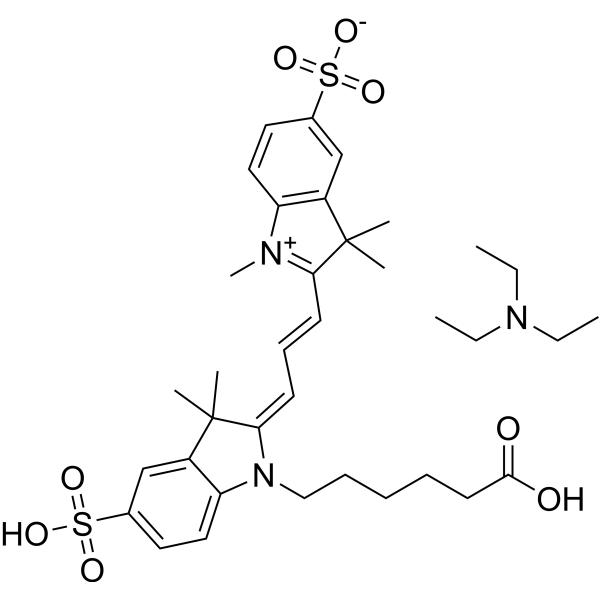
Cat. No.: HY-D1097A
Cyanine 3.18 TEA belongs to the cyanine dye series and is a common fluorescent marker for biomolecules that can interact with biomolecules. Cyanine dyes may also bind to double-helical DNA through intercalation and exhibit enhanced fluorescence upon binding .
loading...
    loading...
Cat. No.: HY-N16484
CAS No.: 55727-46-3
Trichodesmine N-oxide is the oxidized form of a pyrrolizidine alkaloid (PA) that can be isolated from the sunn hemp (Crotalaria juncea) teas. PAs are secondary metabolites in plants, which may exhibit toxicity and carcinogenicity .
loading...
    loading...
Cat. No.: HY-D1365A
Sulfo-Cy3(Me)COOH TEA is a sulfo-Cyanine3 derivative. Cyanine3 is an orange-fluorescent label dye for protein and nucleic acid (Ex=554 nm, Em=568 nm) .
loading...
    loading...
Cat. No.: HY-148840A
Research Areas:  

Others

Sulfo DBCO-PEG3-NHS ester TEA is a click chemistry reagent containing an azide group. Sulfo DBCO-PEG3-NHS ester (TEA) is an analog of DBCO-Acid with PEG linker and a DBCO group. The DBCO group is commonly used for copper-free Click Chemistry reactions due to its strain promoted high energy. The hydrophilic PEG chain and sulfo group increase water solubility. The terminal carboxylic acid can react with primary amine groups in the presence of activators (e.g. EDC, or HATU) to form a stable amide bond. Reagent grade, for research use only .
loading...
    loading...
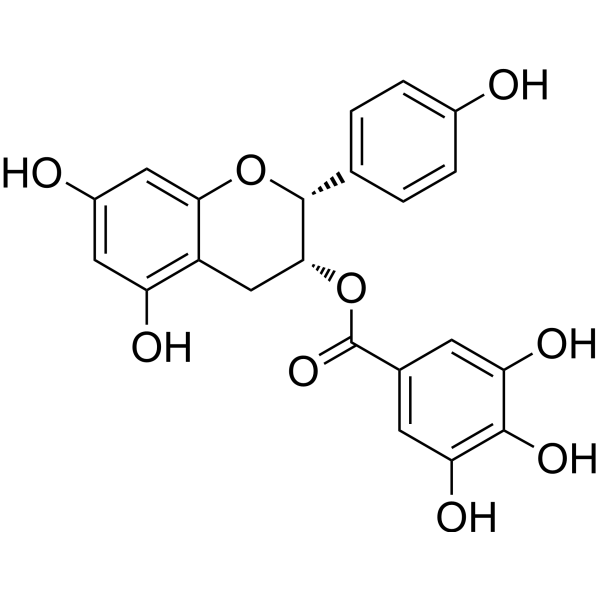
Cat. No.: HY-N8589
CAS No.: 108907-43-3
(-)-Epiafzelechin-3-O-gallate is a natural product that can be isolated from the water extract of Pu-erh tea. (-)-Epiafzelechin-3-O-gallate shows antioxidant activity .
loading...
    loading...
Cat. No.: HY-122924R
CAS No.: 17365-11-6
Synonyms: 3-Galloylquinic acid (Standard)
Theogallin (Standard) is the analytical standard of Theogallin. This product is intended for research and analytical applications. Theogallin (3-Galloylquinic acid) is an active ingredient in decaffeinated green tea extract. Theogallin has antidepressive and cognition enhancing effect .
loading...
    loading...
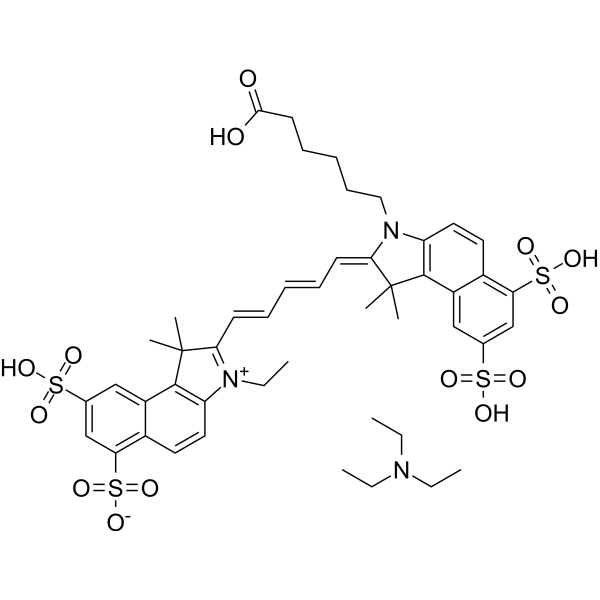
Cat. No.: HY-D0924B
Synonyms: Sulfo-Cyanine5.5 tea
Cy5.5 TEA is a CY dye. CY, short for Cyanine, is a compound consisting of two nitrogen atoms connected by an odd number of methyl units. Cyanine compounds have the characteristics of long wavelength, adjustable absorption and emission, high extinction coefficient, good water solubility and relatively simple synthesis . CY dyes are of en used for the labeling of proteins, antibodies and small molecular compounds. For the labeling of protein antibodies, the combination can be completed through a simple mixing reaction. Below, we introduce the labeling method of protein antibody labeling, which has certain reference significance .
loading...
    loading...
Cat. No.: HY-W041301R
CAS No.: 15356-74-8
(±)-Dihydroactinidiolide (Standard) is the analytical standard of (±)-Dihydroactinidiolide (HY-W041301). This product is intended for research and analytical applications. (±)-Dihydroactinidiolide is the dextrorotatory form of Dihydroactinidiolide (HY-107805). (±)-Dihydroactinidiolide has a strong, pleasant musky, tea-like and tobacco-like aroma and is mainly found in black tea, tobacco and fruits. (±)-Dihydroactinidiolide has antioxidant activity and can be derived from β-carotene.
loading...
    loading...
Cat. No.: HY-W724370
Synonyms: tea bromide-d20
Tetraethylammonium bromide-d20 (TEA bromide-d20) is the deuterium labeled Tetraethylammonium bromide (HY-W014408). Tetraethylammonium bromide is a quaternary ammonium salt consisting of a positively charged tetraethylammonium cation and a negatively charged bromide anion. This compound is commonly used as a phase transfer catalyst in organic chemical reactions, facilitating the transfer of reactants between immiscible phases. It can also be used as a reagent for the synthesis of various organic compounds, an electrolyte in electrochemical experiments, and a source of tetraethylammonium ions in biochemical and pharmacological research.
loading...
    loading...
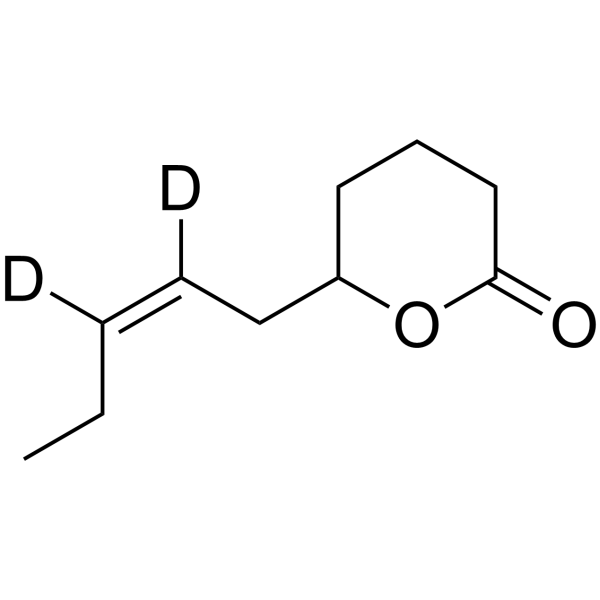
Cat. No.: HY-125678S
Jasmine lactone-d2 is deuterated labeled Jasmine lactone (HY-125678). Jasmine lactone, a volatile substance produced by plants under stress, has a strong odor and is known for its unique jasmine-like floral and fruity scent which is very popular in tea, especially in oolong and black tea. The biosynthesis mechanism of Jasmine lactone in tea is regulated by various stresses, including mechanical damage and low temperature stress. Continuous mechanical damage and low temperature and mechanical damage can enhance the accumulation of Jasmine lactone in tea .
loading...
    loading...
loading...
    loading...
loading...
    loading...
loading...
    loading...
Cat. No.: HY-159806A
CAS No.: 101609-06-7
Synonyms: 3',5'-Uridylyluridine tea
Research Areas:  

Others

3',5'-UpU TEA (3',5'-Uridylyluridine TEA) is a 3',5'-linked uridylyluridine dinucleotide. 3',5'-UpU TEA undergoes cyclization/cleavage reactions to form uridine and uridine 2',3'-cyclic phosphate, and can also isomerize into 2',5'-UpU. Under the consecutive acid-base bifunctional catalysis of imidazole buffer, 3',5'-UpU TEA undergoes cyclization/cleavage reactions via a phosphorane intermediate .
loading...
    loading...
Cat. No.: HY-N20122
Category:  

Extract

Target:  

Others

Tea seed extract is an extract of tea seed (Camellia oleifera) that has anti-tumor activity.
loading...
    loading...
Cat. No.: HY-N20188
Category:  

Extract

Target:  

Others

Oolong tea extract is a type of oolong tea extract that contains a variety of bioactive components, such as antioxidants.
loading...
    loading...
Cat. No.: HY-N20574
Category:  

Extract

Target:  

Others

White tea extract is an extract of white tea (Camellia sinensis) that has anti-inflammatory and antioxidant properties.
loading...
    loading...
Cat. No.: HY-153993A
Target:  

Bacterial

Research Areas:  

Endocrinology

Pyrocatechol sulfate TEA is a dietary phenolic metabolite and uremic toxin. Pyrocatechol sulfate TEA can be derived from diet and gut Bacterial metabolism. Plasma levels of Pyrocatechol sulfate TEA are sensitive to alcohol exposure and withdrawal, and are negatively correlated with anxiety, depression, and craving for alcohol in severe alcohol use disorder. Pyrocatechol sulfate TEA can be used in studies related to chronic kidney disease and severe alcohol use disorder .
loading...
    loading...
Cat. No.: HY-N20409
Category:  

Extract

Target:  

Others

Black tea root extract is an extract from the root of black tea (Camellia sinensis) that can be used to protect teeth.
loading...
    loading...
Cat. No.: HY-N20592
Category:  

Extract

Target:  

Bacterial

Pu-erh tea extract is an extract of Pu-erh tea that can reduce intestinal lesions, promote the growth of probiotics, and inhibit pathogenic bacteria.
loading...
    loading...

