151 Results for "

ionic

" in MedChemExpress (MCE) Product Catalog:
Products (151)

151 Results for "ionic" in MCE Product Catalog:

Cat. No.: HY-186083
CAS No.: 36167-80-3
Target:  

mAChR

Domaines de recherche:  

Cardiovascular Disease

Propylbenzilylcholine mustard (PrBCM) is an irreversible, covalently binding selective antagonist targeting rat cardiac muscarinic receptors, with a preference for muscarinic receptor subtypes that show low affinity for agonists. Propylbenzilylcholine mustard inactivates such receptors in a dose- and time-dependent manner in vitro, and its receptor selectivity remains stable across different ionic strengths and in GTP-containing buffer systems. Propylbenzilylcholine mustard can be applied to basic pharmacological studies on the structure and function of muscarinic receptors, especially focusing on the heterogeneity of cardiac muscarinic receptors and related cardiovascular pharmacological research .
loading...
    loading...
Cat. No.: HY-K3120

MCE Serum/Plasma Exosome Isolation and Purification Kit (Magnetic Beads) utilizes a magnetic bead-based method for the isolation and purification of exosomes. The underlying principle is based on the charge-dependent interaction between exosomes and functional polymers on the surface of the magnetic beads under an optimized buffer system, enabling selective adsorption of exosomes. Subsequent adjustment of the ionic strength and pH of the buffer promotes the gentle dissociation of exosomes from the magnetic beads, thereby enabling efficient exosome isolation and purification while maintaining high vesicle integrity and low impurity carryover.

loading...
    loading...
Cat. No.: HY-D1739
Domaines de recherche:  

Others

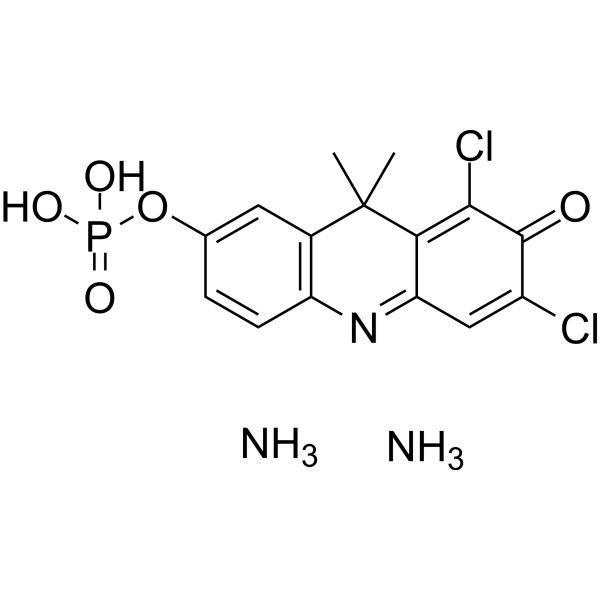
DDAO phosphate diTEA is an amphoteric surfactant derived from DDAO (dimethyldodecylamine oxide). The head group of DDAO in DDAO phosphate diTEA exists in a non-ionic state at pH > 7 and in a cationic state at pH < 5 due to protonation of the oxygen atom. When combined with the anionic surfactant SDS, DDAO can incorporate into mixed micelles, reducing the net micellar charge and attenuating electrostatic repulsion between SDS head groups. DDAO can be used to formulate the ONOO⁻-targeting probe DDAO-PN, which generates significant near-infrared fluorescence at 657 nm .
loading...
    loading...
Cat. No.: HY-148140A
CAS No.: 9041-35-4
Domaines de recherche:  

Others

Cross-linked dextran G 25, coarse is a cross-linked dextran gel chromatography coarse (average particle size D50 = 200-250 μm) that possesses multiple separation activities, including molecular sieve effects, weak anion exchange, and aromatic adsorption. Cross-linked dextran G 25, coarse weakly exchanges cations through immobilized terminal carboxyl groups and repels anions at low ionic strength. Cross-linked dextran G 25, coarse is used for the fractionation of low molecular weight solutes, including peptides, amino acids, nucleotide sugar derivatives, and aromatic compounds .
loading...
    loading...
Cat. No.: HY-148140B
CAS No.: 9041-35-4
Domaines de recherche:  

Others

Cross-linked dextran G 25, medium is a cross-linked dextran gel chromatography medium (average particle size D50 = 120-140 μm) that possesses multiple separation activities, including molecular sieve effects, weak anion exchange, and aromatic adsorption. Cross-linked dextran G 25, medium weakly exchanges cations through immobilized terminal carboxyl groups and repels anions at low ionic strength. Cross-linked dextran G 25, medium is used for the fractionation of low molecular weight solutes, including peptides, amino acids, nucleotide sugar derivatives, and aromatic compounds .
loading...
    loading...
Cat. No.: HY-148140C
CAS No.: 9041-35-4
Domaines de recherche:  

Others

Cross-linked dextran G 25, fine is a cross-linked dextran gel chromatography fine (average particle size D50 = 70-90 μm) that possesses multiple separation activities, including molecular sieve effects, weak anion exchange, and aromatic adsorption. Cross-linked dextran G 25, fine weakly exchanges cations through immobilized terminal carboxyl groups and repels anions at low ionic strength. Cross-linked dextran G 25, fine is used for the fractionation of low molecular weight solutes, including peptides, amino acids, nucleotide sugar derivatives, and aromatic compounds .
loading...
    loading...
Cat. No.: HY-W037619
CAS No.: 487-21-8
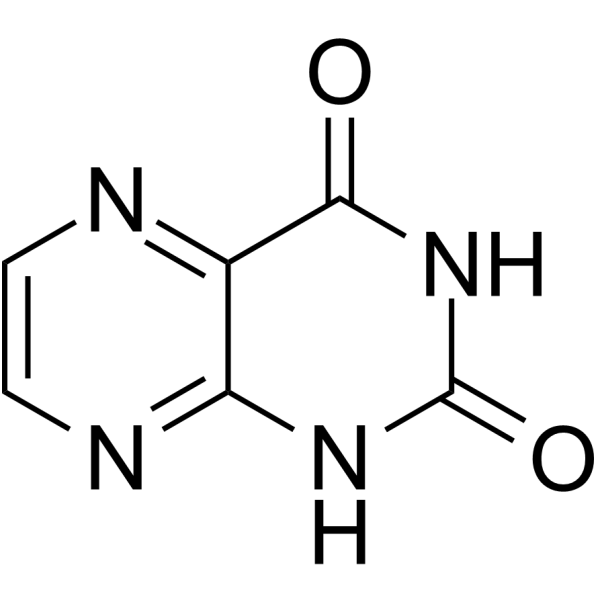
Pteridine-2,4 (1H,3H)-dione is a pteridine derivative (xanthopterin) and a sulfur-containing pteridine compound (2,4-dimercaptopyrimidine). Pteridine-2,4 (1H,3H)-dione possesses metal-binding ability, and forms closed-shell (ionic) interactions with palladium via sulfur and nitrogen atoms. Pteridine-2,4 (1H,3H)-dione derivates can be used in studies related to neuroblastoma, glioma and breast cancer .
loading...
    loading...
Cat. No.: HY-186172
CAS No.: 1689577-22-7
Domaines de recherche:  

Metabolic Disease

KS0365 is a selective TRPV3 agonist with an EC50 of 5.08 μM. KS0365 does not activate TRPV2 or TRPV4 channels. KS0365 triggers an increase in [Ca 2+]i and accelerates keratinocyte migration. KS0365 can be used in studies related to impaired skin wound healing .
loading...
    loading...
Cat. No.: HY-W399025
CAS No.: 1110883-26-5
Domaines de recherche:  

Neurological Disease

ID110460001 is a full agonist of μ-opioid receptor and an agonist of δ-opioid receptor. ID110460001 exhibits high intrinsic efficacy for G protein pathway activation of μ-opioid receptor, and this property is not affected by the reduction in receptor quantity. ID110460001 acts only as a very weak partial agonist in the β-arrestin-2 pathway of both receptors, and binds to μ-opioid receptor via a specific mode. The efficacy of ID110460001 in the G protein pathway of δ-opioid receptor is sensitive to changes in receptor quantity. ID110460001 can be used in pain-related research .
loading...
    loading...
Cat. No.: HY-D1005I
CAS No.: 9003-11-6
Poloxamer L61 is a non-ionic triblock copolymer surfactant. Poloxamer L61 effectively achieves intracellular molecular delivery to cancer cells during photoacoustic molecular delivery, and maintains cell viability by promoting cell membrane resealing, thus avoiding irreversible damage caused by laser-induced membrane permeabilization. Poloxamer L61 is a key component of SP1017, a compound related to gene therapy, which regulates the interaction between DNA and extracellular matrix as well as cellular uptake, and significantly enhances the distribution and bioavailability of plasmid DNA in skeletal muscle. Poloxamer L61 can be used in studies on local or systemic therapeutic protein production .
loading...
    loading...
Cat. No.: HY-W010361
CAS No.: 10581-12-1
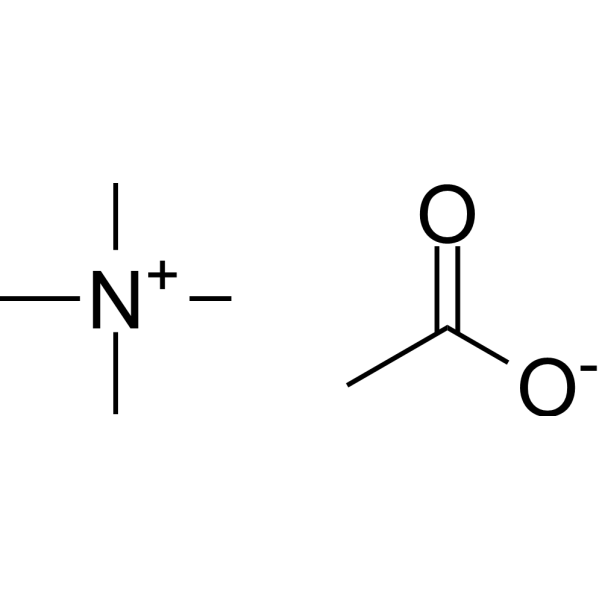
Tetramethylammonium acetate is an organic compound commonly used as a phase transfer catalyst in organic synthesis reactions, especially those involving charged species or polar reagents. It can facilitate the transfer of reactants between two immiscible phases, such as water and organic solvents, by forming stable ion pairs. Additionally, Tetramethylammonium acetate has been used to prepare a variety of organic compounds, including esters, amides, and carboxylic acids. Due to its unique physicochemical properties, it has also been investigated for its potential use in developing new materials such as ionic liquids and liquid crystals. "x" in the formula represents the number of water molecules in the crystal structure, which can vary depending on the preparation method.
loading...
    loading...
Cat. No.: HY-W016638
CAS No.: 479500-35-1
Synonyms: 1-Butyl-1-methylpyrrolidin-1-ium chloride
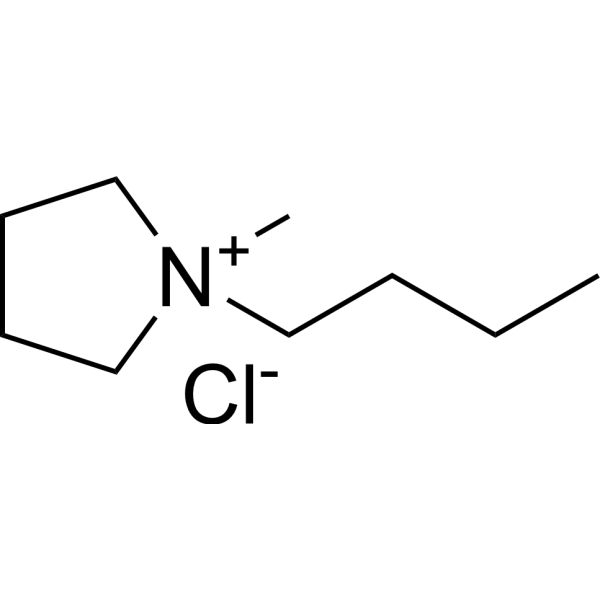
1-Butyl-1-methylpyrrolidin-1-ium chloride, also known as BMIM chloride, belongs to the class of ionic liquids and consists of a positively charged pyrrolidine cation and a negatively charged chloride anion. This compound is commonly used as a solvent for various chemical reactions, especially those involving organic compounds and metals. Its unique physical and chemical properties, such as low volatility, high thermal stability, and tunable solubility, make it useful in a range of applications in catalysis, electrochemistry, and separation science. Furthermore, 1-butyl-1-methylpyrrolidin-1-ium chloride may have potential applications as a green solvent in energy storage devices and various industrial processes.
loading...
    loading...
Cat. No.: HY-128383
CAS No.: 120-94-5
Pureté:  99.02%
Domaines de recherche:  

Others

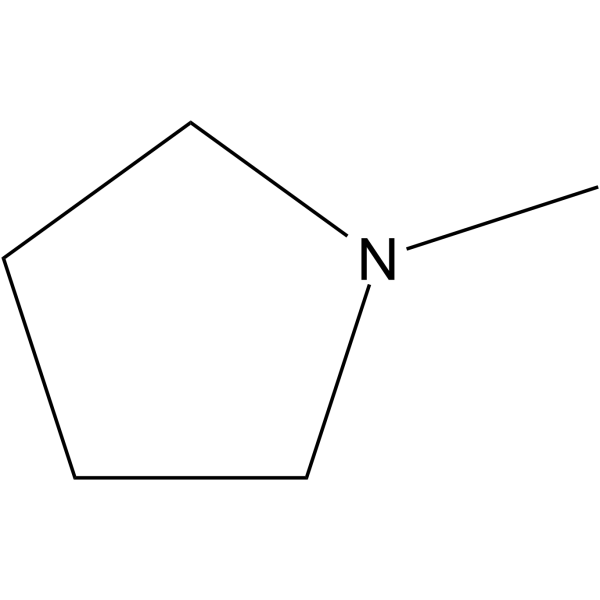
1-Methylpyrrolidine is a methylated pyrrolidine, and cation with thermal-origin negative nonlinear optical (self-defocusing) properties .
loading...
    loading...
Cat. No.: HY-128383R
CAS No.: 120-94-5
Domaines de recherche:  

Others

1-Methylpyrrolidine (Standard) is the analytical standard of 1-Methylpyrrolidine (HY-128383). This product is intended for research and analytical applications. 1-Methylpyrrolidine is a methylated pyrrolidine, and cation with thermal-origin negative nonlinear optical (self-defocusing) properties .
loading...
    loading...
Cat. No.: HY-128383S
CAS No.: 131857-29-9
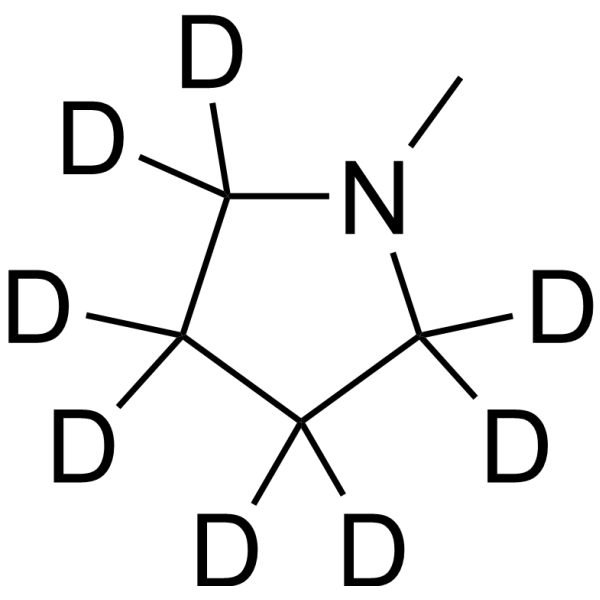
1-Methylpyrrolidine-d8 is the deuterium labeled 1-Methylpyrrolidine (HY-128383). 1-Methylpyrrolidine is a methylated pyrrolidine, and cation with thermal-origin negative nonlinear optical (self-defocusing) properties .
loading...
    loading...
Cat. No.: HY-128383S1
CAS No.: 77422-30-1
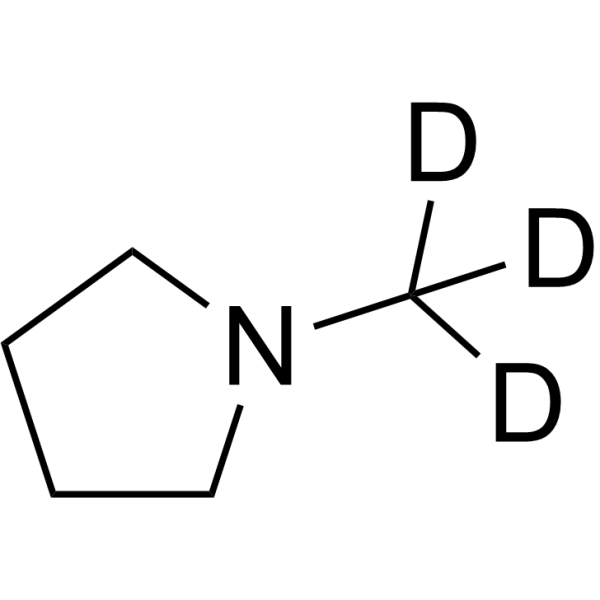
1-Methylpyrrolidine-d3 is the deuterium labeled 1-Methylpyrrolidine (HY-128383). 1-Methylpyrrolidine is a methylated pyrrolidine, and cation with thermal-origin negative nonlinear optical (self-defocusing) properties .
loading...
    loading...
Cat. No.: HY-P11457
CAS No.: 2378579-44-1
Target:  

Bacterial

Domaines de recherche:  

Infection

cCBD-LL37 is a chimeric antimicrobial peptide modified with a collagen-binding domain (cCBD) (TKKTLRT). cCBD-LL37 has improved retention on collagen after PBS washing and varying electrostatic conditions. cCBD-LL37 binds to collagen involves both specific and non-specific interactions, initiated by long-range electrostatic forces that transitions to close range or hydrophobic interactions. cCBD-LL37 has potent antimicrobial activity with improved structural stability under different ionic strengths and pH conditions (pH 5.5-8). cCBD-LL37 can be used for biomaterials like collagen-based wound dressings research .
loading...
    loading...
Cat. No.: HY-W008952
CAS No.: 81741-28-8
Domaines de recherche:  

Others

Tributyltetradecyl phosphonium chloride is a quaternary phosphonium salt cation. Tributyltetradecyl phosphonium chloride can form an acidic aqueous biphasic system with acid and water, exhibits temperature-induced phase separation behavior with a lower critical solution temperature, enables the partitioning of Co 2+, Fe 3+, Pt 4+ and Ni 2+ between the two phases, and also promotes the separation of Co 2+ and Ni 2+ .
loading...
    loading...
Cat. No.: HY-128974R
CAS No.: 69227-93-6
Synonyms: Lauryl Maltoside (Standard)
Domaines de recherche:  

Others

N-Dodecyl-β-D-maltoside (Standard) is the analytical standard of N-Dodecyl-β-D-maltoside (HY-128974). This product is intended for research and analytical applications. N-Dodecyl-β-D-maltoside (Lauryl Maltoside) is a non-ionic detergent. N-Dodecyl-β-D-maltoside has strong adsorption on alumina, titanium dioxide and hematite. N-Dodecyl-β-D-maltoside can promote the reactivation of various proteins. N-Dodecyl-β-D-maltoside can effectively stabilize photoactive reaction center complexes (RCs) and inhibit the degradation of Rhodopseudomonas spheroides R-26 reaction center in solution. N-Dodecyl-β-D-maltoside can be used for purification and stabilization of RNA polymerase and for detection of protein-lipid interactions .
loading...
    loading...
Cat. No.: HY-128974S
CAS No.: 849110-74-3
Synonyms: Lauryl Maltoside-d25
N-Dodecyl-β-D-maltoside-d25 (Lauryl Maltoside-d25) is deuterium labeled N-Dodecyl-β-D-maltoside (HY-128974). N-Dodecyl-β-D-maltoside is a non-ionic detergent. N-Dodecyl-β-D-maltoside has strong adsorption on alumina, titanium dioxide and hematite. N-Dodecyl-β-D-maltoside can promote the reactivation of various proteins. N-Dodecyl-β-D-maltoside can effectively stabilize photoactive reaction center complexes (RCs) and inhibit the degradation of Rhodopseudomonas spheroides R-26 reaction center in solution. N-Dodecyl-β-D-maltoside can be used for purification and stabilization of RNA polymerase and for detection of protein-lipid interactions .
loading...
    loading...

