6 Results for "

HL7702 liver cells

" in MedChemExpress (MCE) Product Catalog:
Products (6)

6 Results for "HL7702 liver cells" in MCE Product Catalog:

Cat. No.: HY-151257
CAS No.: 2414484-25-4
Purity:  99.05%
Target:  

Hippo (MST)

Research Areas:  

Metabolic Disease

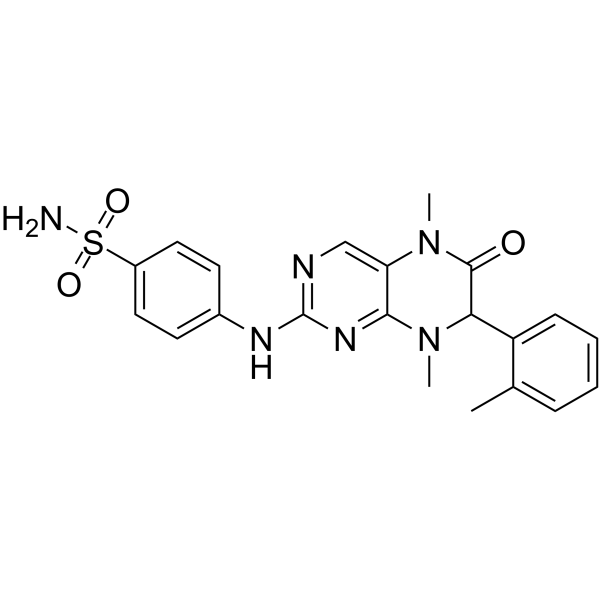
IHMT-MST1-58 is a potent, selective mammalian and orally active STE20-like protein 1 kinase (MST1) inhibitor with IC50 value of 23 nM. IHMT-MST1-58 can be used for the research of Type 1/2 diabetes .
loading...
    loading...
Cat. No.: HY-149669
CAS No.: 3053430-96-6
Purity:  99.29%
Research Areas:  

Cancer

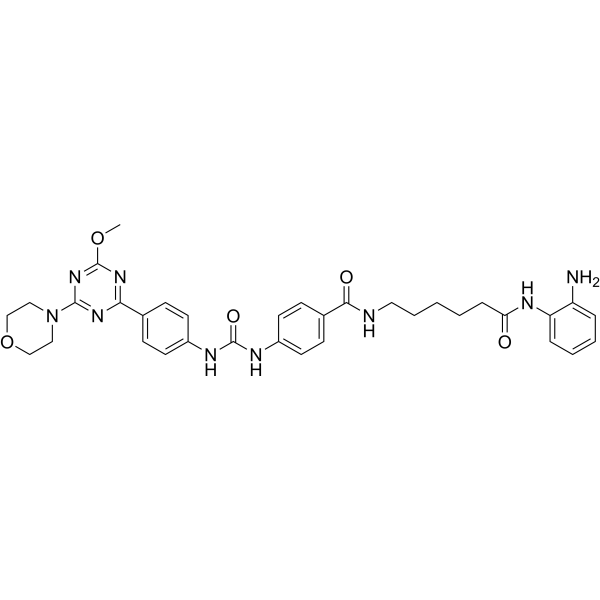
PH14 is a PI3Kα/HDAC3 inhibitor, with an IC50 value of 20.3 nM against PI3Kα and 24.5 nM against HDAC3. PH14 blocks the phosphorylation of AKT, inhibits the PI3K/AKT signaling pathway, increases the level of acetylated histone H3, promotes apoptosis, and exerts antiproliferative activity against tumor cells. PH14 can be used in the research of mantle cell lymphoma, myeloma, acute promyelocytic leukemia, and breast cancer .
loading...
    loading...
Cat. No.: HY-139140
CAS No.: 100276-03-7
Target:  

Phosphorylase

Research Areas:  

Metabolic Disease

BAY R3401 is an orally active glycogen phosphorylase inhibitor that can achieve irreversible and non-selective inhibition of hepatic glycogenolysis. BAY R3401 inhibits glycogenolysis in liver cells, with IC50 values of 27.06 and 52.83 μM in HL-7702 and HepG2 cells, respectively. BAY R3401 can be used for the research of type 2 diabetes .
loading...
    loading...
Cat. No.: HY-N17767
CAS No.: 1360075-79-1
Leonoside F is a phenylethanoid glycoside compound isolated from the aerial parts of Leonurus japonicus Houtt., which protects liver cells from chemically induced damage. At a concentration of 1×10 -5 M, Leonoside F shows significant hepatoprotective activity against D-galactosamine-induced damage in HL-7702 liver cells, with an inhibition rate of 30.9% .
loading...
    loading...
Cat. No.: HY-D3085
CAS No.: 2882924-23-2
SSR-LDs is a fluorescent probe for lipid droplet polarity detection and lipid droplet imaging. SSR-LDs exhibits polarity-dependent fluorescence: it produces intense short-wavelength emission in low-polarity environments, while generating weak long-wavelength emission in high-polarity environments. SSR-LDs enters cells via free diffusion, specifically targets lipid droplets, and is unaffected by intracellular viscosity or pH values ranging from 4.5 to 9.0. SSR-LDs shows variable Ex/Em wavelengths in different solvents, including 590/663 nm in THF, 600/660 nm in mouse tissue and in vivo imaging, and an excitation wavelength of 580 nm with an emission wavelength range of 610-750 nm in cell imaging. SSR-LDs can be used for research related to fatty liver, liver injury and hepatitis .
loading...
    loading...
Cat. No.: HY-D3084
Target:  

Fluorescent Dye

Research Areas:  

Cancer

C-TPA is a fluorescent probe used for hypochlorite detection and bioimaging of lipid droplet polarity in cancer cells. For hypochlorite detection, when its derivative C-TPA-S is exposed to hypochlorite, an oxidative desulfurization reaction converts the thiocarbonyl group of C-TPA-S to the carbonyl group of C-TPA, thus restoring bright fluorescence from the almost non-fluorescent C-TPA-S. For bioimaging of lipid droplet polarity, the intramolecular charge transfer process between its Triphenylamine (HY-W011998) donor group and Coumarin (HY-N0709) acceptor group endows C-TPA with solvatochromism-it exhibits stronger fluorescence in less polar environments (such as lipid droplets in cancer cells) and weaker fluorescence in more polar environments (such as lipid droplets in normal cells), enabling the differentiation of cancer cells and cancer tissues from normal cells and normal tissues. The excitation wavelength of C-TPA is 405 nm, and the emission wavelengths used for cell and tissue imaging cover 425-475 nm and 500-550 nm; in solvents, its emission peak shifts from 494 nm in non-polar toluene to 528 nm in polar water .
loading...
    loading...

