5 Results for "

MCF10A mammary epithelial cells

" in MedChemExpress (MCE) Product Catalog:
Products (5)

5 Results for "MCF10A mammary epithelial cells" in MCE Product Catalog:

1
1 Cited Publications
Cat. No.: HY-159059
Purity:  41.20%
Ganoderma Lucidum/Reishi Extract is a Ganoderma lucidum extract. Ganoderma Lucidum/Reishi Extract reduces the expression of c-Myc, BCL-2, BCL-XL, TERT, PDGFB, eIF4G, Survivin, β-catenin, and eIF4E. Ganoderma Lucidum/Reishi Extract downregulates the gene expression of MMP-9. Ganoderma Lucidum/Reishi Extract upregulates the expression of IL8. Ganoderma Lucidum/Reishi Extract is applicable to the research of inflammatory breast cancer. Ganoderma Lucidum is used in the research of various diseases, such as allergy, arthritis, hypertension, neurasthenia, inflammation, and cancer .
loading...
    loading...
1
1 Cited Publications
Cat. No.: HY-N7435
CAS No.: 54814-64-1
Synonyms: (±)-Massoia lactone
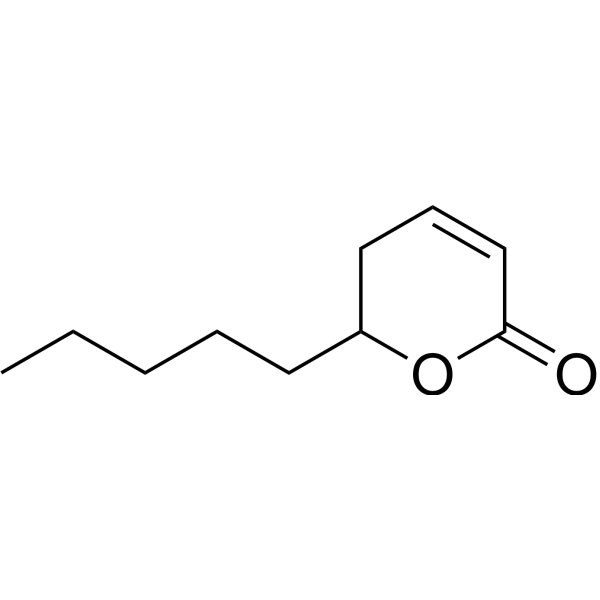
Massoia lactone ((±)-Massoia lactone) is a natural lactone-based biosurfactant with antifungal (fungal), antibiofilm, and cytotoxic activities. Massoia lactone inhibits fungal hyphal growth and spore germination, and induces fungal cell necrosis by forming membrane pores, reducing ergosterol, elevating ROS, and causing leakage of intracellular components. Massoia lactone inhibits the viability and proliferation of tumor cells. Massoia lactone degrades the extracellular polymeric substances of polymicrobial biofilms, penetrates the biofilm matrix, inhibits the growth of planktonic oral bacteria (bacterial), and reduces surface tension through its amphiphilic properties. Massoia lactone is a low-toxicity, biodegradable food additive with a coconut cream aroma, which can be used for flavor improvement and also serves as a quality control marker for Cs-4 mycelium. Massoia lactone can be used for research on Fusarium head blight, malignant tumors, and oral polymicrobial biofilm-associated dental diseases .
loading...
    loading...
Cat. No.: HY-145269
CAS No.: 2761538-66-1
Target:  

Cadherin

Research Areas:  

Cancer

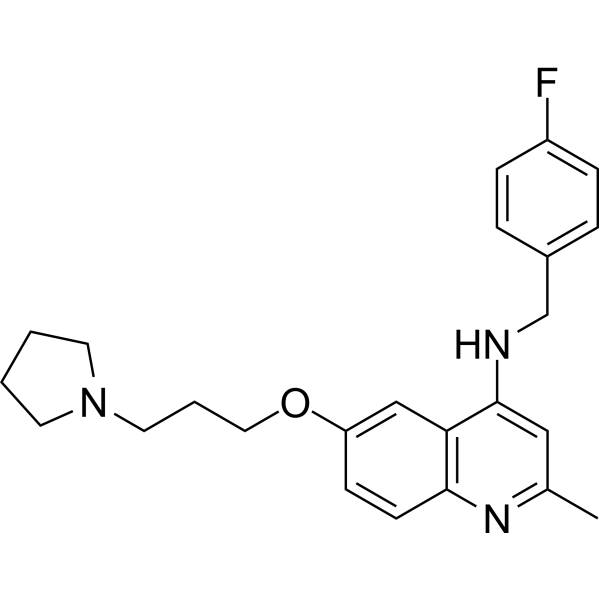
AL-GDa62 is a derivative of the CDH1/E-cadherin modulator SLEC-11 (HY-145268) and induces apoptosis in CDH1 -/- cells. AL-GDa62 has an EC50 of 3.2 μM and 2 μM for isogenic mammary epithelial cells MCF10A-WT (wild type) and mutant MCF10A-CDH1 -/-, respectively. AL-GDa62 specifically inhibits TCOF1, ARPC5, and UBC9, and suppresses SUMOylation at low micromolar concentrations .
loading...
    loading...
Cat. No.: HY-183294
CAS No.: 2834106-56-6
GPX4-IN-24 is an orally active glutathione peroxidase 4 (GPX4) inhibitor with a human IC50 of 10.90 μM, human Kd of 10.04 μM. GPX4-IN-24 suppresses GPX4 enzymatic activity, disrupts redox homeostasis, drives lipid peroxidation, promotes lipid peroxidation, and induces ferroptosis. GPX4-IN-24 can be used for the research of triple-negative breast cancer .
loading...
    loading...
Cat. No.: HY-N7435R
CAS No.: 54814-64-1
Synonyms: (±)-Massoia lactone (Standard)
Massoia lactone (Standard) ((±)-Massoia lactone (Standard)) is the analytical standard of Massoia lactone (HY-N7435). This product is intended for research and analytical applications. Massoia lactone ((±)-Massoia lactone) is a natural lactone-based biosurfactant with antifungal (fungal), antibiofilm, and cytotoxic activities. Massoia lactone inhibits fungal hyphal growth and spore germination, and induces fungal cell necrosis by forming membrane pores, reducing ergosterol, elevating ROS, and causing leakage of intracellular components. Massoia lactone inhibits the viability and proliferation of tumor cells. Massoia lactone degrades the extracellular polymeric substances of polymicrobial biofilms, penetrates the biofilm matrix, inhibits the growth of planktonic oral bacteria (bacterial), and reduces surface tension through its amphiphilic properties. Massoia lactone is a low-toxicity, biodegradable food additive with a coconut cream aroma, which can be used for flavor improvement and also serves as a quality control marker for Cs-4 mycelium. Massoia lactone can be used for research on Fusarium head blight, malignant tumors, and oral polymicrobial biofilm-associated dental diseases .
loading...
    loading...

