1. Search Result
Search Result
Results for "

Proteus vulgaris

" in MedChemExpress (MCE) Product Catalog:

14

阻害剤およびアゴニスト

1

生化学アッセイ試薬

5

天然物

製品番号 製品名 Target 研究分野 構造式
  • HY-B1128A

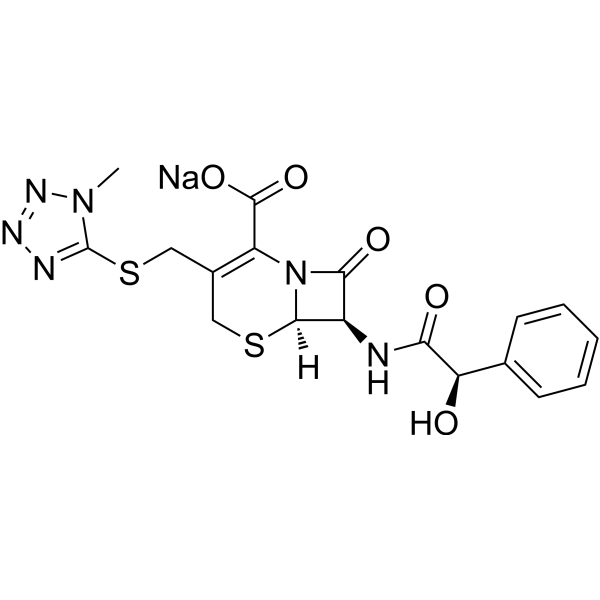
    Cephamandole sodium

    Antibiotic Bacterial Infection
    Cefamandole (Cephamandole) sodium is a semi-synthetic second-generation cephalosporin antibiotic with broad-spectrum antimicrobial activity. Cefamandole sodium is resistant to hydrolysis by β-lactamases produced by some Gram-negative bacteria. Cefamandole sodium kills Gram-positive cocci and various Gram-negative bacilli mainly by inhibiting cell wall synthesis, but it is inactive against Pseudomonas, Proteus vulgaris and Providencia stuartii, and its efficacy is affected by inoculum size. The plasma elimination half-life of Cefamandole sodium in rats is only 0.4 h, it is mainly excreted in urine in biologically active form, and it hardly penetrates the non-inflamed blood-brain barrier. Cefamandole sodium is widely used in studies related to bacterial infections .
    Cefamandole sodium
  • HY-B1128

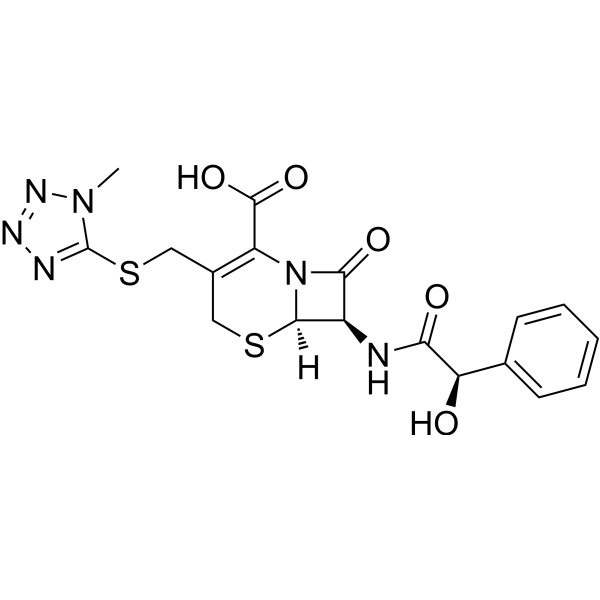
    Cephamandole

    Antibiotic Bacterial Infection
    Cefamandole (Cephamandole) is a semi-synthetic second-generation cephalosporin antibiotic with broad-spectrum antimicrobial activity. Cefamandole is resistant to hydrolysis by β-lactamases produced by some Gram-negative bacteria. Cefamandole kills Gram-positive cocci and various Gram-negative bacilli mainly by inhibiting cell wall synthesis, but it is inactive against Pseudomonas, Proteus vulgaris and Providencia stuartii, and its efficacy is affected by inoculum size. The plasma elimination half-life of Cefamandole in rats is only 0.4 h, it is mainly excreted in urine in biologically active form, and it hardly penetrates the non-inflamed blood-brain barrier. Cefamandole is widely used in studies related to bacterial infections .
    Cefamandole
  • HY-D1056B1

    LPS, from bacterial (Proteus vulgaris)

    Toll-like Receptor (TLR) Inflammation/Immunology
    Lipopolysaccharides, from Proteus vulgaris are lipopolysaccharide endotoxins and TLR-4 activators derived from Proteus vulgaris, classified as S-type LPS, which can activate pathogen-associated molecular patterns (PAMP) of the immune system and induce cellular secretion of migrasomes. Lipopolysaccharides, from Proteus vulgaris exhibit a typical three-part structure: O-antigen, core oligosaccharide, and lipid A. Lipopolysaccharides, from Proteus vulgaris possess a unique molecular structure and chitosan affinity (Kb=2.72 μM), surpassing that of Yersinia pseudotuberculosis (Kb=6.06 μM) and Escherichia coli (Kb=79.50 μM) .
    It is recommended to prepare a solution with concentration ≥2 mg/mL. Vortex thoroughly for more than 10 minutes. Due to the adsorption characteristics of LPS, silanized container or low adsorption centrifuge tubes should be used for aliquoting and storage, and mix thoroughly before use.
    Lipopolysaccharides, from Proteus vulgaris
  • HY-130596

    Antibiotic Bacterial Infection Cancer
    DC-86-M is an antibiotic, which can be isolated from Streptomyces luteogriseus. DC-86-M exhibits antibacterial activities against Bacillus subtilis, Staphylococcus aureus, Enterococcus faecalis, Vibrio anguillarum, and Proteus vulgaris, with MIC <1 μg/mL. DC-86-M exhibits antitumor activity against mouse sarcoma 180 with LD50 of 25 mg/kg .
    DC-86-M
  • HY-113795

    Antibiotic Bacterial Infection
    Aldgamycin E is a neutral macrolide antibiotic that can be derived from culture filtrates of Streptomyces lavendulae. Aldgamycin E has antibacterial activity .
    Aldgamycin E
  • HY-B1128B

    Cephamandole lithium

    Antibiotic Bacterial Infection
    Cefamandole (Cephamandole) lithium is a semi-synthetic second-generation cephalosporin antibiotic with broad-spectrum antimicrobial activity. Cefamandole lithium is resistant to hydrolysis by β-lactamases produced by some Gram-negative bacteria. Cefamandole lithium kills Gram-positive cocci and various Gram-negative bacilli mainly by inhibiting cell wall synthesis, but it is inactive against Pseudomonas, Proteus vulgaris and Providencia stuartii, and its efficacy is affected by inoculum size. The plasma elimination half-life of Cefamandole lithium in rats is only 0.4 h, it is mainly excreted in urine in biologically active form, and it hardly penetrates the non-inflamed blood-brain barrier. Cefamandole lithium is widely used in studies related to bacterial infections .
    Cefamandole lithium
  • HY-147805

    SARS-CoV Bacterial Fungal Infection
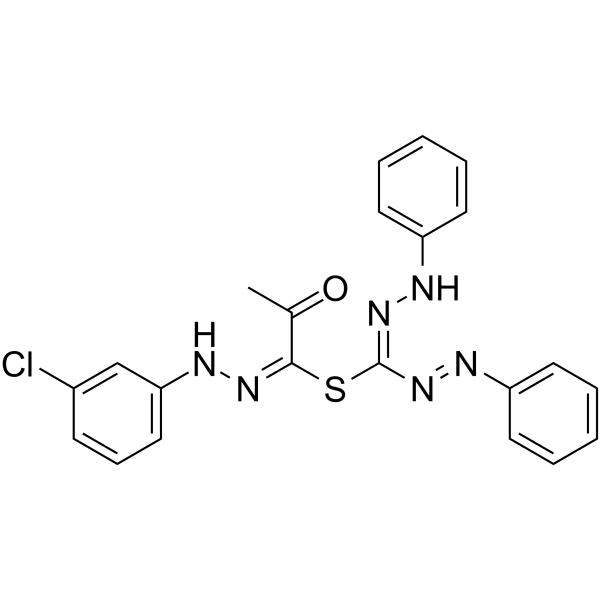
    SARS-CoV-2 3CLpro-IN-4 (Compound 5g) is a SARS CoV-2 3CLpro inhibitor with antiviral, antibacterial and antifungal activities .
    SARS-CoV-2 3CLpro-IN-4
  • HY-B1128AR

    Cephamandole sodium (Standard)

    Reference Standards Antibiotic Bacterial Infection
    Cefamandole (sodium) (Standard) is the analytical standard of Cefamandole (sodium). This product is intended for research and analytical applications. Cefamandole (Cephamandole) sodium is a semi-synthetic second-generation cephalosporin antibiotic with broad-spectrum antimicrobial activity. Cefamandole sodium is resistant to hydrolysis by β-lactamases produced by some Gram-negative bacteria. Cefamandole sodium kills Gram-positive cocci and various Gram-negative bacilli mainly by inhibiting cell wall synthesis, but it is inactive against Pseudomonas, Proteus vulgaris and Providencia stuartii, and its efficacy is affected by inoculum size. The plasma elimination half-life of Cefamandole sodium in rats is only 0.4 h, it is mainly excreted in urine in biologically active form, and it hardly penetrates the non-inflamed blood-brain barrier. Cefamandole sodium is widely used in studies related to bacterial infections .
    Cefamandole sodium (Standard)
  • HY-106304

    Bacterial Drug Derivative Infection
    ME-1228 is an antibacterial agent and sulfur-containing analogue of OCP 9-176. ME 1228 is generally twofold more active than OCP 9-176 against Escherichia coli, Klebsiella pneumoniae, Klebsiella oxytoca, Providencia stuartii, Proteus vulgaris, and Serratia marcescens. ME-1228 has antibacterial activity against E. coli UB 1005, P. aeruginosa K779K, and P. aeruginosa E4, with MICs of 0.25, 0.25, and 1 μg/mL, respectively .
    ME-1228
  • HY-183176

    Bacterial Fungal Infection
    Laurolinium acetate is a cationic antimicrobial agent. Laurolinium acetate exerts activity against Gram-positive and Gram-negative bacteria, and fungi. Laurolinium acetate can be used for the research of microbial infection .
    Laurolinium acetate
  • HY-119555

    Bacterial Infection
    Nifurpipone is an orally active broad-spectrum antimicrobial agent. Nifurpipone acts against Gram-positive and Gram-negative bacteria, and reduces bacterial loads in systemic, intramuscular and urinary tract infections in mouse models. Nifurpipone can be used in studies related to bacterial infections .
    Nifurpipone
  • HY-W012346

    Drug Derivative Bacterial Infection
    Geranyl isobutyrate is a synthetic α,β‑unsaturated branched‑chain aliphatic ester and a geraniol derivative. Geranyl isobutyrate acts as a food and feed flavouring agent and a biologically active antimicrobial compound. Geranyl isobutyrate shows antimicrobial activity against Gram‑positive and most Gram‑negative bacteria .
    Geranyl isobutyrate
  • HY-N13274

    Lacceroic acid

    Bacterial Infection
    Dotriacontanoic acid (Lacceroic acid) is a fatty acid found in Limnophila polystachya Benth. Dotriacontanoic acid exhibits anti-bacterial activity against multiple gram-negative bacteria .
    Dotriacontanoic acid
  • HY-N10342

    Apoptosis Bcl-2 Family Caspase PARP Reactive Oxygen Species (ROS) Bacterial PI3K Akt NF-κB P-glycoprotein Infection Cancer
    Cajanol is an isoflavanone that can be isolated from the roots of Cajanus cajan (L.) Millsp. . Cajanol inhibits cancer cell proliferation and induces cancer cell apoptosis. Cajanol promotes the expression of Bax, inhibits the expression of Bcl-2, activates caspase-9 and caspase-3, induces PARP cleavage, arrests the cell cycle at the G2/M phase, generates ROS, disrupts mitochondrial membrane potential and triggers cytochrome c release. Cajanol induces bacterial DNA damage, disrupts bacterial cell membranes, and exerts antibacterial activity in vitro. Cajanol reduces the expression of PI3K, inhibits the phosphorylation of Akt and NF-κB, downregulates the expression and transport function of P-gp, restores the sensitivity of drug-resistant cancer cells to Paclitaxel, and inhibits the growth of Paclitaxel-resistant metastatic ovarian tumors. Cajanol is applicable to research related to breast cancer, ovarian cancer and bacterial infections .
    Cajanol

オンラインお問い合わせ

入力情報は安全に管理されます. 必須入力項目.

タイトル


国或いは地域 *

お名前 *


組纖名 *

デパートメント *


メールアドレス *


製品名 *

製品番号


カスタマ需要量 *

電話番号 *


必ず会社名を記載ください。個人への返信は行いません。

備考

バルクお問い合わせ

Inquiry Information

製品名:
製品番号:
数量:
MCE 日本正規代理店:

