




1. Search Result
Search Result
Results for "

Pulsatilla chinensis

" in MedChemExpress (MCE) Product Catalog:

9

Inhibitors & Agonists

9

Natural
Products

Cat. No. Product Name Target Research Areas Chemical Structure
  • HY-N0834
    Pulsatilla saponin D
    1 Publications Verification

    SB365; Hederacolchiside A

    Apoptosis Cancer
    Pulsatilla saponin D (SB365), isolated from the root of Pulsatilla chinensis, is an anti-tumor agent .
    Pulsatilla saponin D
  • HY-N6950
    Hederacolchiside A1
    1 Publications Verification

    PI3K Akt mTOR Parasite Apoptosis Infection Cancer
    Hederacolchiside A1, isolated from Pulsatilla chinensis, suppresses proliferation of tumor cells by inducing apoptosis through modulating PI3K/Akt/mTOR signaling pathway . Hederacolchiside A1 has antischistosomal activity, affecting parasite viability both in vivo and in vitro .
    Hederacolchiside A1
  • HY-N0204

    Anemoside A3

    NF-κB p38 MAPK Cardiovascular Disease Neurological Disease Inflammation/Immunology Cancer
    Pulchinenoside A (Anemoside A3) is an orally active triterpenoid glycoside found in the root of Pulsatilla chinensis. Pulchinenoside A has amti-inflammation, antitumor, antidepressant, immunoregulatory and neuroprotective efrects. Pulchinenoside A activates NF-κB/MAPK signaling pathway. Pulchinenoside A can induce relaxing effect in rat renal arteries. Pulchinenoside A can be used for the researches of experimental autoimmune encephalomyelitis, breast cancer, depression and renovascular hypertension .
    Pulchinenoside A
  • HY-N0566

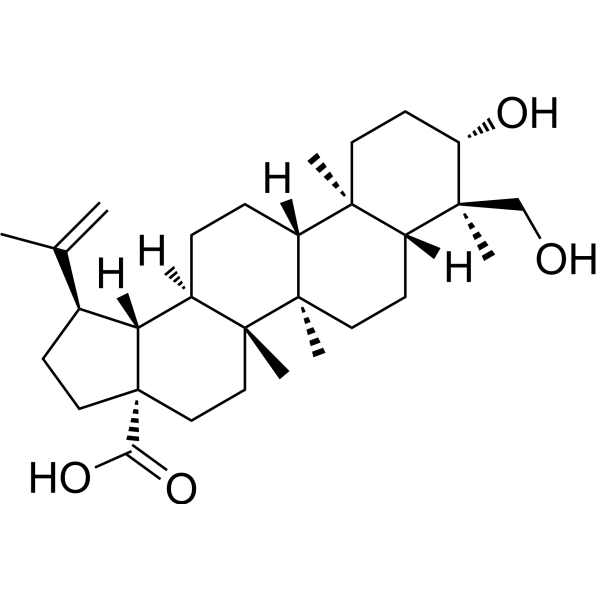
    Anemosapogenin

    Apoptosis Autophagy Bcl-2 Family Caspase Survivin p38 MAPK MMP Cancer
    23-Hydroxybetulinic acid (Anemosapogenin) is an orally active triterpenoid with broad-spectrum anticancer activity. 23-Hydroxybetulinic acid reduces the levels of Bcl-2 and survivin, elevates the level of Bax, promotes the cleavage/activation of caspase-3 and caspase-9, and induces apoptosis via the endogenous mitochondrial pathway involving cytochrome C release and mitochondrial membrane potential disruption. 23-Hydroxybetulinic acid arrests the cell cycle at S and G1 phases, inhibits cancer cell proliferation, blocks the MAPK signaling pathway, regulates MMP2, and induces autophagic apoptosis by upregulating beclin-1. 23-Hydroxybetulinic acid inhibits the activity and efflux function of P-gp, increases the intracellular accumulation of chemotherapeutic drugs, and synergistically enhances cytotoxicity with Doxorubicin (HY-15142). 23-Hydroxybetulinic acid inhibits the phosphorylation and nuclear translocation of STAT6, blocks M2 macrophage polarization, and reduces M2 macrophage-mediated apoptosis resistance of colon cancer cells. 23-Hydroxybetulinic acid can be used in related studies on chronic myeloid leukemia, hepatocellular carcinoma, sarcoma 180, multidrug-resistant breast cancer, leukemia, Doxorubicin-induced cardiotoxicity, and colorectal cancer .
    23-Hydroxybetulinic acid
  • HY-N6950R

    Reference Standards PI3K Akt mTOR Parasite Apoptosis Infection Cancer
    Hederacolchiside A1 (Standard) is the analytical standard of Hederacolchiside A1. This product is intended for research and analytical applications. Hederacolchiside A1, isolated from Pulsatilla chinensis, suppresses proliferation of tumor cells by inducing apoptosis through modulating PI3K/Akt/mTOR signaling pathway . Hederacolchiside A1 has antischistosomal activity, affecting parasite viability both in vivo and in vitro .
    Hederacolchiside A1 (Standard)
  • HY-107314

    Apoptosis Others
    Pulchinenoside B is a triterpenoid saponin isolated from Pulsatilla chinensis .
    Pulchinenoside B
  • HY-125702

    Chinensioside B

    Others Others
    Pulsatilloside E (Chinensioside B) is a triterpenoidal saponin isolated from the roots of Pulsatilla chinensis (Ranunculaceae) .
    Pulsatilloside E
  • HY-N7967

    Others Others
    Pulchinenoside E is a saponin found in the roots of Pulsatilla chinensis (Bunge) Regel .
    Pulchinenoside E
  • HY-N17904

    Others Cancer
    Pulsatilloside D is a triterpene glycoside. Pulsatilloside D induces cytotoxicity in cancer cells. Pulsatilloside D can be used for the research of leukemia and cervical cancer .
    Pulsatilloside D

Inquiry Online

Your information is safe with us. * Required Fields.

Salutation


Country or Region *

Applicant Name *


Organization Name *

Department *


Email Address *


Product Name *

Cat. No.


Requested quantity *

Phone Number *


Remarks

Inquiry Online

Inquiry Information

Product Name:
Cat. No.:
Quantity:
MCE Japan Authorized Agent:

