16 Results for "

amino sugar formation

" in MedChemExpress (MCE) Product Catalog:
Products (16)

16 Results for "amino sugar formation" in MCE Product Catalog:

Cat. No.: HY-Y0079
CAS No.: 673-06-3
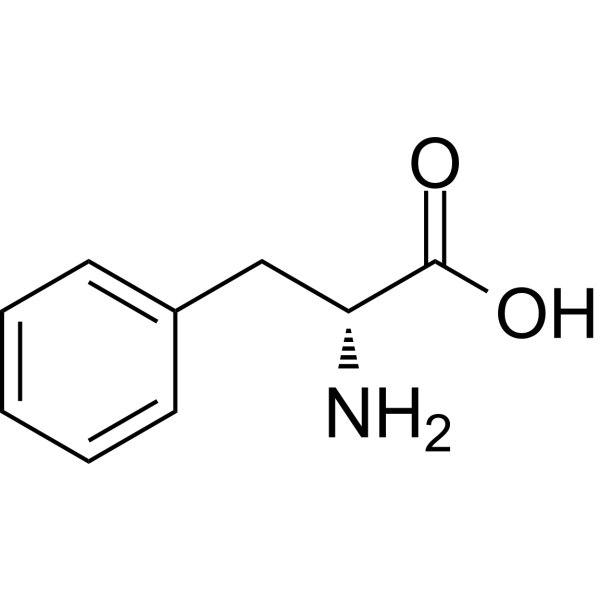
D-Phenylalanine is an atypical D-amino acid and an inhibitor of bacterial biofilm formation. D-Phenylalanine mainly replaces D-alanine (D-Ala) by incorporating into the fourth and fifth positions of bacterial peptidoglycan (PG), changing the cell wall structure, enhancing bacterial acid resistance and affecting biofilm formation. D-Phenylalanine may promote the secretion of peptide tyrosine tyrosine (PYY) in mammals by activating the intestinal GPR109B receptor. D-Phenylalanine can inhibit the maturation of microbial biofilms and promote the release of specific hormones. It can be used for antibacterial preservation, improving the yield of probiotics in the food industry, and studying appetite regulation and blood sugar control in metabolic diseases such as diabetes .
loading...
    loading...
Cat. No.: HY-130480
CAS No.: 25020-14-8
Target:  

AIM2

Research Areas:  

Inflammation/Immunology

Fructose-arginine, an amino-sugar, is an AIM2 inflammasome activation inhibitor. Fructose-arginine attenuates the secretion of IL-1β, IL-18, and caspase-1, and Asc pyroptosome formation and Gsdmd cleavage resulting from AIM2 inflammasome activation .
loading...
    loading...
Cat. No.: HY-N8365
CAS No.: 91183-87-8
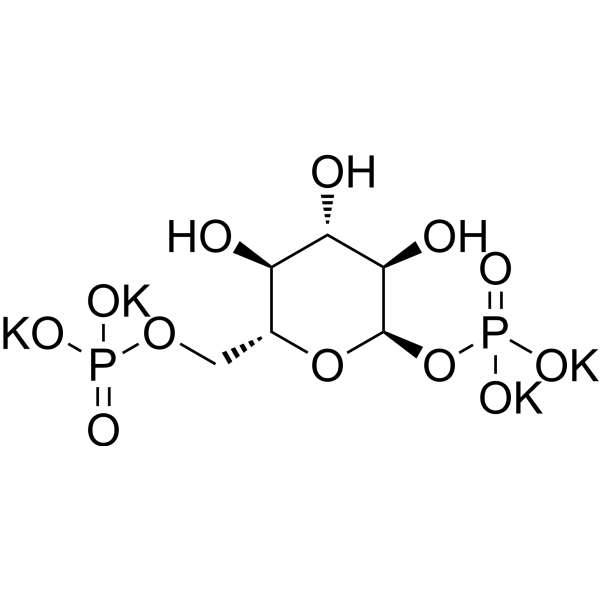
α-D-Glucose 1,6-bisphosphate tetrapotassium is an activator of PMM2 and phosphoglucomutase. α-D-Glucose 1,6-bisphosphate tetrapotassium regulates glycogen metabolism, glycolysis, amino sugar synthesis, as well as the formation of bacterial cell walls and capsules. α-D-Glucose 1,6-bisphosphate tetrapotassium can be used in studies related to pmm2-cdg (cdg-1a or Jaeken syndrome) .
loading...
    loading...
Cat. No.: HY-W013165
CAS No.: 10034-20-5
1,3,4,6-Tetra-O-acetyl-2-amino-2-desoxy-β-D-glucopyranose (hydrochloride) is a class of biochemical reagents used in glycobiology research. Glycobiology studies the structure, synthesis, biology, and evolution of sugars. It involves carbohydrate chemistry, enzymology of glycan formation and degradation, protein-glycan recognition, and the role of glycans in biological systems. This field is closely related to basic research, biomedicine, and biotechnology .
loading...
    loading...
Cat. No.: HY-113002
CAS No.: 10139-18-1
α-D-Glucose 1,6-bisphosphate is an activator of PMM2 and phosphoglucomutase. α-D-Glucose 1,6-bisphosphate regulates glycogen metabolism, glycolysis, amino sugar synthesis, as well as the formation of bacterial cell walls and capsules. α-D-Glucose 1,6-bisphosphate can be used in studies related to pmm2-cdg (cdg-1a or Jaeken syndrome) .
loading...
    loading...
Cat. No.: HY-113002A
CAS No.: 71662-13-0
α-D-Glucose 1,6-bisphosphate cyclohexanamine is an activator of PMM2 and phosphoglucomutase. α-D-Glucose 1,6-bisphosphate cyclohexanamine regulates glycogen metabolism, glycolysis, amino sugar synthesis, as well as the formation of bacterial cell walls and capsules. α-D-Glucose 1,6-bisphosphate cyclohexanamine can be used in studies related to pmm2-cdg (cdg-1a or Jaeken syndrome) .
loading...
    loading...
Cat. No.: HY-W156438
CAS No.: 172838-30-1
α-D-Mannopyranoside,phenylmethyl 3-amino-3-deoxy (hydrochloride) is a class of biochemical reagents used in glycobiology research. Glycobiology studies the structure, synthesis, biology, and evolution of sugars. It involves carbohydrate chemistry, enzymology of glycan formation and degradation, protein-glycan recognition, and the role of glycans in biological systems. This field is closely related to basic research, biomedicine, and biotechnology .
loading...
    loading...
Cat. No.: HY-W777089
CAS No.: 91364-19-1
Benzyl 5-amino-5-deoxy-2,3-O-isopropyl-α-D-mannofuranoside is a class of biochemical reagents used in glycobiology research. Glycobiology studies the structure, synthesis, biology, and evolution of sugars. It involves carbohydrate chemistry, enzymology of glycan formation and degradation, protein-glycan recognition, and the role of glycans in biological systems. This field is closely related to basic research, biomedicine, and biotechnology .
loading...
    loading...
Cat. No.: HY-W415813
CAS No.: 38822-56-9
6-Amino-N-β-D-galactopyranosylhexanamide is a class of biochemical reagents used in glycobiology research. Glycobiology studies the structure, synthesis, biology, and evolution of sugars. It involves carbohydrate chemistry, enzymology of glycan formation and degradation, protein-glycan recognition, and the role of glycans in biological systems. This field is closely related to basic research, biomedicine, and biotechnology .
loading...
    loading...
Cat. No.: HY-W332361
CAS No.: 1272755-07-3
Synonyms: 4-MOP
4-Methoxyphenyl 2-Amino-3, 6-di-o-benzyl-2-deoxy-β-d-Glucopyranoside (4-MOP) is a class of biochemical reagents used for glycobiology research. Glycobiology studies the structure, synthesis, biology, and evolution of sugars. It deals with carbohydrate chemistry, glycan formation and degradation enzymology, protein-glycan recognition, and the role of glycans in biological systems. The field is closely related to basic research, biomedicine and biotechnology .
loading...
    loading...
Cat. No.: HY-W777090
CAS No.: 91364-15-7
Benzyl 5-amino-5-deoxy-2,3-O-isopropylidene-6-O-trityl-α-D-mannofuranoside is a class of biochemical reagents used in glycobiology research. Glycobiology studies the structure, synthesis, biology, and evolution of sugars. It involves carbohydrate chemistry, enzymology of glycan formation and degradation, protein-glycan recognition, and the role of glycans in biological systems. This field is closely related to basic research, biomedicine, and biotechnology .
loading...
    loading...
Cat. No.: HY-W353980
CAS No.: 35978-97-3
6-Amino-N-(6-deoxy-β-L-galactopyranosyl)hexanamide is a class of biochemical reagents used in glycobiology research. Glycobiology studies the structure, synthesis, biology, and evolution of sugars. It involves carbohydrate chemistry, enzymology of glycan formation and degradation, protein-glycan recognition, and the role of glycans in biological systems. This field is closely related to basic research, biomedicine, and biotechnology .
loading...
    loading...
Cat. No.: HY-W354410
CAS No.: 51471-40-0
2-Deoxy-2-[[(4-methoxyphenyl)methylene]amino]-β-D-glucopyranose is a class of biochemical reagents used in glycobiology research. Glycobiology studies the structure, synthesis, biology, and evolution of sugars. It involves carbohydrate chemistry, enzymology of glycan formation and degradation, protein-glycan recognition, and the role of glycans in biological systems. This field is closely related to basic research, biomedicine, and biotechnology .
loading...
    loading...
Cat. No.: HY-W706312
CAS No.: 69880-85-9
D-Mannose,3-amino-3-deoxy (hydrochloride) is a class of biochemical reagents used in glycobiology research. Glycobiology studies the structure, synthesis, biology, and evolution of sugars. It involves carbohydrate chemistry, enzymology of glycan formation and degradation, protein-glycan recognition, and the role of glycans in biological systems. This field is closely related to basic research, biomedicine, and biotechnology .
loading...
    loading...
Cat. No.: HY-W039883
CAS No.: 738583-70-5
1,3,4,6-Tetra-O-acetyl-2-amino-2-deoxy-α-D-glucopyranose sulfate is a class of biochemical reagents used in glycobiology research. Glycobiology studies the structure, synthesis, biology, and evolution of sugars. It involves carbohydrate chemistry, enzymology of glycan formation and degradation, protein-glycan recognition, and the role of glycans in biological systems. This field is closely related to basic research, biomedicine, and biotechnology .
loading...
    loading...
Cat. No.: HY-W739443
CAS No.: 263155-12-0
4-Amino-2,6-anhydro-3,4-dideoxy-D-glycero-D-galacto-non-2-enoic acid is a class of biochemical reagents used in glycobiology research. Glycobiology studies the structure, synthesis, biology, and evolution of sugars. It involves carbohydrate chemistry, enzymology of glycan formation and degradation, protein-glycan recognition, and the role of glycans in biological systems. This field is closely related to basic research, biomedicine, and biotechnology .
loading...
    loading...
  • 1

