1. Search Result
Search Result
Results for "

bio-orthogonal click reaction

" in MedChemExpress (MCE) Product Catalog:

15

Inhibitors & Agonists

3

Fluorescent Dyes

10

Click Chemistry

Cat. No. Product Name Target Research Areas Chemical Structure
  • HY-D2171A
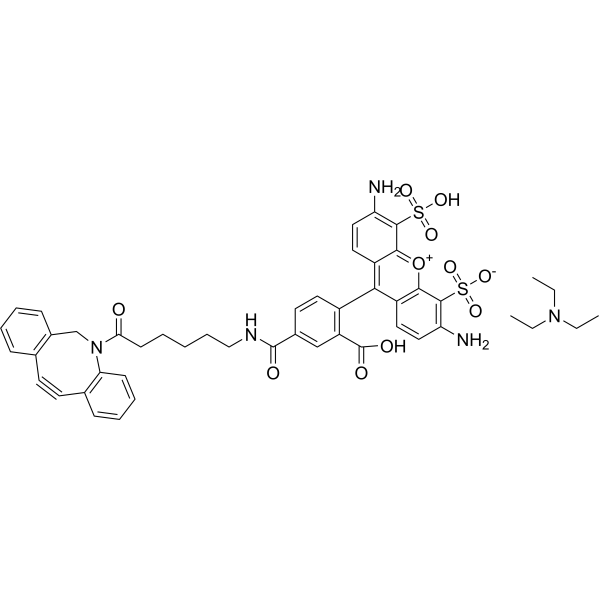
    AF488 DBCO ditriethylamine
    1 Publications Verification

    Fluorescent Dye Others
    AF488 DBCO ditriethylamineis a fluorescent dye and also a click chemistry reagent that can label azide-containing biomolecules. AF488 DBCO ditriethylaminemediates the coupling reaction with azide-modified 2'-OMe RNA oligonucleotides. DBCO is a bioorthogonal partner of azides and enables covalent coupling without copper (Ex/Em = 470/520 nm) .
    AF488 DBCO ditriethylamine
  • HY-W784030

    Amino Acid Derivatives Biochemical Assay Reagents Fluorescent Dye Others
    N-TCO-L-lysine is a non-canonical amino acid. N-TCO-L-lysine contains a trans-cyclooctene (TCO) bioorthogonal reactive linker. N-TCO-L-lysine undergoes a bioorthogonal click reaction with SiR-Tz to enable fluorescent labeling of endogenously expressed proteins with site-specific incorporation. When used in combination with SiR-Tz, N-TCO-L-lysine allows super-resolution and live-cell imaging of endogenous proteins .
    N-TCO-L-lysine
  • HY-D2171

    Fluorescent Dye Others
    AF488 DBCO is a fluorescent dye and also a click chemistry reagent that can label azide-containing biomolecules. AF488 DBCO mediates the coupling reaction with azide-modified 2'-OMe RNA oligonucleotides. DBCO is a bioorthogonal partner of azides and enables covalent coupling without copper (Ex/Em = 470/520 nm) .
    AF488 DBCO
  • HY-151745

    ADC Linker Others
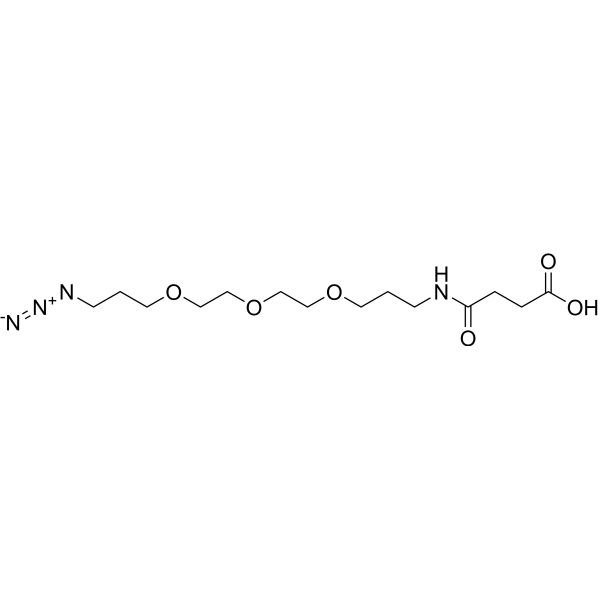
    N3-TOTA-Suc is a click chemistry reagent containing an azide group. Click chemistry is a powerful chemical reaction with excellent bioorthogonality features: biocompatible, rapid and highly specific in biological environments . N3-TOTA-Suc is a click chemistry reagent, it contains an Azide group and can undergo copper-catalyzed azide-alkyne cycloaddition reaction (CuAAc) with molecules containing Alkyne groups. It can also undergo strain-promoted alkyne-azide cycloaddition (SPAAC) reactions with molecules containing DBCO or BCN groups.
    N3-TOTA-Suc
  • HY-151749

    ADC Linker Others
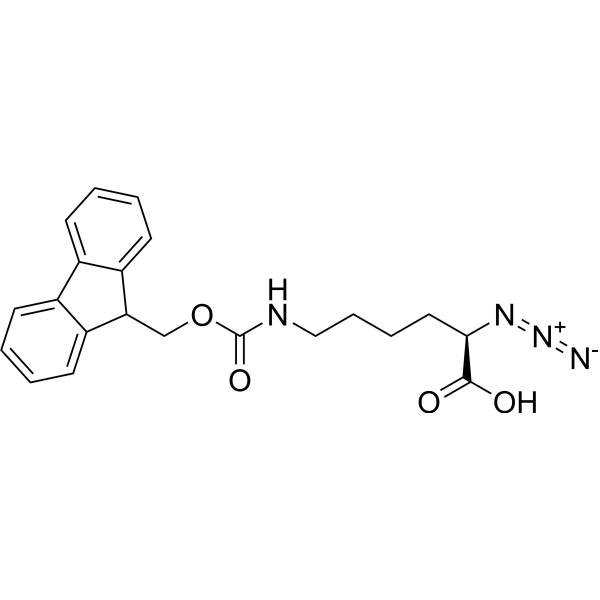
    N3-D-Lys(Fmoc)-OH is a click chemistry reagent containing an azide group. Click chemistry is a powerful chemical reaction with excellent bioorthogonality features: biocompatible, rapid and highly specific in biological environments . N3-D-Lys(Fmoc)-OH is a click chemistry reagent, it contains an Azide group and can undergo copper-catalyzed azide-alkyne cycloaddition reaction (CuAAc) with molecules containing Alkyne groups. It can also undergo strain-promoted alkyne-azide cycloaddition (SPAAC) reactions with molecules containing DBCO or BCN groups.
    N3-D-Lys(Fmoc)-OH
  • HY-151736

    ADC Linker Others
    N3-L-Dap(Boc)-OH is a click chemistry reagent containing an azide group. Click chemistry is a powerful chemical reaction with excellent bioorthogonality features: biocompatible, rapid and highly specific in biological environments . N3-L-Dap(Boc)-OH is a click chemistry reagent, it contains an Azide group and can undergo copper-catalyzed azide-alkyne cycloaddition reaction (CuAAc) with molecules containing Alkyne groups. It can also undergo strain-promoted alkyne-azide cycloaddition (SPAAC) reactions with molecules containing DBCO or BCN groups.
    N3-L-Dap(Boc)-OH
  • HY-152901

    Fluorescent Dye Others
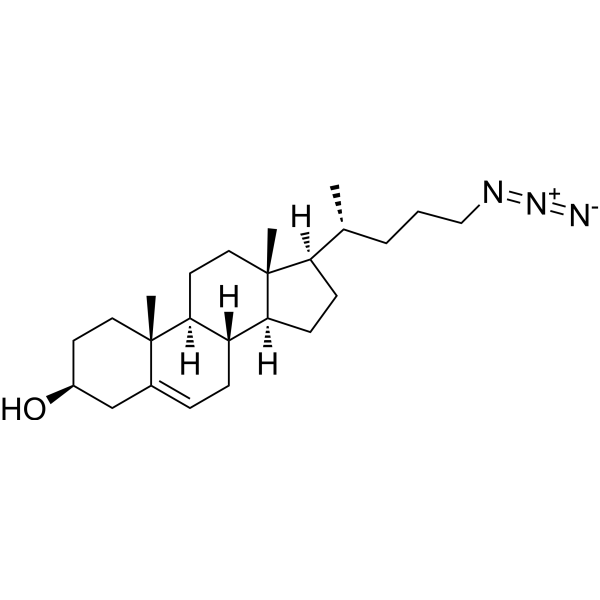
    Chol-N3 is a bioorthogonal-based chol probe. Chol-N3 can combine with super-resolution fluorescence microscopy (SRM), providing direct visualization of nanoscale lipid heterogeneity in the cell surface of resting living cells . Chol-N3 is a click chemistry reagent, it contains an Azide group and can undergo copper-catalyzed azide-alkyne cycloaddition reaction (CuAAc) with molecules containing Alkyne groups. It can also undergo strain-promoted alkyne-azide cycloaddition (SPAAC) reactions with molecules containing DBCO or BCN groups.
    Chol-N3
  • HY-151679

    ADC Linker Others
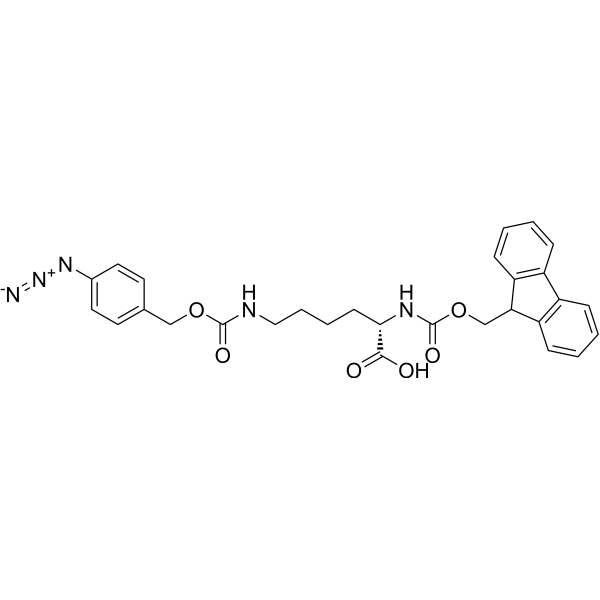
    Fmoc-L-Lys(4-N3-Z)-OH is a click chemistry reagent containing an azide group. Fmoc-L-Lys(4-N3-Z)-OH acts as Lysine building-block for SPPS containing an Azide moiety as a bioorthogonal ligation handle, an infrared probe and a photo-affinity reagent. It can be decaged by trans-cyclooctenols via a strain-promoted 1,3-dipolar cycloaddition . Fmoc-L-Lys(4-N3-Z)-OH is a click chemistry reagent, it contains an Azide group and can undergo copper-catalyzed azide-alkyne cycloaddition reaction (CuAAc) with molecules containing Alkyne groups. It can also undergo strain-promoted alkyne-azide cycloaddition (SPAAC) reactions with molecules containing DBCO or BCN groups.
    Fmoc-L-Lys(4-N3-Z)-OH
  • HY-151686

    Biochemical Assay Reagents Others
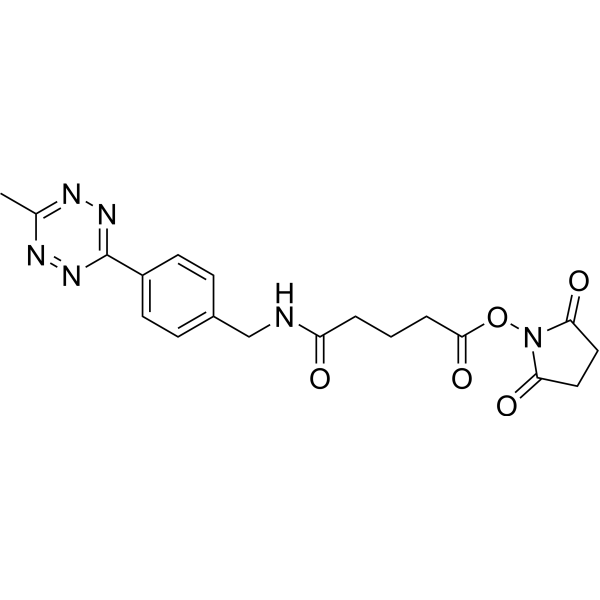
    Bz-(Me)Tz-NHS is a methyltetrazine carboxylic acid NHS ester that enables conjugation of the tetrazine moiety to the 5' end of oligonucleotides via amide coupling reaction, and it is used in oligonucleotide template-mediated fluorescent bioorthogonal cycloaddition reactions. Bz-(Me) Tz-NHS is applicable to click chemistry-related studies .
    Bz-(Me)Tz-NHS
  • HY-D2926

    BG-Tz; SNAP-Tetrazine

    Biochemical Assay Reagents Others
    BG-Tetrazine (BG-Tz; SNAP-Tetrazine) is a SNAP tag substrate that contains a methyl tetrazine group. BG-Tetrazine can specifically covalently label the target protein of the intracellular SNAP-tag fusion. The tetrazine group it carries can rapidly and efficiently undergo a bioorthogonal reaction with functional groups such as trans cyclooctene (TCO), thereby enabling multiple labeling, functionalization or enrichment of proteins. BG-Tetrazine can be applied in click chemistry .
    BG-Tetrazine
  • HY-151833

    ADC Linker Others
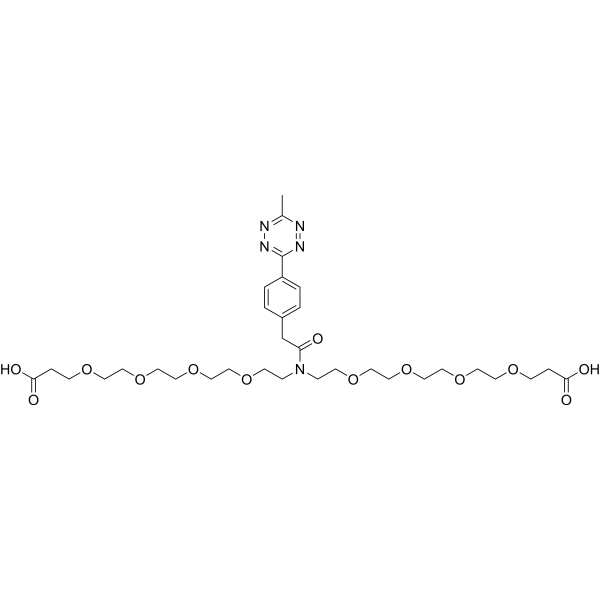
    Methyltetrazine-amido-N-bis(PEG4-acid) is a click chemistry reagent containing an azide group. Methyltetrazine-amido-N-bis(PEG4-acid) is a PEG derivative that contains a methyltetrazine group and two acid groups. This reagent can react with TCO-containing compounds to form a stable covalent bond without the catalysis of Cu or elevated temperatures. The inverse-electron demand Diels-Alder cycloaddition reaction of TCO with tetrazines is the fastest bioorthogonal reaction with exceptional selectivity. The terminal carboxylic acid can react with primary amine groups in the presence of activators (e.g. EDC, or HATU) to form a stable amide bond. PEG linker increases the water solubility of the compound. Reagent grade, for research use only . Methyltetrazine-amido-N-bis(PEG4-acid) is a click chemistry reagent, it contains a Tetrazine group that can undergo an inverse electron demand Diels-Alder reaction (iEDDA) with molecules containing TCO groups.
    Methyltetrazine-amido-N-bis(PEG4-acid)
  • HY-W800708

    Biochemical Assay Reagents Others
    N-(TCO)-N-bis(PEG4-acid) is a branched click chemistry reagent with a terminal TCO group and two terminal carboxylic acids. This reagent can react with tetrazine-containing molecule to form a stable covalent bond . The inverse-electron demand Diels-Alder cycloaddition reaction of TCO with tetrazines is the fastest bioorthogonal reaction with exceptional selectivity. The terminal carboxylic acids can react with primary amino groups in the presence of activators (e.g. EDC, HATU ).
    N-(TCO)-N-bis(PEG4-acid)
  • HY-173578

    Biochemical Assay Reagents Others
    N-(2-Poc-ethyl)betulin amide is a triterpenoid with antiviral and antitumor activities. N-(2-Poc-ethyl)betulin amide contains a Poc (prop-2-yn-1-yloxycarbonyl) alkynyl protecting group, which allows for bioorthogonal reactions (such as click chemistry) and is used for targeted delivery and fluorescent labeling .
    N-(2-Poc-ethyl)betulin amide
  • HY-W800721

    Biochemical Assay Reagents Others
    Methyltetrazine-amido-bis-(carboxyethoxymethyl)-methane is a click chemistry PEG reagent which contains three carboxylic acid groups and a methyltetrazine group. This reagent can react with TCO-containing compounds to form a stable covalent bond without the catalysis of Cu or elevated temperatures. The inverse-electron demand Diels-Alder cycloaddition reaction of TCO with tetrazines is the fastest bioorthogonal reaction with exceptional selectivity. The terminal carboxylic acid can react with primary amine groups in the presence of activators (e.g. EDC, or HATU) to form a stable amide bond.
    Methyltetrazine-amido-bis-(carboxyethoxymethyl)-methane
  • HY-W800718

    Biochemical Assay Reagents Others
    Methyltetrazine-amido-Tri-(acid-PEG1-ethoxymethyl)-methane is a click chemistry PEG reagent which contains three carboxylic acid groups and a methyltetrazine group. This reagent can react with TCO-containing compounds to form a stable covalent bond without the catalysis of Cu or elevated temperatures. The inverse-electron demand Diels-Alder cycloaddition reaction of TCO with tetrazines is the fastest bioorthogonal reaction with exceptional selectivity. The terminal carboxylic acid can react with primary amine groups in the presence of activators (e.g. EDC, or HATU) to form a stable amide bond.
    Methyltetrazine-amido-Tri-(acid-PEG1-ethoxymethyl)-methane

Inquiry Online

Your information is safe with us. * Required Fields.

Salutation


Country or Region *

Applicant Name *


Organization Name *

Department *


Email Address *


Product Name *

Cat. No.


Requested quantity *

Phone Number *


Remarks

Inquiry Online

Inquiry Information

Product Name:
Cat. No.:
Quantity:
MCE Japan Authorized Agent:

