16 Results for "

bio-orthogonal reactivity

" in MedChemExpress (MCE) Product Catalog:
Products (16)

16 Results for "bio-orthogonal reactivity" in MCE Product Catalog:

1
1 Cited Publications
Cat. No.: HY-W440835
Target:  

Liposome

Research Areas:  

Inflammation/Immunology

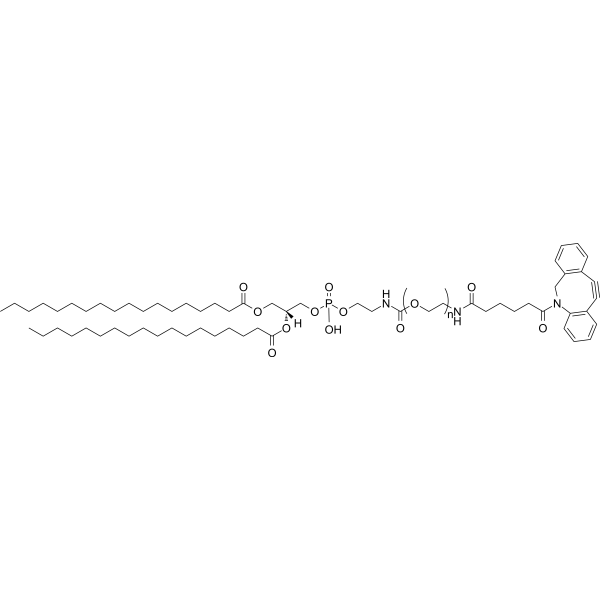
DSPE-PEG2000-DBCO is a phospholipid PEG polymer that combines a hydrophobic phospholipid (DSPE), a hydrophilic polyethylene glycol spacer with a molecular weight of 1000 Da, and a reactive click chemistry terminal group (DBCO). DSPE-PEG2000-DBCO migrates to lymph nodes via the endogenous albumin transport system, implants bioorthogonal DBCO docking sites, and enables the enrichment of azide-functionalized vesicles in lymph nodes mediated by click chemistry. DSPE-PEG2000-DBCO can be used in studies related to atherosclerosis .
loading...
    loading...
Cat. No.: HY-W784030
CAS No.: 1380349-88-1
Research Areas:  

Others

N-TCO-L-lysine is a non-canonical amino acid. N-TCO-L-lysine contains a trans-cyclooctene (TCO) bioorthogonal reactive linker. N-TCO-L-lysine undergoes a bioorthogonal click reaction with SiR-Tz to enable fluorescent labeling of endogenously expressed proteins with site-specific incorporation. When used in combination with SiR-Tz, N-TCO-L-lysine allows super-resolution and live-cell imaging of endogenous proteins .
loading...
    loading...
Cat. No.: HY-W440835E
Research Areas:  

Inflammation/Immunology

DSPE-PEG5000-DBCO is a phospholipid PEG polymer that combines a hydrophobic phospholipid (DSPE), a hydrophilic polyethylene glycol spacer with a molecular weight of 5000 Da, and a reactive click chemistry terminal group (DBCO). DSPE-PEG-DBCO migrates to lymph nodes via the endogenous albumin transport system, implants bioorthogonal DBCO docking sites, and enables the enrichment of azide-functionalized vesicles in lymph nodes mediated by click chemistry. DSPE-PEG-DBCO can be used in studies related to atherosclerosis .
loading...
    loading...
Cat. No.: HY-114354
CAS No.: 302795-84-2
Purity:  98.41%
Synonyms: BOD FL alkyne
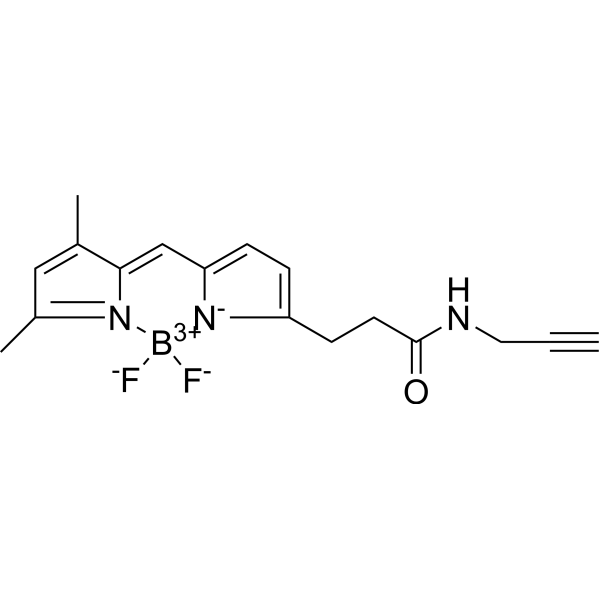
BODIPY (BOD) FL alkyne is an alkyne-containing BODIPY fluorophore derivative. BODIPY FL alkyne is a bioorthogonal labeling reagent with low toxicity and extremely low non-specific reactivity, and it is widely used in fluorescent bioimaging. BODIPY FL alkyne specifically labels azide groups on intracellular glycoconjugates mainly via strain-promoted azide-alkyne cycloaddition (SPAAC), or mediates site-specific conjugation with proteins such as IL-33, and supports positive cross-linking with other probes (e.g., DBCO-SCy5) for dual labeling. With the advantages of high specificity and low background interference, BODIPY FL alkyne can be used in the research of related diseases such as asthma, atopic dermatitis and inflammatory bowel disease .
loading...
    loading...
Cat. No.: HY-125372
CAS No.: 16348-49-5
Purity:  99.85%
Synonyms: ABAO
Research Areas:  

Others

2-Amino benzamidoxime (ABAO) acts as a bioconjugation reagent precursor and a fluorescent probe precursor. 2-Amino benzamidoxime contains an aniline group for imine activation of aldehydes, as well as a nucleophilic group (Nu:) located at the ortho position of the amine, which is responsible for intramolecular cyclization. 2-Amino benzamidoxime reacts with glyoxal at the N-terminus of phage-displayed peptide libraries. Derivatives of 2-Amino benzamidoxime can be used for protein bioconjugation. Derivatives of 2-Amino benzamidoxime serve as fluorescent probes .\n


loading...
    loading...
Cat. No.: HY-W714969A
CAS No.: 1393524-83-8
Target:  

Phosphoramidites

Research Areas:  

Others

BCN-CE-phosphoramidite is an oligonucleotide modifier containing a BCN strained cyclooctyne structure. BCN-CE-phosphoramidite possesses bioorthogonal reactivity and bioconjugation capability .
loading...
    loading...
Cat. No.: HY-W440835D
Research Areas:  

Inflammation/Immunology

DSPE-PEG3400-DBCO is a phospholipid PEG polymer that combines a hydrophobic phospholipid (DSPE), a hydrophilic polyethylene glycol spacer with a molecular weight of 3400 Da, and a reactive click chemistry terminal group (DBCO). DSPE-PEG-DBCO migrates to lymph nodes via the endogenous albumin transport system, implants bioorthogonal DBCO docking sites, and enables the enrichment of azide-functionalized vesicles in lymph nodes mediated by click chemistry. DSPE-PEG-DBCO can be used in studies related to atherosclerosis .
loading...
    loading...
Cat. No.: HY-W440835C
Research Areas:  

Inflammation/Immunology

DSPE-PEG1000-DBCO is a phospholipid PEG polymer that combines a hydrophobic phospholipid (DSPE), a hydrophilic polyethylene glycol spacer with a molecular weight of 1000 Da, and a reactive click chemistry terminal group (DBCO). DSPE-PEG-DBCO migrates to lymph nodes via the endogenous albumin transport system, implants bioorthogonal DBCO docking sites, and enables the enrichment of azide-functionalized vesicles in lymph nodes mediated by click chemistry. DSPE-PEG-DBCO can be used in studies related to atherosclerosis .
loading...
    loading...
Cat. No.: HY-W440835A
Research Areas:  

Inflammation/Immunology

DSPE-PEG400-DBCO is a phospholipid PEG polymer that combines a hydrophobic phospholipid (DSPE), a hydrophilic polyethylene glycol spacer with a molecular weight of 400 Da, and a reactive click chemistry terminal group (DBCO). DSPE-PEG-DBCO migrates to lymph nodes via the endogenous albumin transport system, implants bioorthogonal DBCO docking sites, and enables the enrichment of azide-functionalized vesicles in lymph nodes mediated by click chemistry. DSPE-PEG-DBCO can be used in studies related to atherosclerosis .
loading...
    loading...
Cat. No.: HY-W440835B
Research Areas:  

Inflammation/Immunology

DSPE-PEG600-DBCO is a phospholipid PEG polymer that combines a hydrophobic phospholipid (DSPE), a hydrophilic polyethylene glycol spacer with a molecular weight of 600 Da, and a reactive click chemistry terminal group (DBCO). DSPE-PEG-DBCO migrates to lymph nodes via the endogenous albumin transport system, implants bioorthogonal DBCO docking sites, and enables the enrichment of azide-functionalized vesicles in lymph nodes mediated by click chemistry. DSPE-PEG-DBCO can be used in studies related to atherosclerosis .
loading...
    loading...
Cat. No.: HY-W440835H
Research Areas:  

Inflammation/Immunology

DSPE-PEG10000-DBCO is a phospholipid PEG polymer that combines a hydrophobic phospholipid (DSPE), a hydrophilic polyethylene glycol spacer with a molecular weight of 10000 Da, and a reactive click chemistry terminal group (DBCO). DSPE-PEG-DBCO migrates to lymph nodes via the endogenous albumin transport system, implants bioorthogonal DBCO docking sites, and enables the enrichment of azide-functionalized vesicles in lymph nodes mediated by click chemistry. DSPE-PEG-DBCO can be used in studies related to atherosclerosis .
loading...
    loading...
Cat. No.: HY-D3501
Research Areas:  

Others

5-FAM BCN is a reactive fluorophore-labeled strained alkyne probe and bicyclononyne. 5-FAM BCN undergoes inverse-electron-demand Diels-Alder cycloaddition with five-membered cyclic dienes. 5-FAM BCN facilitates bioorthogonal bioconjugation reactions .
loading...
    loading...
Cat. No.: HY-185797
Research Areas:  

Others

TCO Phosphoramidite is a nucleic acid phosphoramidite modifier containing a trans-cyclooctene (TCO) reactive group. TCO Phosphoramidite enables nucleic acid fragment ligation via the inverse electron demand Diels-Alder (IEDDA) bioorthogonal reaction between TCO and tetrazine (Tz), and it can be used for research on oligonucleotide and RNA modification and assembly .
loading...
    loading...
Cat. No.: HY-185782
Research Areas:  

Others

Methyltetrazine-PEG2-tris (PEG3-DBCO) is a methyltetrazine-derived multi-arm PEG crosslinker designed specifically for the inverse electron-demand Diels-Alder (IEDDA) bioorthogonal reaction. Methyltetrazine-PEG2-tris (PEG3-DBCO) contains both methyltetrazine and tris (PEG3-DBCO) domains, and carries DBCO reactive groups. Methyltetrazine-PEG2-tris (PEG3-DBCO) serves as a highly efficient bioorthogonal conjugation reagent .
loading...
    loading...
Cat. No.: HY-L258
437 compounds

In modern medicinal chemistry and chemical biology research, alkyne (-C≡C-) structures play an important role in click chemistry, bioorthogonal labeling, and the construction of functional molecules due to their unique linear geometry and high reactivity. In particular, driven by the development of copper-catalyzed azide-alkyne cycloaddition (CuAAC) and copper-free click reactions (SPAAC), terminal alkyne groups have become important “chemical handles” for building complex biomolecular systems.

The MCE Alkyne Compound Library contains 437 compounds designed for the construction of click chemistry reaction systems and the development of diverse functional molecules. In drug discovery, these structures serve as key reactive sites that can efficiently undergo click reactions with azide groups, enabling modular assembly of PROTAC molecules, construction of ADC linkers, and rapid synthesis of bioorthogonal labeling probes. In addition, alkyne groups exhibit high stability, mild reaction conditions, and excellent biocompatibility, allowing them to maintain reactivity in complex biological environments. This contributes to improved efficiency and controllability in drug development, making them indispensable chemical building blocks in modern drug design and functional molecular engineering.

Cat. No.: HY-L256
100 compounds

In modern drug discovery and chemical biology research, the azide group (-N3) is an important functional moiety that is widely used in click chemistry, biomolecular labeling, drug delivery systems, and prodrug design due to its unique reactivity and bioorthogonality.

The MCE Azide Structural Compound Library contains 100 compounds featuring -N3 functional groups. It is designed for the construction of click chemistry reaction systems and the subsequent development of functional molecules. This library enables the rapid assembly of targeting ligands, linkers, and functional molecular modules, thereby accelerating PROTAC assembly, optimization of antibody-drug conjugate (ADC) linkers, and the development of biological labeling probes. In addition, the high reaction selectivity and excellent biocompatibility of the azide group allow it to maintain stable reactivity even in complex biological environments, improving controllability and efficiency in drug design. It serves as an indispensable molecular tool in modern medicinal chemistry and chemical biology research.

  • 1

