
1. Search Result
Search Result
Results for "

colorectal tumours

" in MedChemExpress (MCE) Product Catalog:

10

Inhibitors & Agonists

1

Fluorescent Dyes

4

Inhibitory Antibodies

Cat. No. Product Name Target Research Areas Chemical Structure
  • HY-P99011
    Cibisatamab
    2 Publications Verification

    CD3 Cancer
    Cibisatamab, a T cell bispecific antibody, binds Carcino-Embryonic Antigen (CEA) on cancer cells and CD3 on T cells. Cibisatamab triggers T cell killing of cancer cell lines expressing moderate to high levels of CEA at the cell surface. Cibisatamab can be used for colorectal cancer research .
    Cibisatamab
  • HY-13432
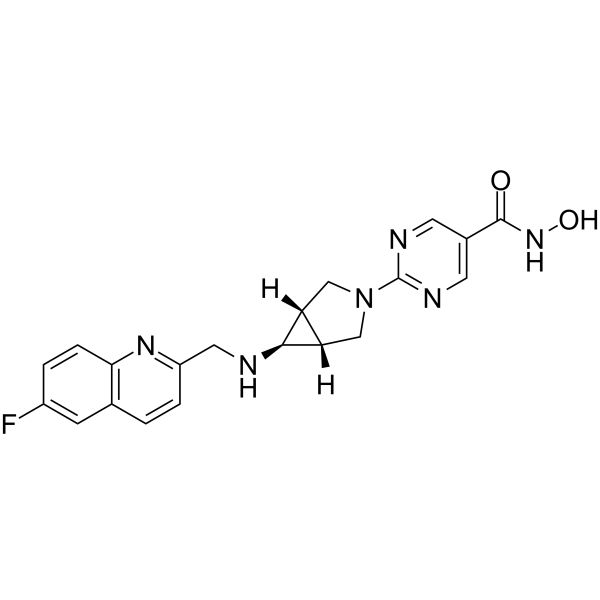
    Nanatinostat
    2 Publications Verification

    CHR-3996

    HDAC Apoptosis Cancer
    Nanatinostat (CHR-3996) is a potent, class I selective and orally active HDAC inhibitor with IC50s of 3 nM, 4 nM, and 7 nM for HDAC1, HDAC2, and HDAC3, respectively. Nanatinostat has low activity against HDAC5 (IC50 of 200 nM) and HDAC6 (IC50 of 2100 nM). Nanatinostat induces apoptosis in myeloma cells. Nanatinostat has potent anticancer effects, such as myeloma, advanced solid tumours and colorectal cancer .
    Nanatinostat
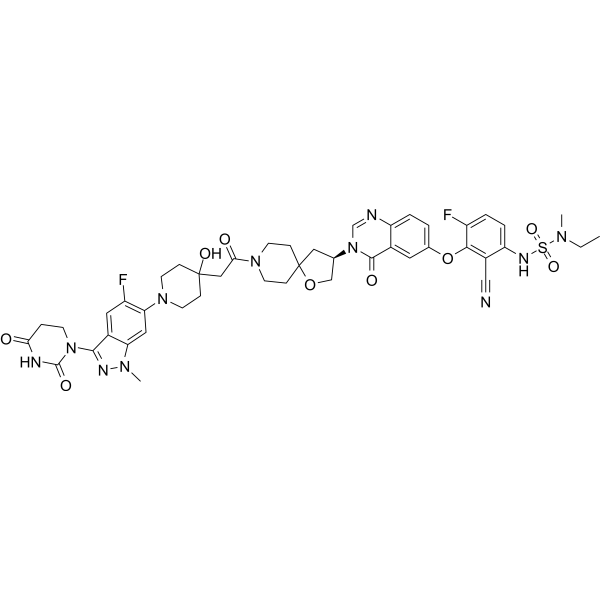
  • HY-176761

    Apoptosis Autophagy Caspase mTOR Cancer
    NSC647889 is an apoptosis and autophagy inducer. NSC647889 induces apoptosis, inhibits mTOR pathway and abrogates DNA synthesis. NSC647889 triggers LC3-positive vesicle formation, modulates AKT and 4EBP1 phosphorylation and shows heightened caspase-3 activation in multicellular spheroids. NSC647889 can be used for the research of solid cancer tumour, head-neck carcinoma, and colorectal cancer .
    NSC647889
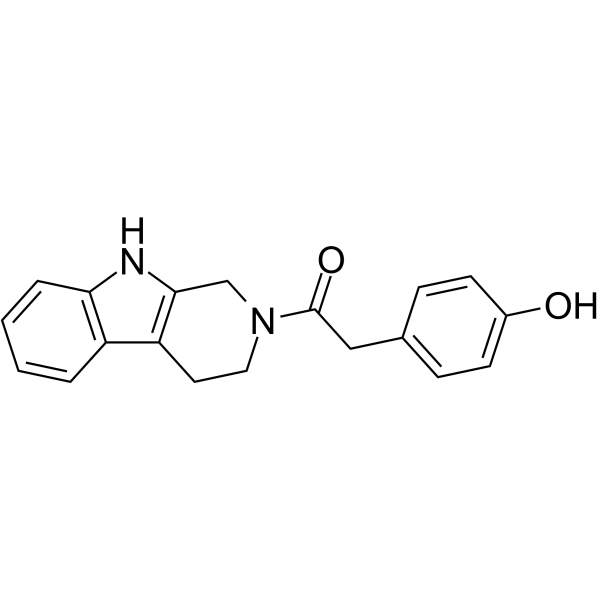
  • HY-120213

    FAK Src PI3K MMP Apoptosis Cancer
    YH-306 is an antitumor agent. YH-306 suppresses colorectal tumour growth and metastasis via FAK pathway. YH-306 significantly inhibits the migration and invasion of colorectal cancer cells. YH-306 potently suppresses uninhibited proliferation and induces cell apoptosis. YH-306 suppresses the activation of FAK, c-Src, paxillin, and PI3K, Rac1 and the expression of MMP2 and MMP9. YH-306 also inhibita actin-related protein (Arp2/3) complex-mediated actin polymerization .
    YH-306
  • HY-P991348

    PD-1/PD-L1 Cancer
    BAT-1306 is a human monoclonal antibody (mAb) targeting PDCD1/PD-1/CD279. BAT-1306 can be used in Colorectal cancer and Solid tumours research .
    BAT-1306
  • HY-P991391

    Transmembrane Glycoprotein Cancer
    COM902 is a human IgG4 monoclonal antibody (mAb) targeting TIGIT. COM902 enhances anti-tumor immune responses. COM902 can be used in Multiple myeloma, Solid tumours and Colorectal cancer research. Recommended isotype control: IgG4-lambda .
    COM902
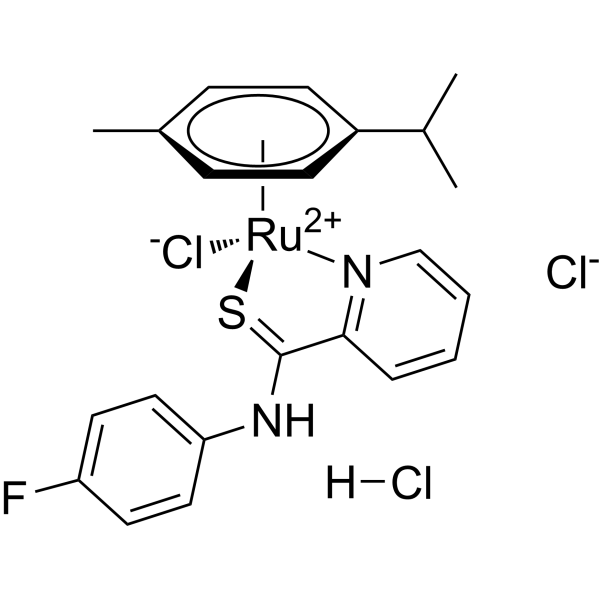
  • HY-175003

    Proton Pump Cancer
    HV1-IN-2 (Compound 14c) is a human voltage-gated proton channel (HV1) inhibitor with an IC50 of 2.14 μM. HV1-IN-2 has a potent anticancer activity with significant antiproliferative effects against THP-1 and MCF-7 cells. HV1-IN-2 can be used for cancers research, such as colorectal tumours, leukaemia, and breast cancer .
    HV1-IN-2
  • HY-P991344

    PD-1/PD-L1 Cancer
    AMP-224 is a fusion protein targeting PD-L2. AMP-224 specifically binds to PD-1 T cells (chronically stimulated/exhausted T cells). AMP-224 can be used in Colorectal cancer and Solid tumours research .
    AMP-224
  • HY-13432A

    CHR-3996 TFA

    HDAC Apoptosis Cancer
    Nanatinostat (CHR-3996) TFA is a potent, class I selective and orally active HDAC inhibitor with IC50s of 3 nM, 4 nM, and 7 nM for HDAC1, HDAC2, and HDAC3, respectively. Nanatinostat TFA has low activity against HDAC5 (IC50 of 200 nM) and HDAC6 (IC50 of 2100 nM). Nanatinostat TFA induces apoptosis in myeloma cells. Nanatinostat TFA has potent anticancer effects, such as myeloma, advanced solid tumours and colorectal cancer .
    Nanatinostat TFA
  • HY-D3352

    AGSCYCSGPPRFECWCYETEGT-Cy5

    Fluorescent Dye c-Met/HGFR Cancer
    EMI-137 (AGSCYCSGPPRFECWCYETEGT-Cy5) is a fluorescent imaging agent targeting the c-Met receptor. EMI-137 specifically binds to the extracellular domain of the c-Met receptor and is used for fluorescent visualization of c-Met-expressing cells and tissues. EMI-137 can be applied to research related to colorectal cancer .
    EMI-137

Inquiry Online

Your information is safe with us. * Required Fields.

Salutation


Country or Region *

Applicant Name *


Organization Name *

Department *


Email Address *


Product Name *

Cat. No.


Requested quantity *

Phone Number *


Remarks

Inquiry Online

Inquiry Information

Product Name:
Cat. No.:
Quantity:
MCE Japan Authorized Agent:

