



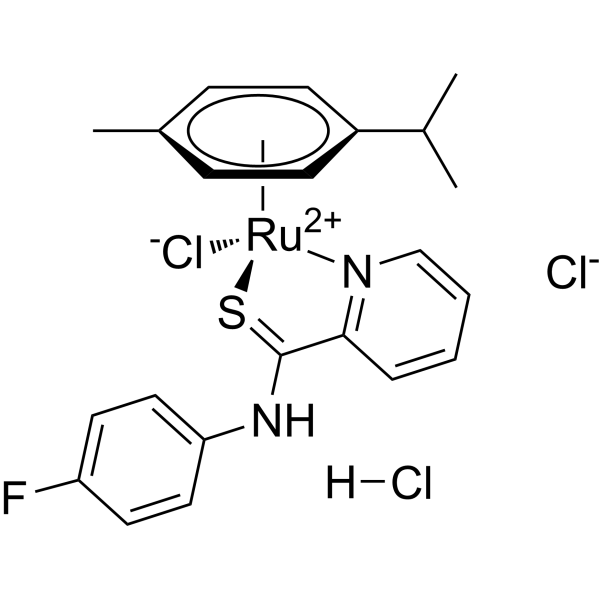
Plecstatin-1 hydrochloride
Based on 1 publication(s) in Google Scholar
Plecstatin-1 hydrochloride is a metal complex that drives the aggregation and collapse of the plectin network, and disrupts the cytoskeletal structures of α‑tubulin and F‑actin. Plecstatin-1 hydrochloride triggers oxidative stress, mediates the phosphorylation of eIF2α, and induces molecular features associated with immunogenic cell death, including calreticulin membrane exposure, membrane localization of HSP70/HSP90, ATP secretion, and HMGB‑1 release. Plecstatin-1 hydrochloride induces apoptosis via the intrinsic mitochondrial pathway and exerts anti-invasive activity. Plecstatin-1 hydrochloride inhibits sphere proliferation and reduces clonogenicity in the 3D tumor spheroid model of colon cancer cells. Plecstatin-1 hydrochloride is applicable to relevant research on colorectal cancer.
For research use only. We do not sell to patients.
- Purity : 98.96%
- Formula: C22H24Cl3FN2RuS
- Molecular Weight:574.93
-
Storage:
-20°C, sealed storage, away from moisture
* In solvent : -80°C, 6 months; -20°C, 1 month (sealed storage, away from moisture)

To place orders, for customer services and technical support, please contact: MedChemExpress USA
Tel: 609-228-6898 E-mail: [email protected] [email protected]


-
 Biological Activity
-
Chemical Information
-
Solvent & Solubility
- Purity & Documentation
- References
-
 Help & FAQs


Publications Citing Use of MedChemExpress (MCE) Plecstatin-1 hydrochloride
MoreAll Caspase Isoforms
More

Biological Activity
Description
IC50 & Target
|
α-Tubulin |
eIF2-α |
HSP70 |
HSP90 |
Caspase 3 |
In Vitro
Plecstatin-1 hydrochloride inhibits the growth of HCT-116, HCT-15 and HT-29 colon cancer cells in both 2D monolayer and 3D spheroid models. Its potency is lower in the spheroid model, and its effects on spheroid size and morphology are cell line-dependent[1].
Plecstatin-1 hydrochloride (200 μM; 72 h) hydrochloride reduces the proliferative capacity of HCT-116 colon cancer spheroids[1].
Plecstatin-1 hydrochloride (7 days) hydrochloride reduces the long-term proliferation capacity of HCT-116 and HT-29 colon cancer cell monolayers, as evidenced by decreased colony formation at its IC50 concentration[1].
Plecstatin-1 hydrochloride (50 μM; 15 min-6 h) hydrochloride only weakly interacts with pUC19 plasmid DNA in a cell-free system, indicating that DNA damage is not its primary mechanism of action[1].
Plecstatin-1 hydrochloride (400 μM; 5 days) hydrochloride preferentially accumulates in the proliferative peripheral cells of HT-29 and HCT-116 colon cancer spheroids, with limited uptake by quiescent inner cells[1].
Plecstatin-1 hydrochloride (200 μM; 72 h) hydrochloride disrupts the cytoskeletal structures of plectin, α-tubulin and F-actin in HCT-116 colon cancer spheroids, while exerts weaker effects in HT-29 spheroids[1].
Plecstatin-1 hydrochloride (40 μM; 72 h) hydrochloride reduces the invasiveness of HT1080 fibrosarcoma spheroids in Matrigel invasion assays[1].
Plecstatin-1 hydrochloride (200 μM; 24 h) hydrochloride induces phosphorylation of the stress regulator eIF2α in HCT-116 colon cancer spheroids[1].
Plecstatin-1 hydrochloride (200 μM; 24 h) hydrochloride induces CRT translocation to the plasma membrane of HCT-116, HCT-15 and HT-29 colon cancer spheroids; it also induces ATP secretion from HCT-116 and HT-29 colon cancer spheroids, with the strongest effect observed in HCT-116 spheroids[1].
Plecstatin-1 hydrochloride (200 μM; 72 h) hydrochloride induces HMGB-1 release from HCT-116 and HT-29 colon cancer spheroids, with a stronger effect observed in HCT-116 spheroids[1].
Plecstatin-1 hydrochloride (200 μM; 24 h) hydrochloride increases the levels of HSP70 and HSP90 and promotes their translocation to the plasma membrane of colon cancer spheres[1].
Plecstatin‑1 (200 μM; 72 h) hydrochloride induces mild apoptosis in HCT‑116 and HCT‑15 colon cancer spheroids, but exerts no significant effect on apoptosis in HT‑29 spheroids[1].
Plecstatin-1 hydrochloride (200 μM; 48-72 h) hydrochloride induces apoptosis in HCT-116 colon cancer spheroids via the intrinsic mitochondrial pathway, as evidenced by cytochrome c release and caspase-3 cleavage[1].
Plecstatin-1 hydrochloride (200 μM; 24 h) hydrochloride induces oxidative stress in HCT-116, HCT-15 and HT-29 colon cancer spheroids, with the most potent effect observed in HCT-116 spheroids, and ROS localizes to proliferative peripheral cells[1].
MedChemExpress (MCE) has not independently confirmed the accuracy of these methods. They are for reference only.


Chemical Information
-
Appearance Solid
-
Molecular Weight 574.93
-
Formula C22H24Cl3FN2RuS
-
Color Brown to red
-
SMILES
[H]Cl.C[Ru@+2]1([Cl-])[S]=C(C2=[N]1C=CC=C2)NC3=CC=C(F)C=C3.Cc4ccc(C(C)C)cc4.[Cl-]
-
Shipping
Room temperature in continental US; may vary elsewhere.
-
Storage
-20°C, sealed storage, away from moisture
* In solvent : -80°C, 6 months; -20°C, 1 month (sealed storage, away from moisture)


Publications (1)
-
Journal Impact Factor
-
Most Recent
-
bioRxiv
The umbrella cell keratin network: organization as a tile-like mesh, formation of a girded layer in response to bladder filling, and dependence on the plectin cytolinker. [Abstract]2024 Jun 13:2024.06.11.598498. PMID: 38915686


Solvent & Solubility
In Vitro:
DMSO : 100 mg/mL (173.93 mM; Need ultrasonic; Hygroscopic DMSO has a significant impact on the solubility of product, please use newly opened DMSO)
Methanol : 62.5 mg/mL (108.71 mM; Need ultrasonic)
Please refer to the solubility information to select the appropriate solvent. Once prepared, please aliquot and store the solution to prevent product inactivation from repeated freeze-thaw cycles.
Storage method and period of stock solution: -80°C, 6 months; -20°C, 1 month (sealed storage, away from moisture). When stored at -80°C, please use it within 6 months. When stored at -20°C, please use it within 1 month.
Please refer to the solubility information to select the appropriate solvent. Once prepared, please aliquot and store the solution to prevent product inactivation from repeated freeze-thaw cycles.
Storage method and period of stock solution: -80°C, 6 months; -20°C, 1 month (sealed storage, away from moisture). When stored at -80°C, please use it within 6 months. When stored at -20°C, please use it within 1 month.
Concentration (start) × Volume (start) = Concentration (final) × Volume (final)
In Vivo:
Select the appropriate dissolution method based on your experimental animal and administration route.
- For the following dissolution methods, please ensure to first prepare a clear stock solution using an In Vitro approach and then sequentially add co-solvents:
- To ensure reliable experimental results, the clarified stock solution can be appropriately stored based on storage conditions. As for the working solution for In Vivo experiments, it is recommended to prepare freshly and use it on the same day.
- The percentages shown for the solvents indicate their volumetric ratio in the final prepared solution. If precipitation or phase separation occurs during preparation, heat and/or sonication can be used to aid dissolution.
Add each solvent one by one: 10% DMSO 40% PEG300 5% Tween-80 45% Saline
Solubility: ≥ 5 mg/mL (8.70 mM); Clear solution
This protocol yields a clear solution of ≥ 5 mg/mL (saturation unknown).
Taking 1 mL working solution as an example, add 100 μL DMSO stock solution (50.0 mg/mL) to 400 μL PEG300, and mix evenly; then add 50 μL Tween-80 and mix evenly; then add 450 μL Saline to adjust the volume to 1 mL.
Preparation of Saline: Dissolve 0.9 g sodium chloride in ddH₂O and dilute to 100 mL to obtain a clear Saline solution.
Add each solvent one by one: 10% DMSO 90% (20% SBE-β-CD in Saline)
Solubility: ≥ 5 mg/mL (8.70 mM); Clear solution
This protocol yields a clear solution of ≥ 5 mg/mL (saturation unknown).
Taking 1 mL working solution as an example, add 100 μL DMSO stock solution (50.0 mg/mL) to 900 μL 20% SBE-β-CD in Saline, and mix evenly.
Preparation of 20% SBE-β-CD in Saline (4°C, storage for one week): 2 g SBE-β-CD powder is dissolved in 10 mL Saline, completely dissolve until clear.
In Vivo Dissolution Calculator
Please enter the basic information of animal experiments:
-
-
-
-
Recommended: Prepare an additional quantity of animals to account for potential losses during experiments.
Please enter your animal formula composition:
-
%DMSO +
Recommended: Keep the proportion of DMSO in working solution below 2% if your animal is weak.
-
%+
-
+%Tween-80 + +
-
%Saline +
The co-solvents required include: DMSO, . All of co-solvents are available by MedChemExpress (MCE). , Tween 80. All of co-solvents are available by MedChemExpress (MCE).
Working solution concentration: 0.22 mg/mL
Method for preparing stock solution: mg drug dissolved in μL DMSO. Stock solution concentration: mg/mL. * In solvent : -80°C, 6 months; -20°C, 1 month (sealed storage, away from moisture)
1. Take μL DMSO stock solution;
2. Add μL .
μL , mix evenly;
3. Then add μL Tween 80, mix evenly;
4. Then add μL
Please ensure that the stock solution in the first step is dissolved to a clear state, and add co-solvents in sequence. You can use ultrasonic heating (ultrasonic cleaner, recommended frequency 20-40 kHz), vortexing, etc. to assist dissolution.


Purity & Documentation
-
Data Sheet (299 KB)
-
SDS (252 KB)
- English - EN (252 KB)
- Français - FR (252 KB)
- Deutsch - DE (252 KB)
- Norwegian - NO (252 KB)
- Español - ES (252 KB)
- Swedish - SV (252 KB)
- Italian - IT (252 KB)
- Korean - KR (252 KB)
- Portuguese - PT (252 KB)
-
Handling Instructions (2659 KB)
References


Complete Stock Solution Preparation Table
Please refer to the solubility information to select the appropriate solvent. Once prepared, please aliquot and store the solution to prevent product inactivation from repeated freeze-thaw cycles.
Storage method and period of stock solution: -80°C, 6 months; -20°C, 1 month (sealed storage, away from moisture). When stored at -80°C, please use it within 6 months. When stored at -20°C, please use it within 1 month.
| Optional Solvent | Concentration Solvent Mass | 1 mg | 5 mg | 10 mg | 25 mg |
|---|---|---|---|---|---|
| Methanol / DMSO | 1 mM | 1.7393 mL | 8.6967 mL | 17.3934 mL | 43.4836 mL |
| 5 mM | 0.3479 mL | 1.7393 mL | 3.4787 mL | 8.6967 mL | |
| 10 mM | 0.1739 mL | 0.8697 mL | 1.7393 mL | 4.3484 mL | |
| 15 mM | 0.1160 mL | 0.5798 mL | 1.1596 mL | 2.8989 mL | |
| 20 mM | 0.0870 mL | 0.4348 mL | 0.8697 mL | 2.1742 mL | |
| 25 mM | 0.0696 mL | 0.3479 mL | 0.6957 mL | 1.7393 mL | |
| 30 mM | 0.0580 mL | 0.2899 mL | 0.5798 mL | 1.4495 mL | |
| 40 mM | 0.0435 mL | 0.2174 mL | 0.4348 mL | 1.0871 mL | |
| 50 mM | 0.0348 mL | 0.1739 mL | 0.3479 mL | 0.8697 mL | |
| 60 mM | 0.0290 mL | 0.1449 mL | 0.2899 mL | 0.7247 mL | |
| 80 mM | 0.0217 mL | 0.1087 mL | 0.2174 mL | 0.5435 mL | |
| 100 mM | 0.0174 mL | 0.0870 mL | 0.1739 mL | 0.4348 mL |


Plecstatin-1 hydrochloride Related Classifications
HY-156675A Related Classifications
 Powered by Bioz
Keywords
- Plecstatin-1
- Plecstatin1
- Plecstatin 1
- Microtubule/Tubulin
- Eukaryotic Initiation Factor (eIF)
- HSP
- Caspase
- Reactive Oxygen Species (ROS)
- Apoptosis
- endoplasmic reticulum stress
- eukaryotic initiation factor 2-alpha
- F-actin
- HCT-116
- colorectal tumour spheroid
- integrated stress response
- plectin
- immunogenic cell death
- colon adenocarcinoma cell
- α-tubulin
- Inhibitor
- inhibitor
- inhibit