16 Results for "

confocal microscopy imaging

" in MedChemExpress (MCE) Product Catalog:
Products (16)

16 Results for "confocal microscopy imaging" in MCE Product Catalog:

1
1 Cited Publications
Cat. No.: HY-D1540
CAS No.: 2097714-45-7
Synonyms: Cy 5.5 amine; Lumiprobe Cy 5.5 amine
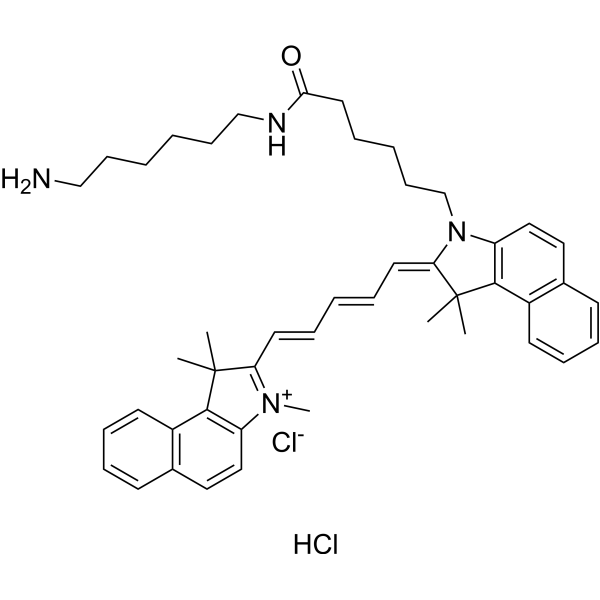
Cyanine5.5 amine (Cy 5.5 amine), a Cy5.5 Analogue, is a near-infrared (NIR) fluorescent dye (Ex=648 nm, Em=710 nm). Cyanine5.5 amine can be used in the preparation of Cy5.5-labeled nanoparticles, which can be tracked and imaged with low fluorescence background using confocal microscopy .
loading...
    loading...
Cat. No.: HY-W923198
CAS No.: 480439-15-4
Synonyms: Methacryloyloxy fluorescein
Fluorescein O-methacrylate (Methacryloyloxy fluorescein) is a pH-responsive fluorescent monomeric dye. Fluorescein O-methacrylate exhibits pH-responsive fluorescence properties: its fluorescence is activated under alkaline conditions and quenched under neutral or acidic conditions; reversible switching of fluorescence is achievable by adjusting the pH of the solution. Fluorescein O-methacrylate can be used as a monomer for the synthesis of amphiphilic fluorescein polymers. These polymers can self-assemble into stable polymer nanoparticles with enhanced aqueous-phase fluorescence, and also enable the conjugation of nanoparticles with amine-containing biomolecules to support sensitive optical detection of biomarkers (Ex/Em = 490/520 nm) .
loading...
    loading...
Cat. No.: HY-NP163A
Synonyms: WGA-AF488
Wheat germ agglutinin-AF488 (WGA-AF488) is a cell membrane-specific staining agent prepared by conjugating wheat germ agglutinin with the Alexa Fluor 488 (HY-D1304) fluorescent dye, and it binds to cell surface glycoproteins with high affinity. Wheat germ agglutinin-AF488 is applied in fluorescence microscopy and confocal imaging techniques, and it can clearly label the membrane structures of various cells including breast cancer cells, enabling high-resolution visual observation. Wheat germ agglutinin-AF488 is used in studies of breast cancer and triple-negative breast cancer to observe cell morphology and membrane dynamic changes .
loading...
    loading...
Cat. No.: HY-D1991
CAS No.: 906664-68-4
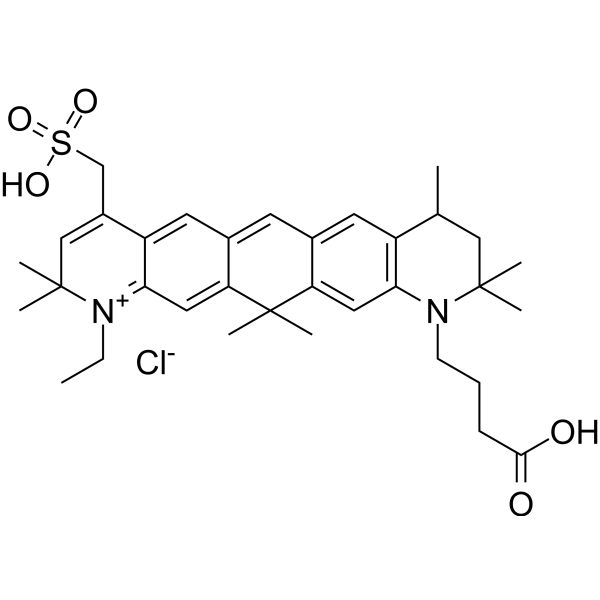
ATTO 647 is a carborhodamine fluorophore and imaging tracer with photostable properties. ATTO 647 serves as a fluorescent probe to investigate cell membrane structure and diffusion characteristics. When conjugated with wheat germ agglutinin, ATTO 647 specifically binds to N-acetyl-β-D-glucosamine and sialic acid residues on membrane glycoproteins, enabling single-molecule tracing of glycoprotein diffusion. ATTO 647 exhibits highly stable fluorescence properties with significantly reduced blinking in mounting media such as ROXS (AA/MV) and ROXS (TX/TQ), whereas its brightness properties vary in Ibidi-MM and Vectashield. ATTO 647 can also be used to label histone H2B-GFP in fixed cells for confocal microscopy photobleaching experiments .
loading...
    loading...
Cat. No.: HY-D2994
CAS No.: 2434651-49-5
Synonyms: SNAP-MaP555
Target:  

Fluorescent Dye

Research Areas:  

Others

SPY555-BG (SNAP-MaP555) is a cell-permeable fluorescent dye for SNAP-tag labeling of HIV-1 Gag, which enables visualization of HIV-1 intercellular transmission via SNAPf. SPY555-BG relies on irreversible covalent binding to the active-site cysteine of the SNAPf tag fused to HIV-1 Gag .
loading...
    loading...
Cat. No.: HY-D2341
CAS No.: 3055969-34-8
6FC-GABA-Taxol is a fluorescent probe with cell permeability, which is formed by connecting 6FC to the anticancer drug Taxol (HY-B0015) via γ-aminobutyric acid (GABA). 6FC-GABA-Taxol can bind to microtubules in living cells and image them through confocal microscopy. Additionally, 6FC-GABA-Taxol enables the quantification of microtubule binding using flow cytometry without the addition of efflux inhibitors .
loading...
    loading...
Cat. No.: HY-D1439
CAS No.: 172807-13-5
Target:  

Fluorescent Dye

Research Areas:  

Neurological Disease

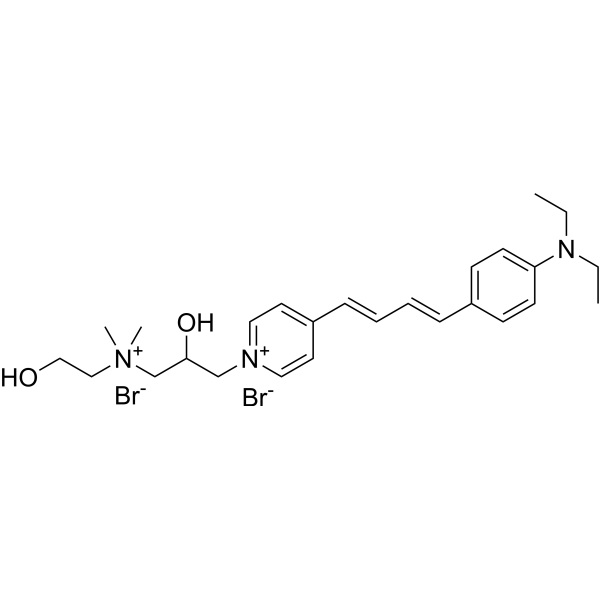
RH 795 is a lipophilic potentiometric styryl fluorescent dye (Ex/Em = 530 nm/712 nm). RH 795 stains the cell membranes of sensory cells and nerve fibers in living cells that maintain membrane potential, while it shows weak staining effect on supporting cells. RH 795 supports in vivo and in vitro confocal microscopy imaging of intact living inner ear cells and neuronal components. RH 795 can be used in studies related to hearing loss .
loading...
    loading...
Cat. No.: HY-121364
CAS No.: 1416130-06-7
Research Areas:  

Others

Bodilisant is a histamine H3 receptor (hH3R) ligand and imaging/labeling agent, with a Ki value of 6.51 nM for hH3R. Bodilisant binds to hH3R to produce strong green fluorescence, localizes to the extracellular membrane without internalization, and generates clear, displaceable fluorescent labeling of hH3R in native human brain tissues. Bodilisant serves as a pharmacological tool to visualize the distribution of hH3R via fluorescence confocal laser scanning microscopy .
loading...
    loading...
Cat. No.: HY-D3379
Neuro-DiO trifluoromethanesulfonate is a green Fluorescent carbocyanine dye and also a vascular labeling agent. Neuro-DiO trifluoromethanesulfonate can be used for confocal microscopy imaging of cerebral blood vessels in mice (Mus musculus) .
loading...
    loading...
Cat. No.: HY-D3446
CAS No.: 2358677-26-4
PA-SiR-Halo is a photoactivatable fluorophore targeting HaloTag. When bound to HaloTag, PA-SiR-Halo stabilizes its fluorescent form under physiological pH. After conjugation and photoactivation, it exhibits enhanced resistance to nucleophiles, and enables live-cell confocal imaging, fixed-cell single-molecule localization microscopy imaging, live-cell single-particle tracking, as well as live-cell single-molecule localization microscopy imaging of dynamic mitochondrial structures without the need for washing .
loading...
    loading...
Cat. No.: HY-P11850
CAS No.: 1192023-11-2
Research Areas:  

Cancer

PTP peptide is a specific Plectin-1 binder. PTP peptide can serve as a component of imaging agents; when conjugated with magnetofluorescent nanoparticles, it enables the detection of small pancreatic ductal adenocarcinomas and precancerous lesions via in vivo confocal microscopy and MRI. When conjugated with imaging agents, PTP peptide specifically targets pancreatic ductal adenocarcinoma cells, and can be used for tumor visualization and compound delivery. PTP peptide is applicable to research related to pancreatic ductal adenocarcinoma .
loading...
    loading...
Cat. No.: HY-D3573
Research Areas:  

Others

AF488 C5 Maleimide is a thiol-reactive Fluorescent dye used to label target proteins and bacterial structures. AF488 C5 Maleimide irreversibly forms covalent thioether conjugates with cysteine ​​thiol groups. AF488 C5 Maleimide stabilizes pre-formed globular low-molecular-weight Tau protein oligomers by blocking cysteine-dependent tau protein aggregation, allowing observation of the internalization process of tau protein oligomers into neuronal cells via confocal microscopy. AF488 C5 Maleimide can label cysteine-modified pili; the outer membrane permeability varies among different bacterial species, allowing imaging via epifluorescence microscopy using a FITC filter set .
loading...
    loading...
Cat. No.: HY-D3164
CAS No.: 1380316-56-2
Target:  

Fluorescent Dye

Research Areas:  

Others

TPE-Cy is a fluorescent probe with both aggregation-induced emission (AIE) property and pH-dependent luminescent behavior. TPE-Cy exhibits significant luminescent differences under different acidic and alkaline conditions: it shows moderate to strong red emission with linear variation with pH in acidic environments and within the pH range of 5-7, weak or even no emission within the pH range of 7-10, and switches to blue emission under alkaline conditions. TPE-Cy possesses excellent cell permeability and biocompatibility, enabling accurate ratiometric pH sensing and imaging monitoring in living cells via confocal microscopy, ratiometric analysis and flow cytometry .
loading...
    loading...
Cat. No.: HY-D3120
CAS No.: 2246946-53-0
Target:  

Fluorescent Dye

Research Areas:  

Others

LysoAIE2 is a Fluorescent probe for lysosomal viscosity detection and live-cell imaging. Its detection mechanism relies on the aggregation-induced emission effect: it exhibits only weak fluorescence in non-viscous media; in viscous environments, restricted intramolecular motion inhibits non-radiative energy dissipation pathways, thereby significantly enhancing fluorescence intensity. It achieves specific targeting of lysosomes through the proton acceptor property of its indole ring structure, while its hydroxyl group endows it with excellent water solubility. This probe is basically unaffected by microenvironmental polarity and pH within the range of pH 4.0 to pH 8.0, which avoids interference from these factors in viscosity measurement. LysoAIE2 has an emission wavelength of 570 nm. It can be used to monitor lysosomal viscosity changes during processes such as Dexamethasone (HY-14648)-induced lysosomal migration and starvation-induced mitophagy in live cells; at concentrations up to 40 μM, cell viability remains above 80%, demonstrating excellent biocompatibility .
loading...
    loading...
Cat. No.: HY-D3367
Research Areas:  

Others

Th-TMR-S-SNAP is a fluorescent probe used for SNAP-tag labeling and wash-free live-cell imaging of intracellular SNAP-tag fusion proteins. The excitation wavelength of Th-TMR-S-SNAP is 561 nm, and its emission wavelength ranges from 570 to 620 nm .
loading...
    loading...
Cat. No.: HY-D3567
Target:  

Fluorescent Dye

Research Areas:  

Others

AF647 Cadaverine is a far-red fluorescent polarity tracer. AF647 Cadaverine possesses a primary amine group that enables covalent labeling of carboxylic acids via carbodiimide activation or covalent labeling of glutamine residues through transamidation, rendering it applicable for bioconjugation, cell imaging, and blood-brain barrier permeability assays (Ex/Em = 651/670 nm) .
loading...
    loading...
  • 1

