13 Results for "

cyclic nucleotide analog

" in MedChemExpress (MCE) Product Catalog:
Products (13)

13 Results for "cyclic nucleotide analog" in MCE Product Catalog:

Cat. No.: HY-131763
CAS No.: 55443-13-5
Purity:  99.94%
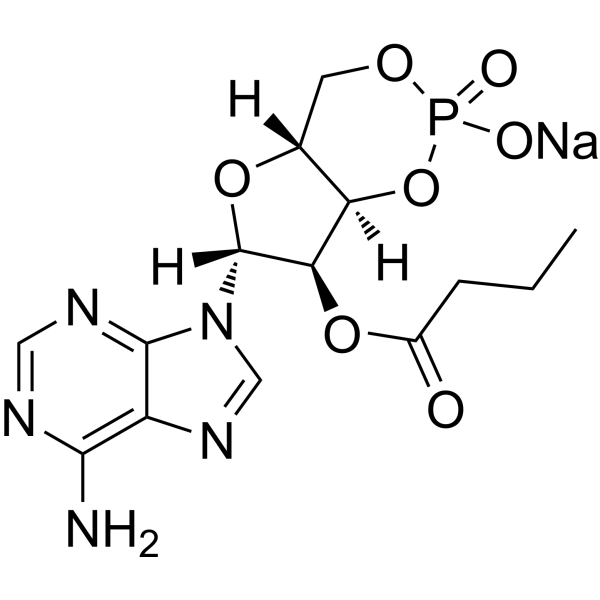
Synonyms: 2'-O-Monobutyryl cyclic AMP sodium
Research Areas:  

Cancer

2'-O-MB-cAMP (2'-O-Monobutyryl cyclic AMP) sodium is an inactive analog of Cyclic AMP. 2'-O-MB-cAMP sodium serves as a reference standard in FAB/MIKE mass spectrometry for the characterization of butyryl derivatives of cyclic nucleotides. 2'-O-MB-cAMP sodium does not induce differentiation or upregulate Nm23-R1 in glioma cells. 2'-O-MB-cAMP sodium can be used as a negative control cAMP analog for glioma-related research .
loading...
    loading...
Cat. No.: HY-108548
CAS No.: 185246-32-6
Synonyms: Rp-8-Bromo-PET-cGMPS
Target:  

PKG

Research Areas:  

Inflammation/Immunology

Rp-8-Br-PET-cGMPS sodium (Rp-8-Bromo-PET-cGMPS) is an analog of cyclic GMP (cGMP). It is a cell permeable, competitive, and reversible inhibitor of cGMP-dependent protein kinases (cGKs) that blocks activation of cGKI and cGKII by cGMP (Kis=35 and 30 nM). It less potently inhibits protein kinase A (Ki=11 μM) and cGMP-induced activation of cyclic nucleotide-gated channels (IC50=25 μM). In the absence of cGMP stimulation, Rp-8-bromo-PET-cGMPS can act as a partial agonist of cGKI (Ki=1 μM). Rp-8-bromo-PET-cGMPS is resistant to hydrolysis by phosphodiesterase 11.
loading...
    loading...
Cat. No.: HY-137325A
CAS No.: 301334-89-4
Target:  

Calcium Channel

Research Areas:  

Metabolic Disease

2-Chloro-ATP sodium (2-Chloro ATP) is an adenine nucleotide and an analog of ATP. It is an antagonist of the purinergic P2Y1 receptor and inhibits intracellular calcium mobilization induced by ADP (HY-W010918) in Jurkat cells expressing the human receptor (Ki=2.3 μM). 2-Chloro-ATP sodium is an agonist of the purinergic P2X receptor and induces inward currents in HEK293 cells expressing human bladder smooth muscle or rat PC12 forms of the receptor (EC50=0.5 and 2.5 μM). 2-Chloro-ATP sodium induces relaxation of precontracted guinea pig cecal strips in a concentration-dependent manner. 2-Chloro-ATP sodium has been used to study the substrate specificity of cyclic nucleotide-dependent protein kinases such as protein kinase A (PKA) and PKG.
loading...
    loading...
Cat. No.: HY-134263
CAS No.: 190522-24-8
Target:  

PKA Ras

Research Areas:  

Cardiovascular Disease

8-Br-cAMP-AM is a cyclic adenosine monophosphate (cAMP) analog that activates two major signal transduction pathways in the heart by mimicking the effects of cAMP: protein kinase A (PKA) and guanosine nucleotide exchange factor (Epac), which is directly activated by cAMP. 8-Br-cAMP-AM can be used to study cardiac ischemia and reperfusion injury .
loading...
    loading...
Cat. No.: HY-106110
CAS No.: 101758-79-6
Research Areas:  

Metabolic Disease

OP-2507 is a prostacyclin analog. OP-2507 can increase brain glucose levels in mice, suppress the breakdown of energy metabolism under hypoxic conditions, and has a protective effect against changes in cyclic nucleotides in hypoxic brain tissue (specifically, an increase in cyclic AMP and a decrease in cyclic GMP). OP-2507 provides protective effects against brain hypoxia and edema .
loading...
    loading...
Cat. No.: HY-116540A
CAS No.: 115116-37-5
Synonyms: 7DMB-Forskolin
Target:  

Adenylate Cyclase

Research Areas:  

Cardiovascular Disease

L 858051 (7DMB-Forskolin) dihydrochloride, an analog of Forskolin (HY-15371), is an adenylyl cyclase stimulator. L 858051 dihydrochloride directly activates adenylyl cyclase to increase intracellular, cellular, and ciliary cAMP levels. L 858051 dihydrochloride activates recombinant cyclic nucleotide-gated (E583M CNGA2) channels to induce a non-selective, Mg 2+-sensitive current in adult rat ventricular myocytes. L 858051 dihydrochloride maximally stimulates L-type Ca 2+ current in adult rat ventricular myocytes. L 858051 dihydrochloride increases total PDE3 and PDE4 activities in adult rat ventricular myocytes, with effects insensitive to PKA inhibition. L 858051 dihydrochloride serves as a tool to elevate intracellular cAMP for studying subsarcolemmal cAMP dynamics and compartmentation in adult rat ventricular myocytes .
loading...
    loading...
Cat. No.: HY-131824
CAS No.: 142754-31-2
Research Areas:  

Others

5,6-DM-cBIMP, a cyclic nucleotide analog, is an agonist of PDE2 that can significantly enhance the cAMP and cGMP hydrolytic activities of PDE2 [2.
loading...
    loading...
Cat. No.: HY-134325
CAS No.: 31356-95-3
Synonyms: 8-Hydroxy-cAMP
Target:  

PKA

8-OH-cAMP (8-Hydroxy-cAMP) is a polar, membrane-impermeable cyclic adenosine monophosphate analog that is resistant to mammalian cyclic nucleotide-dependent phosphodiesterases. As a polar PKA agonist, 8-OH-cAMP is used to study the role of cAMP in the development and progression of cardiovascular and metabolic diseases .
loading...
    loading...
Cat. No.: HY-131777
CAS No.: 39023-65-9
Target:  

PKA

Research Areas:  

Others

2-Cl-cAMP is an analog of cAMP and a potent stimulator of cAMP-dependent protein kinases such as PKA type I and II. 2-Cl-cAMP can be used as starting material for cyclic nucleotides .
loading...
    loading...
Cat. No.: HY-134280
CAS No.: 477782-33-5
Synonyms: Nicotinamide 8-Br-hypoxanthine dinucleotide
Target:  

Drug Derivative

Research Areas:  

Others

8-Br-NHD+ (Nicotinamide 8-Br-hypoxanthine dinucleotide) is a derivative of NAD+ (nicotinamide adenine dinucleotide) that acts as a potential substrate, competitive inhibitor or modulator of enzymes that interact with β-NAD+. 8-Br-NHD+ can be used to synthesize a cyclic ADP nucleotide (cADPR) analog .
loading...
    loading...
Cat. No.: HY-116540
CAS No.: 110452-75-0
Synonyms: 7DMB-Forskolin free base
Target:  

Adenylate Cyclase

Research Areas:  

Cardiovascular Disease

L 858051 (7DMB-Forskolin free base), an analog of Forskolin (HY-15371), is an adenylyl cyclase stimulator. L 858051 directly activates adenylyl cyclase to increase intracellular, cellular, and ciliary cAMP levels. L 858051 activates recombinant cyclic nucleotide-gated (E583M CNGA2) channels to induce a non-selective, Mg 2+-sensitive current in adult rat ventricular myocytes. L 858051 maximally stimulates L-type Ca 2+ current in adult rat ventricular myocytes. L 858051 increases total PDE3 and PDE4 activities in adult rat ventricular myocytes, with effects insensitive to PKA inhibition. L 858051 serves as a tool to elevate intracellular cAMP for studying subsarcolemmal cAMP dynamics and compartmentation in adult rat ventricular myocytes .
loading...
    loading...
Cat. No.: HY-131763R
CAS No.: 55443-13-5
Synonyms: 2'-O-Monobutyryl cyclic AMP sodium (Standard)
Research Areas:  

Cancer

2'-O-MB-cAMP sodium (Standard) (2'-O-Monobutyryl cyclic AMP sodium (Standard)) is the analytical standard of 2'-O-MB-cAMP sodium (HY-131763). This product is intended for research and analytical applications. 2'-O-MB-cAMP (2'-O-Monobutyryl cyclic AMP) sodium is an inactive analog of Cyclic AMP. 2'-O-MB-cAMP sodium serves as a reference standard in FAB/MIKE mass spectrometry for the characterization of butyryl derivatives of cyclic nucleotides. 2'-O-MB-cAMP sodium does not induce differentiation or upregulate Nm23-R1 in glioma cells. 2'-O-MB-cAMP sodium can be used as a negative control cAMP analog for glioma-related research .
loading...
    loading...
Cat. No.: HY-D3577
Target:  

Fluorescent Dye

Research Areas:  

Others

AF555 Picolyl Azide is a Fluorescent dye that enables site-specific fluorescent labeling via click chemistry. AF555 Picolyl Azide conjugates with the non-canonical amino acid N-propargyl-L-lysine introduced through ochre stop codon suppression via the copper (I)-catalyzed azide-alkyne cycloaddition (CuAAC) reaction, achieving labeling of hyperpolarization-activated cyclic nucleotide-gated HCN channels; its picolyl group accelerates the CuAAC reaction rate, thus completing labeling rapidly at room temperature and minimizing copper-induced cytotoxicity. AF555 Picolyl Azide forms covalent bonds with the alkynyl groups of nucleotide analogs through its azide moiety, labeling viral genomes containing 5-ethynyl-2'-deoxyuridine for visualization via fluorescence microscopy .
loading...
    loading...
  • 1

