13 Results for "

inherited diseases

" in MedChemExpress (MCE) Product Catalog:
Products (13)

13 Results for "inherited diseases" in MCE Product Catalog:

2
2 Cited Publications
Cat. No.: HY-161111
CAS No.: 3056394-59-0
Target:  

Ser/Thr Kinase

Research Areas:  

Cancer

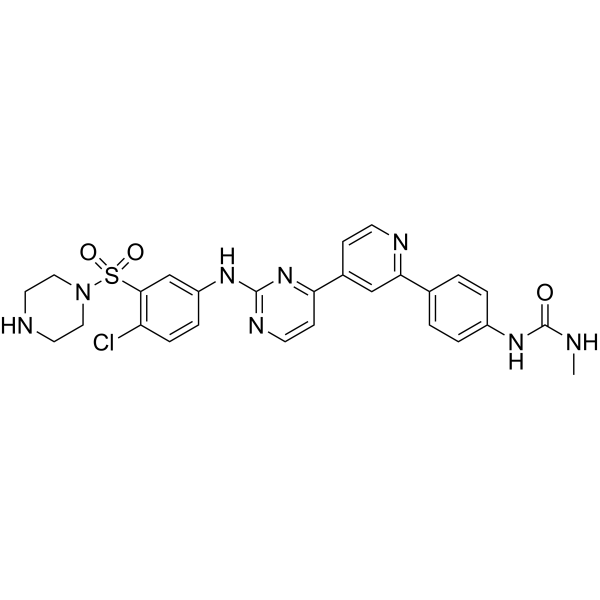
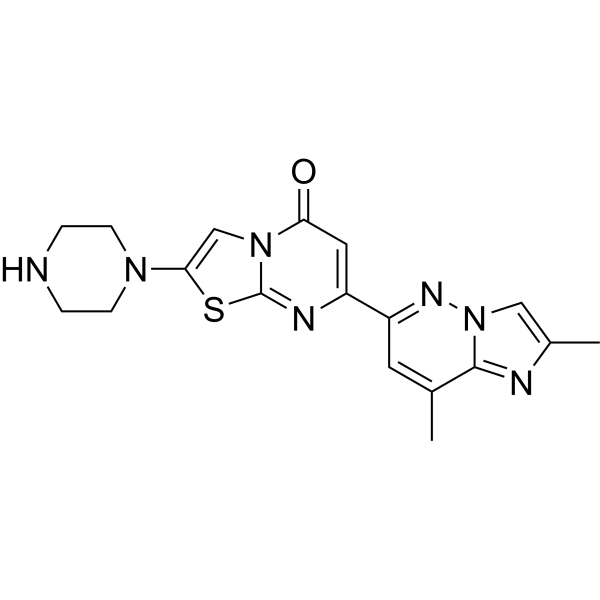
KVS0001 is a selective SMG1 inhibitor. KVS0001 elevates the expression of transcripts and proteins resulting from truncating mutations. KVS0001 increased the presentation of immune-targetable HLA class I-associated peptides from nonsense-mediated decay (NMD)-downregulated proteins on the surface of cancer cells. KVS0001 exerts anti-tumor properties and can be studied in research for NMD-related diseases, including cancer and inherited diseases .
loading...
    loading...
1
1 Cited Publications
Cat. No.: HY-W012734
CAS No.: 3105-95-1
Synonyms: H-HoPro-OH
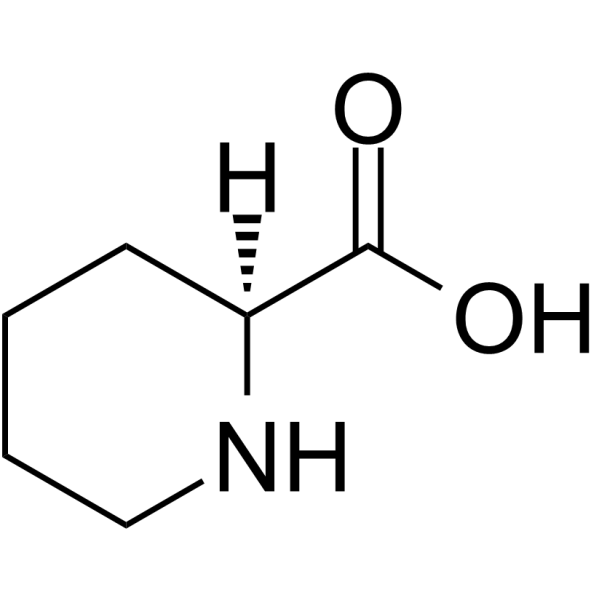
L-Pipecolic acid (H-HoPro-OH) is an oral active metabolite of Lysine and can accumulate in the bodily fluids of infants with autosomal inherited diseases, such as Zellweger syndrome and neonatal adrenal insufficiency. L-Pipecolic acid can promote muscle cell health and growth by enhancing protein synthesis, and plays a role in promoting gut health. L-Pipecolic acid holds promise for research in the fields of metabolic disorders, muscle growth disorders, and intestinal diseases .
loading...
    loading...
Cat. No.: HY-148794
CAS No.: 2031185-00-7
Purity:  98.42%
Synonyms: IkT-148009
Target:  

c-Met/HGFR Bcr-Abl

Research Areas:  

Neurological Disease Cancer

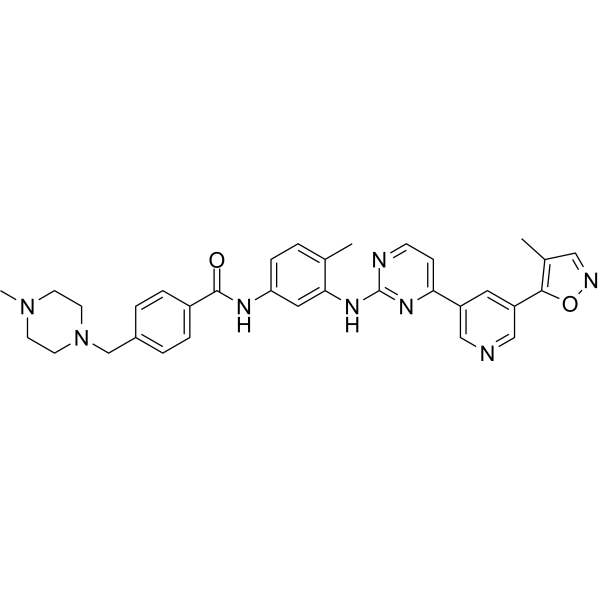
Risvodetinib (IkT-148009) is an orally active, selective and brain-penetrant protein tyrosine kinase inhibitor, displaying excellent target efficacy against c-Abl1, c-Abl2/Arg with IC50 values of 33 nM, 14 nM, respectively. Risvodetinib suppresses c-Abl activation and substantially protects dopaminergic neurons from degeneration in mouse models of both inherited and sporadic Parkinson’s disease (PD), which is promising for research in the field of PD .
loading...
    loading...
Cat. No.: HY-N16119
CAS No.: 53950-58-6
Phytyl palmitate is a phytyl ester. Phytyl palmitate can be isolated from the leaves Fatsia japonica. Phytyl palmitate can be used for inherited disorder of the lipid metabolism like Refsum’s disease research .
loading...
    loading...
Cat. No.: HY-113377
CAS No.: 28305-26-2
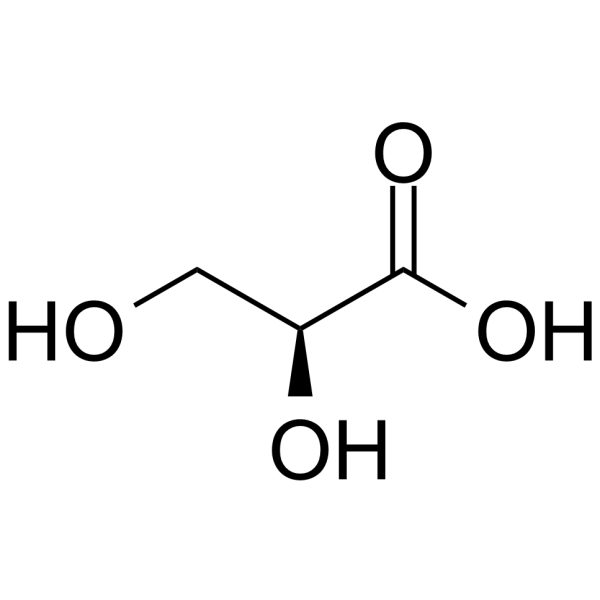
L-Glyceric acid is a mainly urinary metabolite accumulating in rare inherited metabolic disease L-glyceric aciduria. L-Glyceric acid can be used to diagnose primary hyperoxaluria type 2 (PH2). L-Glyceric acid excretion to distinguish PH1 from PH2 .
loading...
    loading...
Cat. No.: HY-W012734R
CAS No.: 3105-95-1
Synonyms: H-HoPro-OH (Standard)
L-Pipecolic acid (Standard) is an analytical standard of L-Pipecolic acid. This product is used for research and analytical applications. L-Pipecolic acid (H-HoPro-OH) is an oral active metabolite of Lysine and can accumulate in the bodily fluids of infants with autosomal inherited diseases, such as Zellweger syndrome and neonatal adrenal insufficiency. L-Pipecolic acid can promote muscle cell health and growth by enhancing protein synthesis, and plays a role in promoting gut health. L-Pipecolic acid holds promise for research in the fields of metabolic disorders, muscle growth disorders, and intestinal diseases .
loading...
    loading...
Cat. No.: HY-W141374
CAS No.: 108883-90-5
Target:  

DNA/RNA Synthesis

Research Areas:  

Neurological Disease

CB096 is an r(G4C2) exp RNA binder with EC50 values of 19 μM, 20 μM and 33 μM. CB096 selectively interacts with the 5′CGG/3′GGC 1×1 GG internal loop motif of folded r(G4C2) exp RNA, alters motif dynamics and closed base pairs, and rescues disease-related pathways. CB096 can be used for research on inherited amyotrophic lateral sclerosis/frontotemporal dementia (c9ALS/FTD) .
loading...
    loading...
Cat. No.: HY-150245
CAS No.: 2839311-21-4
Target:  

Huntingtin

Research Areas:  

Neurological Disease

mHTT-IN-1 (Example 1) is a potent mutant huntingtin (mHTT) inhibitor. mHTT is toxic and a major cause of the inherited autosomal dominant neurodegenerative disorder, Huntington's disease (HD). mHTT-IN-1 conducts the reduction of mHTT with an EC50 value of 46 nM .
loading...
    loading...
Cat. No.: HY-175671
Research Areas:  

Neurological Disease

LSD1/HDAC-IN-3 is a inhibitor targeting class I HDAC and LSD1 enzymes. LSD1/HDAC-IN-3 inhibits HDAC1, HDAC2, HDAC3, and LSD1 with IC50 values of 1702 nM, 842 nM, 358 nM, and 1074 nM, respectively. LSD1/HDAC-IN-3 exhibits antioxidant effects in H2O2-stressed ARPE-19 and 661W retinal cells, increasing levels of acetylated and methylated histone H3. LSD1/HDAC-IN-3 enhances photoreceptor survival in the rd10 mouse model of retinitis pigmentosa. LSD1/HDAC-IN-3 can be used for the study of inherited retinal diseases such as retinitis pigmentosa (RP) .
loading...
    loading...
Cat. No.: HY-113377A
CAS No.: 146298-95-5
Purity:  ≥99.0%
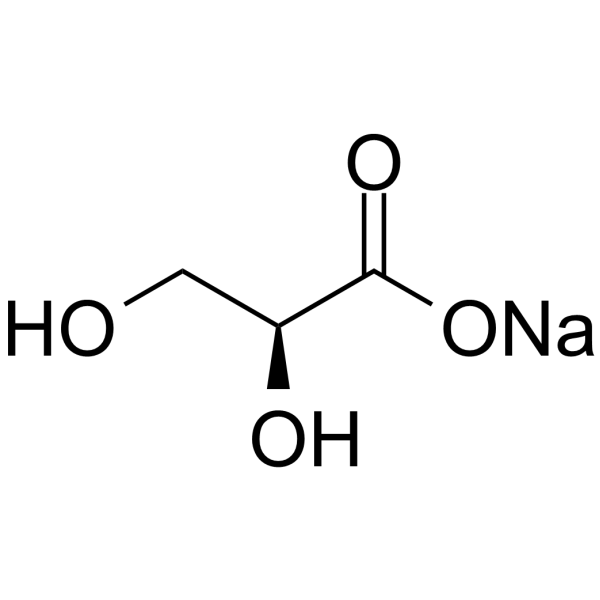
L-Glyceric acid sodium is a mainly urinary metabolite accumulating in rare inherited metabolic disease L-glyceric aciduria. L-Glyceric acid sodium can be used to diagnose primary hyperoxaluria type 2 (PH2). L-Glyceric acid sodium excretion to distinguish PH1 from PH2 .
loading...
    loading...
Cat. No.: HY-169761
CAS No.: 2879251-63-3
Research Areas:  

Cardiovascular Disease

WIZ-IN-1 (Example 2) is a Wiz inhibitor (DC50: 0.36 μM). WIZ-IN-1 can be used for research of inherited blood disorders (e.g., hemoglobinopathies, e.g., beta- hemoglobinopathies), such as sickle cell disease and beta-thalassemia .
loading...
    loading...
Cat. No.: HY-117051
CAS No.: 1046490-67-8
Target:  

HSP

Research Areas:  

Cancer

STA-2842 is an inhibitor of heat shock protein HSP90 with potential to inhibit autosomal dominant polycystic kidney disease (ADPKD). ADPKD is caused by inherited mutations in the PKD1 or PKD2 genes that abnormally activate multiple signaling proteins and pathways that regulate cell proliferation. STA-2842 can significantly reduce initial renal cyst formation and kidney growth in mice, and slow disease progression in mice with existing cysts.
loading...
    loading...
Cat. No.: HY-163818
CAS No.: 2839552-69-9
WIZ degrader 2 (Compound 142) is a molecular glue degrader for widely interspaced zinc (WIZ) finger motifs with an AC50 of 0.011 μM. WIZ degrader 2 induces the expression of fetal hemoglobin (HbF) with an EC50 of 0.038 μM. WIZ degrader 2 can be used in research related to hereditary blood disorders, such as sickle cell disease (SCD) and thalassemia .
loading...
    loading...
  • 1

