11 Results for "

lysine bioavailability

" in MedChemExpress (MCE) Product Catalog:
Products (11)

11 Results for "lysine bioavailability" in MCE Product Catalog:

20
20 Publications Verification
Cat. No.: HY-100626
CAS No.: 2012607-27-9
Purity:  99.75%
Target:  

WNK Kinase

Research Areas:  

Cancer

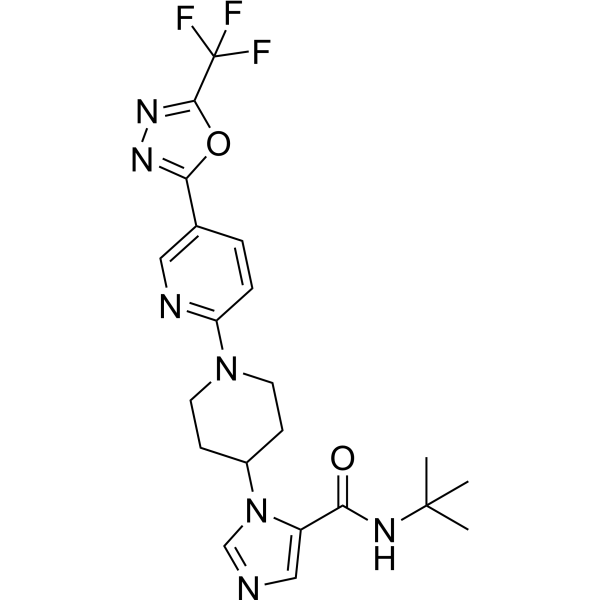
WNK463 is an orally bioavailable pan-With-No-Lysine (K) (WNK)-kinase inhibitor with IC50s of 5 nM, 1 nM, 6 nM, and 9 nM for WNK1, WNK2, WNK3, and WNK4, respectively .
loading...
    loading...
5
5 Cited Publications
Cat. No.: HY-100014
CAS No.: 1905481-36-8
Purity:  99.64%
Target:  

Histone Demethylase

Research Areas:  

Cancer

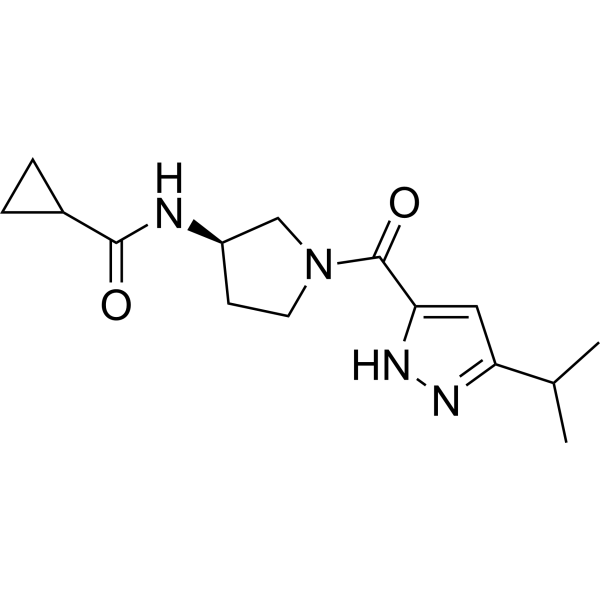
KDM5A-IN-1 is a potent, orally bioavailable pan-histone lysine demethylases 5 (KDM5) inhibitor with IC50s of 45 nM, 56 nM and 55 nM for KDM5A, KDM5B and KDM5C, respectively, and with an EC50 value of 960 nM for PC9 H3K4Me3. KDM5A-IN-1 is significantly less potent against other KDM5B enzymes (1A, 2B, 3B, 4C, 6A, 7B) .
loading...
    loading...
2
2 Cited Publications
Cat. No.: HY-Y0669
CAS No.: 535-75-1
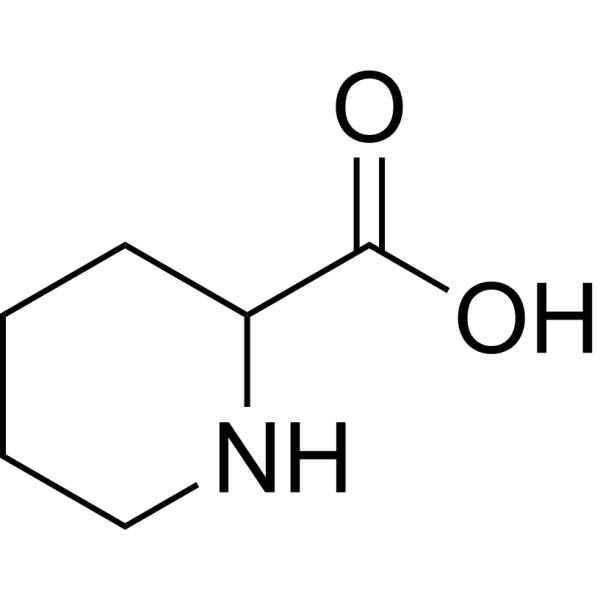
Pipecolic acid is an orally bioavailable, blood-brain barrier-permeable metabolite of lysine with antioxidant, inhibitor, and inducer activity. Pipecolic acid modulates the YAP-GPX4 signaling pathway, reduces retinal vascular tube formation, and mitigates ferroptosis. Pipecolic acid potentiates voltage-sensitive Ca 2+ channel currents and induces neuronal apoptosis. Pipecolic acid can be used for the research of diabetic retinopathy .
loading...
    loading...
Cat. No.: HY-W011165
CAS No.: 52123-30-5
Synonyms: L-Lysyl-L-lysine dihydrochloride
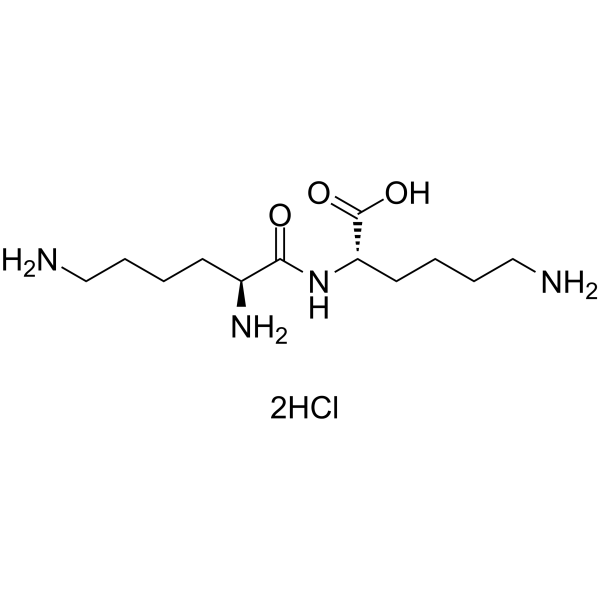
Lysyllysine dihydrochloride (L-Lysyl-L-lysine dihydrochloride) is an orally active PepT1 substrate. Lysyllysine dihydrochloride enhances whole-body protein synthesis, improves intestinal structure, alleviates intestinal mucosal inflammation, and exhibits higher lysine bioavailability in neonatal piglets with PN-induced intestinal atrophy. Lysyllysine dihydrochloride inhibits the growth of axenic cyanobacterial strains and induces their cell lysis. Lysyllysine dihydrochloride can be used in studies related to intestinal atrophy and metabolism .
loading...
    loading...
Cat. No.: HY-120791
CAS No.: 13184-13-9
Synonyms: L-Lysyl-L-lysine
Lysyllysine (L-Lysyl-L-lysine ) is an orally active PepT1 substrate. Lysyllysine enhances whole-body protein synthesis, improves intestinal structure, alleviates intestinal mucosal inflammation, and exhibits higher lysine bioavailability in neonatal piglets with PN-induced intestinal atrophy. Lysyllysine inhibits the growth of axenic cyanobacterial strains and induces their cell lysis. Lysyllysine can be used in studies related to intestinal atrophy and metabolism .
loading...
    loading...
Cat. No.: HY-170832
Research Areas:  

Cancer

Menin–KMT2A-IN-1 (Compound 20) is the inhibitor for menin–KMT2A that binds to menin with an IC50 of 8 nM, and inhibits the interaction between menin and lysine methyltransferase 2A (KMT2A). Menin–KMT2A-IN-1 inhibits hERG with an IC50 of 65 μM. Menin–KMT2A-IN-1 inhibits cell MV4-11 with an IC50 of 74 nM. Menin–KMT2A-IN-1 exhibits good pharmacokinetic characteristics in CD-1 mouse with an orally bioavailability of 74% .
loading...
    loading...
Cat. No.: HY-120791A
CAS No.: 73343-51-8
Synonyms: L-Lysyl-L-lysine trihydrochloride
Lysyllysine trihydrochloride (L-Lysyl-L-lysine trihydrochloride) is an orally active PepT1 substrate. Lysyllysine trihydrochloride enhances whole-body protein synthesis, improves intestinal structure, alleviates intestinal mucosal inflammation, and exhibits higher lysine bioavailability in neonatal piglets with PN-induced intestinal atrophy. Lysyllysine trihydrochloride inhibits the growth of axenic cyanobacterial strains and induces their cell lysis. Lysyllysine trihydrochloride can be used in studies related to intestinal atrophy and metabolism .
loading...
    loading...
Cat. No.: HY-100014R
CAS No.: 1905481-36-8
Research Areas:  

Cancer

KDM5A-IN-1 (Standard) is the analytical standard of KDM5A-IN-1 (HY-100014). This product is intended for research and analytical applications. KDM5A-IN-1 is a potent, orally bioavailable pan-histone lysine demethylases 5 (KDM5) inhibitor with IC50s of 45 nM, 56 nM and 55 nM for KDM5A, KDM5B and KDM5C, respectively, and with an EC50 value of 960 nM for PC9 H3K4Me3. KDM5A-IN-1 is significantly less potent against other KDM5B enzymes (1A, 2B, 3B, 4C, 6A, 7B) .
loading...
    loading...
Cat. No.: HY-184414
Research Areas:  

Cancer

BMS-135-L-Lys is a dual-cation prodrug derived from CK2 inhibitor BMS-135 (HY-181022) through esterification with L-lysine using a secondary alcohol. BMS-135-L-Lys achieves enhanced solubility by maintaining protonation of the ε-amino group of the Lys side chain at intestinal pH. BMS-135-L-Lys is released in situ by intestinal wall esterase from the parent drug, significantly increasing the oral bioavailability of the parent drug and overcoming the non-linear pharmacokinetic problem when the dose of the parent drug is increased. BMS-135-L-Lys can be used in related research on colon cancer and lung cancer .
loading...
    loading...
Cat. No.: HY-184414A
Research Areas:  

Cancer

BMS-135-L-Lys TFA is a dual-cation prodrug derived from CK2 inhibitor BMS-135 (HY-181022) through esterification with L-lysine using a secondary alcohol. BMS-135-L-Lys TFA achieves enhanced solubility by maintaining protonation of the ε-amino group of the Lys side chain at intestinal pH. BMS-135-L-Lys TFA is released in situ by intestinal wall esterase from the parent drug, significantly increasing the oral bioavailability of the parent drug and overcoming the non-linear pharmacokinetic problem when the dose of the parent drug is increased. BMS-135-L-Lys TFA can be used in related research on colon cancer and lung cancer .
loading...
    loading...
Cat. No.: HY-184414B
Research Areas:  

Cancer

BMS-135-L-Lys dihydrochloride is a dual-cation prodrug derived from CK2 inhibitor BMS-135 (HY-181022) through esterification with L-lysine using a secondary alcohol. BMS-135-L-Lys dihydrochloride achieves enhanced solubility by maintaining protonation of the ε-amino group of the Lys side chain at intestinal pH. BMS-135-L-Lys dihydrochloride is released in situ by intestinal wall esterase from the parent drug, significantly increasing the oral bioavailability of the parent drug and overcoming the non-linear pharmacokinetic problem when the dose of the parent drug is increased. BMS-135-L-Lys dihydrochloride can be used in related research on colon cancer and lung cancer .
loading...
    loading...
  • 1

