

1. Search Result
Search Result
Results for "

quantum dots

" in MedChemExpress (MCE) Product Catalog:

22

Inhibitors & Agonists

9

Fluorescent Dye

9

Biochemical Assay Reagents

1

Peptides

1

Natural
Products

1

Click Chemistry

Cat. No. Product Name Target Research Areas Chemical Structure
  • HY-126505
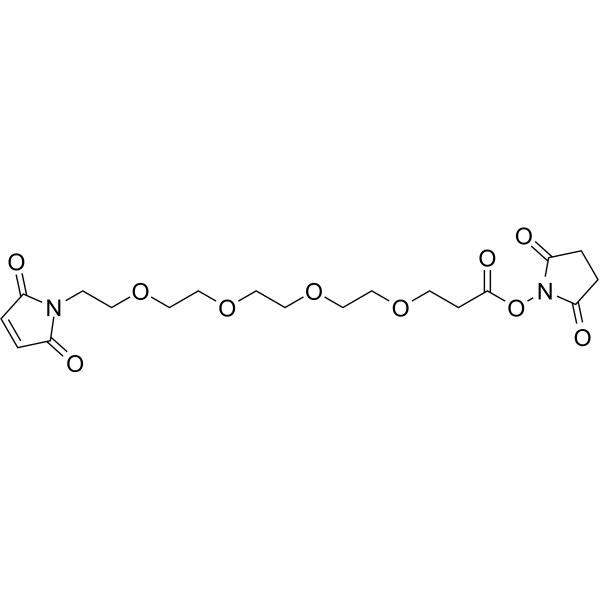
    Mal-​PEG4-​NHS ester
    2 Publications Verification

    ADC Linker Cancer
    Mal-PEG4-NHS ester is a non-cleavable ADC linker which links Quantum dots (QDs) with PEGylated liposomes .
    Mal-​PEG4-​NHS ester
  • HY-W019831
    Silicon dioxide
    1 Publications Verification

    Silica; Colloidal anhydrous silica

    Biochemical Assay Reagents Others
    Silicon dioxide (Silica) is the core of gold-coated silica nanoparticles. Silicon dioxide has the characteristic of a spherical structure, with a layer of gold nanoparticles covering its surface. Silicon dioxide can be used as a coating material for quantum dots, enhancing their stability, reducing toxicity and improving hydrophilicity .
    Silicon dioxide
  • HY-B1529A
    Citric acid triammonium
    5+ Cited Publications

    Triammonium citrate

    Apoptosis Endogenous Metabolite Bacterial Others Cancer
    Citric acid triammonium (Triammonium citrate) is formed by Citric acid (HY-N1428) reacting with ammonia in a molar ratio of 1:3. Citric acid triammonium can be used as the carbon source to prepare carbon quantum dots (CDs). Citric acid triammonium with higher nitrogen components might promote the nitrogen-based functional groups in CDs, leading to a more efficient emission-color tunability .
    Citric acid triammonium
  • HY-B1529
    Ammonium citrate dibasic, 99%
    5+ Cited Publications

    Ammonium hydrogencitrate, 99%; Diammonium hydrogen citrate, 99%

    Environmental Pollutants Endogenous Metabolite Biochemical Assay Reagents Apoptosis Others
    Ammonium citrate dibasic, 99% (Ammonium hydrogencitrate, 99%) can be used as the carbon source to prepare carbon quantum dots (CDs). Ammonium citrate dibasic, 99% is a buffering agent .
    Ammonium citrate dibasic, 99%
  • HY-W127716
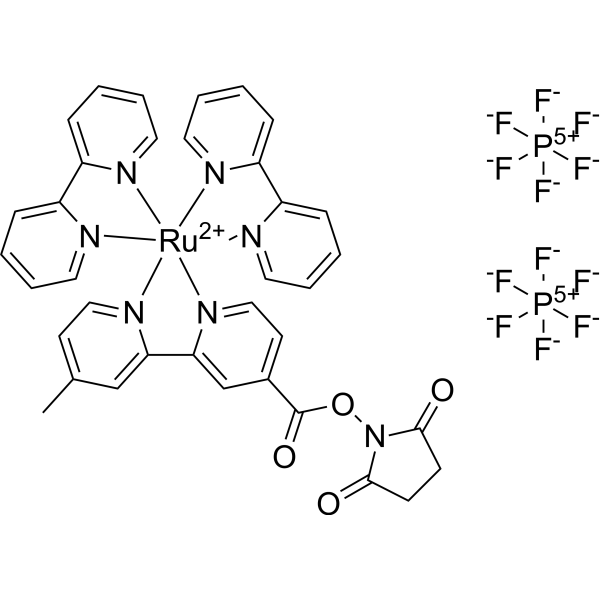
    Ru(bpy)2(mcbpy-O-Su-ester)(PF6)2
    1 Publications Verification

    Fluorescent Dye Cancer
    Ru(bpy)2(mcbpy-O-Su-ester)(PF6)2 is a potent ruthenium-based dye. Ru(bpy)2(mcbpy-O-Su-ester)(PF6)2 can bu used as an effective quencher of quantum dots (QDs) fluorescence and the capture probe of virus antigen EV71. Ru(bpy)2(mcbpy-O-Su-ester)(PF6)2 can be used sensitive electrogenerated chemiluminescence (ECL) labels for detection of matrix metalloproteinases (MMPs) .
    Ru(bpy)2(mcbpy-O-Su-ester)(PF6)2
  • HY-D1703

    Fluorescent Dye Others
    Oxazine 170 perchlorate is a laser dye with a wide excitation spectrum range (300−550 nm), which strongly absorbs light with a wavelength greater than 550 nm, and it emits fluorescence with a wavelength of about 645 nm .
    Oxazine 170 perchlorate
  • HY-D2195

    Fluorescent Dye Others
    AgAuSe-PEG-NH2 (1000 nm) is a fluorescent quantum dot that emits fluorescence in the near-infrared II region, with an emission peak reaching 1000 nm that can be used in bioimaging.
    AgAuSe-PEG-NH2 (1000 nm)
  • HY-D2198

    Fluorescent Dye Others
    AgAuSe-PEG-NH2 (1120 nm) is a fluorescent quantum dot that emits fluorescence in the near-infrared II region, with an emission peak reaching 1120 nm that can be used in bioimaging .
    AgAuSe-PEG-NH2 (1120 nm)
  • HY-130197

    PROTAC Linkers Cancer
    Lipoamido-PEG4-azide is a PEG-based PROTAC linker can be used in the synthesis of PROTACs. Lipoamido-PEG4-azide is a click chemistry reagent, it contains an Azide group and can undergo copper-catalyzed azide-alkyne cycloaddition reaction (CuAAc) with molecules containing Alkyne groups. It can also undergo strain-promoted alkyne-azide cycloaddition (SPAAC) reactions with molecules containing DBCO or BCN groups.
    Lipoamido-PEG4-azide
  • HY-D2956

    CLIP-GLA-NHS

    Biochemical Assay Reagents Others
    BC-GLA-NHS (CLIP-GLA-NHS) is a NHS-labeled CLIP tag, which is an amine-reactive crosslinker and can achieve site-specific protein labeling. The NHS ester of BC-GLA-NHS reacts with the primary amine of the target molecule (such as antibodies, quantum dots) in a pH 7.5-8.5 buffer solution to form a stable amide bond. After coupling, the BC molecule undergoes a nucleophilic substitution reaction with the active site (Cys) of the CLIP-tagged fusion protein, releasing benzylcytosine and forming an irreversible thioether bond, achieving covalent labeling. BC-GLA-NHS can be used for click chemistry labeling .
    BC-GLA-NHS
  • HY-D1394

    AgAuSe

    Fluorescent Dye Others
    AgAuSe QDs (AgAuSe) is a near infrared (NIR) fluorescent quantum dots (QDs), with a bright emission from 820 to 1170 nm. AgAuSe QDs can be used for the research in biomedical imaging and NIR devices .
    AgAuSe QDs
  • HY-D1391

    PbS/CdSe QD

    Fluorescent Dye Others
    PbS/CdS QDs (PbS/CdSe QD) is a fluorescent probe that can be used for in vivo fluorescence imaging in the second near-infrared window .
    PbS/CdS QDs
  • HY-P11088

    Transmembrane Glycoprotein Radionuclide-Drug Conjugates (RDCs) Inflammation/Immunology
    VCAM1 binding peptide is a VCAM1 binder with internalization activity. VCAM1 binding peptide can be labeled with 5-FAM. VCAM1 binding peptide serves as a component of biosensing systems for visualizing in vitro VCAM1 endocytic pathways. VCAM1 binding peptide forms the research and development basis for MacroP and NAMP, PET radiotracers targeting VCAM1. VCAM1 binding peptide is applicable to studies related to atherosclerosis .
    VCAM1 binding peptide
  • HY-D1393

    Pb:Ag2Se

    Fluorescent Dye Others
    Pb:Ag2Se QDs (Pb:Ag2Se) is an effective biological probe in the second near-infrared window (NIR-II) that can be used in bioimaging with high tissue penetration depth and high spatiotemporal resolution .
    Pb:Ag2Se QDs
  • HY-D2194

    Fluorescent Dye Others
    AgAuSe-COOH (1000 nm) is a fluorescent quantum dot that emits fluorescence in the near-infrared II region, with an emission peak reaching 1000 nm. AgAuSe-COOH (1000 nm) has the advantages of narrow band gap, large Stokes shift, and good photostability. AgAuSe-COOH (1000 nm) can bind proteins, antibodies, peptides, PEG, etc., and can be widely used in the field of biological imaging.
    AgAuSe-COOH (1000 nm)
  • HY-W1051944H

    Biochemical Assay Reagents Others
    4-arm PEG1000-LA is a multifunctional drug delivery system composed of lipoic acid (HY-18733) and polyethylene glycol (PEG). The lipoic acid group has a high affinity for metal surfaces and is widely used in gold nanoparticles and quantum dot surfaces.
    4-arm PEG1000-LA
  • HY-W1051944A

    Biochemical Assay Reagents Others
    4-arm PEG5000-LA is a multifunctional drug delivery system composed of lipoic acid (HY-18733) and polyethylene glycol (PEG). The lipoic acid group has a high affinity for metal surfaces and is widely used in gold nanoparticles and quantum dot surfaces.
    4-arm PEG5000-LA
  • HY-W1051944I

    Biochemical Assay Reagents Others
    4-arm PEG3400-LA is a multifunctional drug delivery system composed of lipoic acid (HY-18733) and polyethylene glycol (PEG). The lipoic acid group has a high affinity for metal surfaces and is widely used in gold nanoparticles and quantum dot surfaces.
    4-arm PEG3400-LA
  • HY-W1051944E

    Biochemical Assay Reagents Others
    4-arm PEG600-LA is a multifunctional drug delivery system composed of lipoic acid (HY-18733) and polyethylene glycol (PEG). The lipoic acid group has a high affinity for metal surfaces and is widely used in gold nanoparticles and quantum dot surfaces.
    4-arm PEG600-LA
  • HY-W1051944

    Biochemical Assay Reagents Others
    4-arm PEG2000-LA is a multifunctional drug delivery system composed of lipoic acid (HY-18733) and polyethylene glycol (PEG). The lipoic acid group has a high affinity for metal surfaces and is widely used in gold nanoparticles and quantum dot surfaces.
    4-arm PEG2000-LA
  • HY-W1051944B

    Biochemical Assay Reagents Others
    4-arm PEG10000-LA is a multifunctional drug delivery system composed of lipoic acid (HY-18733) and polyethylene glycol (PEG). The lipoic acid group has a high affinity for metal surfaces and is widely used in gold nanoparticles and quantum dot surfaces.
    4-arm PEG10000-LA
  • HY-W1051944D

    Biochemical Assay Reagents Others
    4-arm PEG400-LA is a multifunctional drug delivery system composed of lipoic acid (HY-18733) and polyethylene glycol (PEG). The lipoic acid group has a high affinity for metal surfaces and is widely used in gold nanoparticles and quantum dot surfaces.
    4-arm PEG400-LA

Inquiry Online

Your information is safe with us. * Required Fields.

Salutation


Country or Region *

Applicant Name *


Organization Name *

Department *


Email Address *


Product Name *

Cat. No.


Requested quantity *

Phone Number *


Remarks

Inquiry Online

Inquiry Information

Product Name:
Cat. No.:
Quantity:
MCE Japan Authorized Agent:

