1. Search Result
Search Result
Results for "

safety testing

" in MedChemExpress (MCE) Product Catalog:

8

Inhibitors & Agonists

1

Screening Libraries

1

Natural
Products

Cat. No. Product Name Target Research Areas Chemical Structure
  • HY-175188

    BPN-0027490

    Myosin Neurological Disease
    MT-110 (BPN-0027490) is a non-muscle myosin NMIIB-selective inhibitor with high brain penetration and favorable safety profile. MT-110 specifically disrupts NMIIB-dependent actin dynamics in dendritic spines, while it exerts no significant adverse effects on cardiac myosin II and cardiac functions (such as cardiac output and heart rate) at tested concentrations. A single administration of MT-110 produces long-lasting (sustained for several weeks) blockade of methamphetamine motivation associated with environmental cues. MT-110 exhibits extremely high specificity, with no interference with cocaine motivation, hippocampus-dependent memory, fear memory, or locomotor and anxiety-like behaviors. MT-110 serves as a valuable tool compound for investigating the mechanisms of methamphetamine use disorder .
    MT-110
  • HY-131146
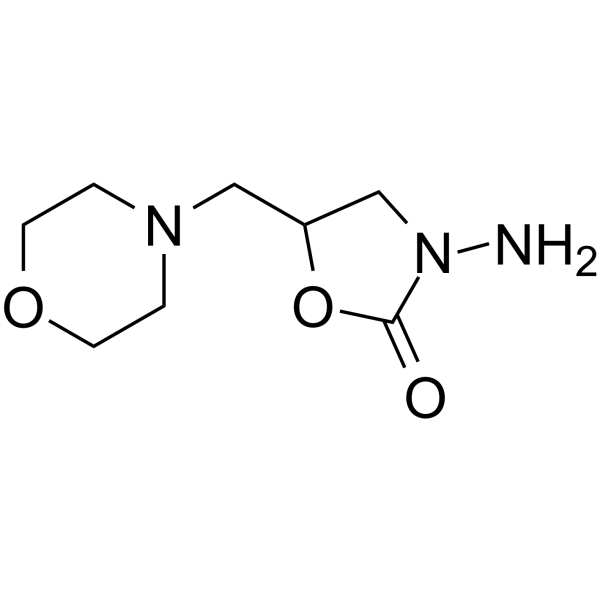
    AMOZ
    1 Publications Verification

    3-Amino-5-morpholinomethyl-2-oxazolidone

    Drug Metabolite Infection
    AMOZ is a carcinogenic metabolite of Furaltadone (HY-B1148A), which forms stable tissue residues by covalently binding to proteins as a hapten. AMOZ can be coupled with carrier proteins (such as BSA/OVA) to induce immune response and is released after acid hydrolysis. AMOZ residues can be detected by competitive ELISA method, and the detection limit in the monoclonal antibody 2E5.1 test is as low as 0.16 μg/kg (shrimp sample). AMOZ can be used as a typical marker to monitor drug residues in animal-derived foods in the field of food safety[1][2].
    AMOZ
  • HY-W075770

    Nickel monoxide

    Environmental Pollutants Apoptosis Reactive Oxygen Species (ROS) Caspase TGF-beta/Smad p38 MAPK Akt PI3K Infection Metabolic Disease Cancer
    Nickel(II) oxide (nickel monoxide) is a chemical warfare agent that can enter the body through the respiratory tract and other routes, distributing to organs such as the lungs and testes. The nanoparticle form of nickel(II) oxide (NiO NPs) exhibits antibacterial, anti-leishmanial, anti-diabetic, and anti-cancer activities. NiO NPs can be activated by ultraviolet and visible light, generating reactive oxygen species (ROS). Nickel(II) oxide induces oxidative stress by generating reactive oxygen species, activating the TGF-β1-mediated MAPK and PI3K/AKT pathways, disrupting the MMPs/TIMPs balance, and upregulating the expression of inflammatory factors (IL-1β, IL-6) and apoptosis-related molecules (Bax, caspase-3, p53), while inhibiting the activity of the anti-apoptotic molecule Bcl-2. Nickel(II) oxide induces cytotoxicity, promotes fibrosis, triggers inflammatory responses, and causes apoptosis. Nickel(II) oxide can be applied in research on the safety assessment of nanomaterials, such as in the context of pulmonary fibrosis and reproductive system toxicity .
    Nickel(II) oxide
  • HY-16997A
    Itacitinib adipate
    20+ Cited Publications

    JAK Cancer
    Itacitinib adipate is an orally bioavailable and selective JAK1 inhibitor which has been tested for efficacy and safety in a phase II trial in myelofibrosis.
    Itacitinib adipate
  • HY-121870A

    Larocaine hydrochloride

    Dopamine Receptor Neurological Disease
    Dimethocaine (Larocaine) hydrochloride is distributed and consumed as "new psychoactive substance" (NPS) without any safety testing
    Dimethocaine hydrochloride
  • HY-119530

    BW 57-323

    Nucleoside Antimetabolite/Analog Others
    Thiamiprine (BW 57-323) is a compound related to azathioprine. Its nucleoside forms are similar to the parent compound in terms of cytotoxicity in vitro (except for the arabinoside). In the rat adjuvant arthritis model in vivo, its riboside and 2'-deoxyriboside are less active than the parent compound. The arabinoside is inactive and nontoxic. It has similar potency to the other parent compounds tested, but has a different safety profile.
    Thiamiprine
  • HY-119821R

    Reference Standards Glycosidase Infection
    Thiamiprine (Standard) is the analytical standard of Thiamiprine. This product is intended for research and analytical applications. Thiamiprine (BW 57-323) is a compound related to azathioprine. Its nucleoside forms are similar to the parent compound in terms of cytotoxicity in vitro (except for the arabinoside). In the rat adjuvant arthritis model in vivo, its riboside and 2'-deoxyriboside are less active than the parent compound. The arabinoside is inactive and nontoxic. It has similar potency to the other parent compounds tested, but has a different safety profile.
    Terphenyllin (Standard)
  • HY-119530R

    BW 57-323 (Standard)

    Nucleoside Antimetabolite/Analog Reference Standards Others
    Thiamiprine (Standard) is the analytical standard of Thiamiprine. This product is intended for research and analytical applications. Thiamiprine (BW 57-323) is a compound related to azathioprine. Its nucleoside forms are similar to the parent compound in terms of cytotoxicity in vitro (except for the arabinoside). In the rat adjuvant arthritis model in vivo, its riboside and 2'-deoxyriboside are less active than the parent compound. The arabinoside is inactive and nontoxic. It has similar potency to the other parent compounds tested, but has a different safety profile.
    Thiamiprine (Standard)

Inquiry Online

Your information is safe with us. * Required Fields.

Salutation


Country or Region *

Applicant Name *


Organization Name *

Department *


Email Address *


Product Name *

Cat. No.


Requested quantity *

Phone Number *


Remarks

Inquiry Online

Inquiry Information

Product Name:
Cat. No.:
Quantity:
MCE Japan Authorized Agent:

