
1. Search Result
Search Result
Results for "

thrombosis

" in MedChemExpress (MCE) Product Catalog:

230

Inhibitors & Agonists

2

Screening Libraries

1

Fluorescent Dyes

5

Biochemical Assay Reagents

18

Peptides

5

Inhibitory Antibodies

25

Natural
Products

13

Isotope-Labeled Compounds

6

Oligonucleotides

Cat. No. Product Name Target Research Area
  • HY-A0299

    Tripeptide 29

    Peptides Inflammation/Immunology
    H-Gly-Pro-Hyp-OH is a collagen-derived peptide and also a dipeptidyl peptidase-4 inhibitor.\nH-Gly-Pro-Hyp-OH inhibits the activity of dipeptidyl peptidase-4 in vitro. H-Gly-Pro-Hyp-OH binds to the DNA-binding site of the JUN/FOS complex, blocks the formation of the DNA-JUN/FOS complex, and inhibits transcriptional activity. H-Gly-Pro-Hyp-OH is applicable to research related to skin photoaging, UVB-induced skin aging/photoaging, and thrombosis .
  • HY-P4245

    Factor Xa Kallikrein Cardiovascular Disease Neurological Disease
    D-Pro-Phe-Arg-Chloromethylketone, a inhibitor of coagulation factor XII and plasma kallikrein, plays an important role in thrombosis and inflammation .
  • HY-P0074
    GPRP
    3 Publications Verification

    Gly-Pro-Arg-Pro; Pefa 6003

    Thrombin Cardiovascular Disease
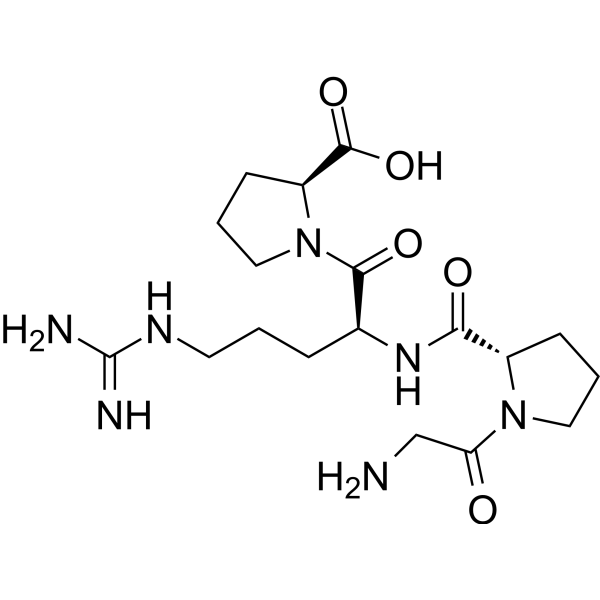
    GPRP (Gly-Pro-Arg-Pro; Pefa 6003) is a fibrin polymerization inhibitor that inhibits the interaction between fibrinogen and the platelet membrane glycoprotein Ⅱb/IIIa complex (glycoprotein IIb/IIIa receptor) . GPRP increases the level of free thrombin in activated platelet-rich plasma by reducing the adsorption of thrombin onto fibrin. GPRP inhibits platelet aggregation and prolongs the thrombin-initiated clotting time in plasma. GPRP is applicable for research related to thrombosis and thrombotic diseases .
  • HY-P5126
    DOTA-LM3
    2 Publications Verification

    Radionuclide-Drug Conjugates (RDCs) Somatostatin Receptor Cancer
    DOTA-LM3 is a somatostatin receptor (SSTR) antagonist. LM3 refers to p-Cl-Phe- cyclo(D-Cys-Tyr-D-4-amino-Phe(carbamoyl)-Lys-Thr-Cys)D-Tyr- NH2, as well as a somatostatin antagonist. DOTA-LM3 is often isotopically labeled for tracing tumors in vivo, such as 177Lu-DOTA-LM3 and 68 Ga-DOTA-LM3. 68 Ga-DOTA-LM3 shows favorable biodistribution, high tumor uptake, good tumor retention, and few safety concerns. 177Lu-DOTA-LM3 can be used for research in DOTATOC-negative liver metastases, such as pancreatic NET and extensive tumor thrombosis . DOTA-LM3 can be used for the synthesis/research of Radionuclide-Drug Conjugates (RDCs).
  • HY-131409

    D-Val-Leu-Lys-p-itoailide dihydrochloride; D-VLK-pNA dihydrochloride; S 2251 dihydrochloride

    Fluorescent Dye Others
    D-Val-Leu-Lys-pNA (D-Val-Leu-Lys-p-nitroanilide) dihydrochloride is a chromogenic peptide substrate that serves as a characteristic substrate for plasmin and plasminogen. D-Val-Leu-Lys-pNA dihydrochloride acts as a sensitive substrate for the DFE27 serine protease derived from Bacillus subtilis DC27. Catalyzed by plasmin, D-Val-Leu-Lys-pNA dihydrochloride binds and hydrolyzes to release p-nitroaniline (pNA), which can be detected colorimetrically at 405 nm as a measure of fibrinolytic activity .
  • HY-122542B
    PPACK TFA
    2 Publications Verification

    Ligands for E3 Ligase Molecular Glues IKZF Family Cardiovascular Disease
    PPACK TFA is an orally active, selective molecular glue degrader targeting IKZF2. Through a molecular glue mechanism, PPACK TFA binds to CRBN, recruits IKZF2 to form a ternary complex, and promotes its ubiquitination and proteasomal degradation. This further converts inhibitory regulatory T cells (Treg) into effector-like T cells, enhances CD8 + T cell responses, and modulates the Teff:Treg balance. PPACK TFA also increases the production of the inflammatory cytokine IL-2 and reduces the suppressive activity of Treg. PPACK TFA can be used in cancer immunotherapy research, and exhibits a synergistic effect when combined with immune checkpoint inhibitors such as anti-PD1 .
  • HY-P5542

    SB-01; Peniel 2000

    Factor Xa TGF-beta/Smad Inflammation/Immunology
    Vicatertide (SB-01, Peniel 2000) is a polypeptide with both competitive inhibitory activity against TGF-β1 and selective inhibitory activity against human factor XIa (hFXIa, with a Ka of 80 nM for hFXIa). Vicatertide binds allosterically to the two binding sites of dimeric hFXI/hFXIa, while directly binding to activated TGF-β1, selectively blocking the Smad1/5/8 pathway and maintaining low-level activation of the Smad2 pathway to enhance the synthesis of type Ⅱ collagen and aggrecan. Vicatertide inhibits thrombus formation in arteriovenous thrombosis models, and also reduces thrombus weight and thrombus incidence in mouse lung cancer models. Vicatertide can be used for research on degenerative disc disease and thrombosis-related diseases .
  • HY-P5126A
    DOTA-LM3 TFA
    2 Publications Verification

    Radionuclide-Drug Conjugates (RDCs) Somatostatin Receptor Cancer
    DOTA-LM3 TFA is a somatostatin receptor (SSTR) antagonist. LM3 refers to p-Cl-Phe- cyclo(D-Cys-Tyr-D-4-amino-Phe(carbamoyl)-Lys-Thr-Cys)D-Tyr- NH2, as well as a somatostatin antagonist. DOTA-LM3 TFA is often isotopically labeled for tracing tumors in vivo, such as 177Lu-DOTA-LM3 TFA and 68 Ga-DOTA-LM3 TFA. 68 Ga-DOTA-LM3 TFA shows favorable biodistribution, high tumor uptake, good tumor retention, and few safety concerns. 177Lu-DOTA-LM3 TFA can be used for research in DOTATOC-negative liver metastases, such as pancreatic NET and extensive tumor thrombosis . DOTA-LM3 (TFA) can be used for the synthesis/research of Radionuclide-Drug Conjugates (RDCs).
  • HY-P10014

    Peptides Cardiovascular Disease
    Bibapcitide, a 26 amino acid, inhibits thrombosis .
  • HY-P2021

    Thrombin Cardiovascular Disease
    BMS 180742 is a thrombin exosite inhibitor. BMS 180742 does not inhibit arterial thrombosis .
  • HY-P10577

    Protease Activated Receptor (PAR) Cardiovascular Disease
    RAG8 peptide is an antagonist for protease-activated receptor 4 (PAR 4), which inhibits late-stage platelet activation, and reduces thrombosis without altering hemostasis or increasing bleeding risk. RAG8 peptide can be used for atherosclerosis research .
  • HY-P0038

    L-367073

    Integrin Cardiovascular Disease
    MK-852 (L-367073) is an effective GPIIb/IIIa receptor antagonist. MK-852 can significantly inhibit the binding of fibrinogen to platelets in vitro. MK-852can be used for the study of thrombosis .
  • HY-P2102

    Thrombin Cardiovascular Disease
    BCH-2763 is a potent and selective Thrombin inhibitor. BCH-2763 has a very high affinity for thrombin (Ki = 0.11 nM). BCH-2763 can effectively inhibit fibrin formation, platelet aggregation, and free thrombin activity. BCH-2763 can be used for the study of thrombosis .
  • HY-P11467

    Bacterial p38 MAPK NF-κB PERK JNK Cardiovascular Disease Infection
    Gy-CATH is an anionic antimicrobial peptide. Gy-CATH activates MAPK and NF-κB signaling pathways (elevated levels of phospho-ERK, -p38, -JNK, -p65, and -IκBα). Gy-CATH upregulates the expression levels of three physiological anticoagulant pathways. Gy-CATH inhibits ADP-, Collagen-, and PMA-induced platelet aggregation. Gy-CATH has no direct antimicrobial activity, but shows significant preventive abilities against mice infected with Staphylococcus aureus, Escherichia coli, and Methicillin (HY-121544)-resistant Staphylococcus aureus. Gy-CATH exhibits potent immunomodulatory activity, enhancing macrophage-and neutrophil-mediated bactericidal functions. Gy-CATH significantly reduces the extent of pulmonary fibrin deposition and prevents thrombosis in mice .
  • HY-P1711

    Peptides Cardiovascular Disease
    L 366763 is a potent peptide that acts as a fibrinogen receptor antagonist, preventing collagen-induced platelet aggregation and adhesion. L 366763 inhibits platelet deposition and maintains blood flow in a baboon thrombosis model, significantly prolonging bleeding time. L 366763 has antithrombotic efficacy, whereas recombinant LAPP does not have the same effect .
  • HY-P11798

    P-selectin Cardiovascular Disease Inflammation/Immunology Cancer
    P‑Selectin binding peptide is a short peptide that specifically targets P‑selectin. P‑Selectin binding peptide binds with high affinity to P‑selectin, which is highly expressed on activated platelets, inflamed endothelium, and in the tumor microenvironment. P‑Selectin binding peptide is used for precise targeted delivery and intervention in inflammation, thrombosis, and tumors .
  • HY-P11416

    Integrin Cardiovascular Disease
    Ac-RGDS-NH2, a tetrapeptide, is an integrin antagonist. Ac-RGDS-NH2 competitively binds to the GPIIb/IIIa receptor (Ki = 4.2 μM), inhibiting the binding of fibrinogen to platelets and thereby effectively suppressing platelet aggregation. Ac-RGDS-NH2 can be used for research on thrombosis .
  • HY-168378A

    S-2251 acetate

    Fluorescent Dye Others
    D-Val-Leu-Lys-pNA acetate (S-2251 acetate) is a chromogenic peptide substrate that serves as a characteristic substrate for plasmin and plasminogen. D-Val-Leu-Lys-pNA acetate acts as a sensitive substrate for the DFE27 serine protease derived from Bacillus subtilis DC27. Catalyzed by plasmin, D-Val-Leu-Lys-pNA acetate binds and hydrolyzes to release p-nitroaniline (pNA), which can be detected colorimetrically at 405 nm as a measure of fibrinolytic activity .

Inquiry Online

Your information is safe with us. * Required Fields.

Salutation


Country or Region *

Applicant Name *


Organization Name *

Department *


Email Address *


Product Name *

Cat. No.


Requested quantity *

Phone Number *


Remarks

Inquiry Online

Inquiry Information

Product Name:
Cat. No.:
Quantity:
MCE Japan Authorized Agent:

