



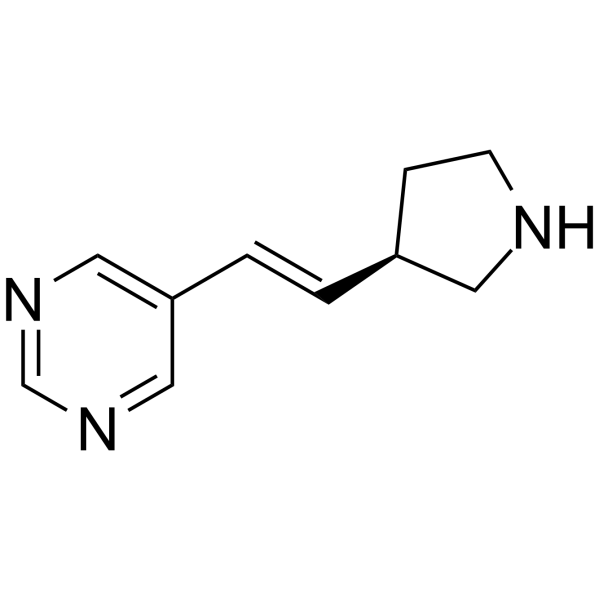
Simpinicline

Based on 1 Customer Validation
Simpinicline (OC-02), a highly selective nicotinic acetylcholine receptor (nAChR) agonist, shows potent antiviral activity against the SARS-CoV-2 variants in cell culture with an IC50 of 0.04 µM.
For research use only. We do not sell to patients.
- Purity : 98.28%
- CAS No.: 753015-44-0
- Formula: C10H13N3
- Molecular Weight:175.23
-
Storage:Pure form -20°C, 3 years , 4°C, 2 years ; In solvent -80°C, 6 months , -20°C, 1 month

To place orders, for customer services and technical support, please contact: MedChemExpress USA
Tel: 609-228-6898 E-mail: [email protected] [email protected]


-
 Biological Activity
-
Chemical Information
-
Solvent & Solubility
- Protocols
- Purity & Documentation
- References
-
 Help & FAQs




Biological Activity
Description
Clinical Trial
| NCT Number | Sponsor | Condition | Start Date |
Phase

|
|---|---|---|---|---|
| NCT01329991 | 2011-05 | PHASE1 |


Chemical Information
-
CAS No. 753015-44-0
-
Appearance Oil
-
Molecular Weight 175.23
-
Formula C10H13N3
-
Color Yellow to brown
-
SMILES
[C@@H]1(CCNC1)/C=C/C2=CN=CN=C2
-
Synonyms
OC-02
-
Shipping
Room temperature in continental US; may vary elsewhere.
-
Storage
Pure form -20°C 3 years 4°C 2 years In solvent -80°C 6 months -20°C 1 month


Solvent & Solubility
In Vitro:
DMSO : ≥ 100 mg/mL (570.68 mM; Hygroscopic DMSO has a significant impact on the solubility of product, please use newly opened DMSO)
* "≥" means soluble, but saturation unknown.
Please refer to the solubility information to select the appropriate solvent. Once prepared, please aliquot and store the solution to prevent product inactivation from repeated freeze-thaw cycles.
Storage method and period of stock solution: -80°C, 6 months; -20°C, 1 month. When stored at -80°C, please use it within 6 months. When stored at -20°C, please use it within 1 month.
Please refer to the solubility information to select the appropriate solvent. Once prepared, please aliquot and store the solution to prevent product inactivation from repeated freeze-thaw cycles.
Storage method and period of stock solution: -80°C, 6 months; -20°C, 1 month. When stored at -80°C, please use it within 6 months. When stored at -20°C, please use it within 1 month.
Concentration (start) × Volume (start) = Concentration (final) × Volume (final)


Purity & Documentation
-
Data Sheet (269 KB)
-
SDS (252 KB)
- English - EN (252 KB)
- Français - FR (252 KB)
- Deutsch - DE (252 KB)
- Norwegian - NO (252 KB)
- Español - ES (252 KB)
- Swedish - SV (252 KB)
- Italian - IT (252 KB)
- Korean - KR (252 KB)
- Portuguese - PT (252 KB)
-
Handling Instructions (2659 KB)
References


Complete Stock Solution Preparation Table
Please refer to the solubility information to select the appropriate solvent. Once prepared, please aliquot and store the solution to prevent product inactivation from repeated freeze-thaw cycles.
Storage method and period of stock solution: -80°C, 6 months; -20°C, 1 month. When stored at -80°C, please use it within 6 months. When stored at -20°C, please use it within 1 month.
| Optional Solvent | Concentration Solvent Mass | 1 mg | 5 mg | 10 mg | 25 mg |
|---|---|---|---|---|---|
| DMSO | 1 mM | 5.7068 mL | 28.5339 mL | 57.0679 mL | 142.6696 mL |
| 5 mM | 1.1414 mL | 5.7068 mL | 11.4136 mL | 28.5339 mL | |
| 10 mM | 0.5707 mL | 2.8534 mL | 5.7068 mL | 14.2670 mL | |
| 15 mM | 0.3805 mL | 1.9023 mL | 3.8045 mL | 9.5113 mL | |
| 20 mM | 0.2853 mL | 1.4267 mL | 2.8534 mL | 7.1335 mL | |
| 25 mM | 0.2283 mL | 1.1414 mL | 2.2827 mL | 5.7068 mL | |
| 30 mM | 0.1902 mL | 0.9511 mL | 1.9023 mL | 4.7557 mL | |
| 40 mM | 0.1427 mL | 0.7133 mL | 1.4267 mL | 3.5667 mL | |
| 50 mM | 0.1141 mL | 0.5707 mL | 1.1414 mL | 2.8534 mL | |
| 60 mM | 0.0951 mL | 0.4756 mL | 0.9511 mL | 2.3778 mL | |
| 80 mM | 0.0713 mL | 0.3567 mL | 0.7133 mL | 1.7834 mL | |
| 100 mM | 0.0571 mL | 0.2853 mL | 0.5707 mL | 1.4267 mL |


Simpinicline Related Classifications
HY-139582 Related Classifications
 Powered by Bioz