



Sodium α-ketoisocaproate
Based on 1 publication(s) in Google Scholar
Sodium α-ketoisocaproate (Sodium 4-methyl-2-oxopentanoate) is an insulin secretagogue. Sodium α-ketoisocaproate undergoes transamination catalyzed by BCAT and BCATm to produce α-ketoglutarate and leucine; it also binds to the SUR1 site to inhibit KATP channel activity, but does not directly affect the Kir6.2 subunit. Sodium α-ketoisocaproate regulates Ca2+ influx. Sodium α-ketoisocaproate exerts insulinotropic activity in pancreatic islets and intact mouse pancreata with sufficient BCATm expression. Sodium α-ketoisocaproate can be used in research related to type 2 diabetes.
For research use only. We do not sell to patients.
- Purity : 98.0%
- CAS No.: 4502-00-5
- Formula: C6H9NaO3
- Molecular Weight:152.12
-
Storage:
4°C, sealed storage, away from moisture
* In solvent : -80°C, 6 months; -20°C, 1 month (sealed storage, away from moisture)


To place orders, for customer services and technical support, please contact: MedChemExpress USA
Tel: 609-228-6898 E-mail: [email protected] [email protected]


-
 Biological Activity
-
Chemical Information
-
Solvent & Solubility
- Purity & Documentation
- References
-
 Help & FAQs


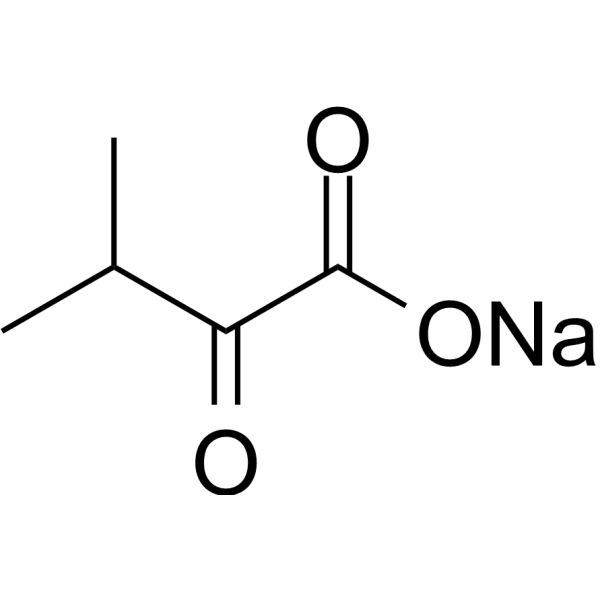
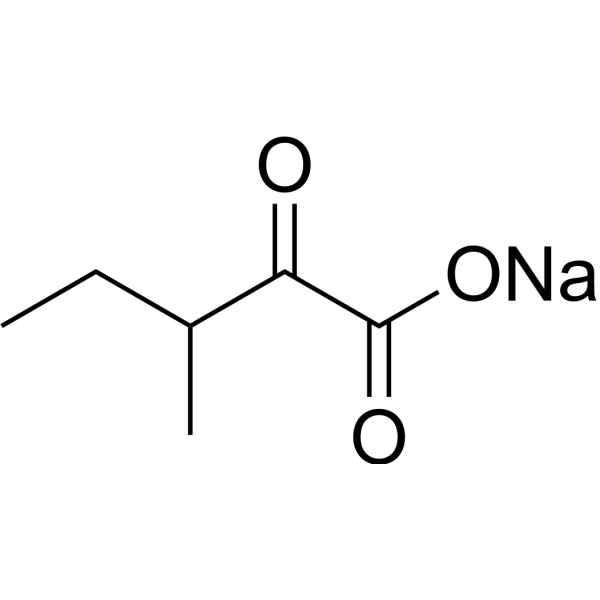
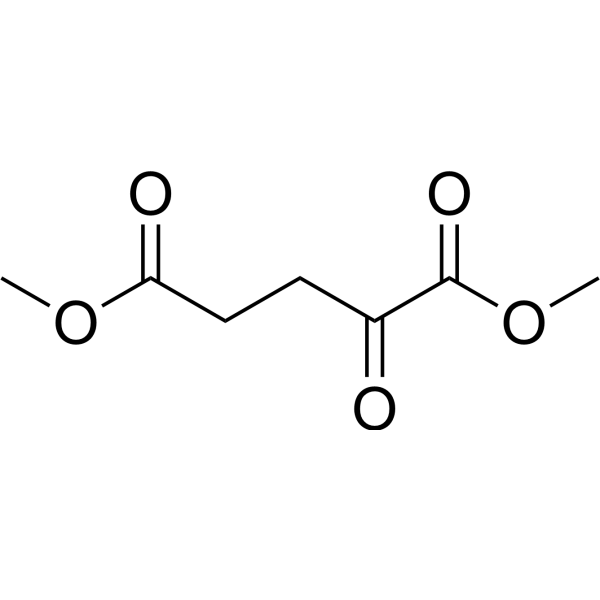
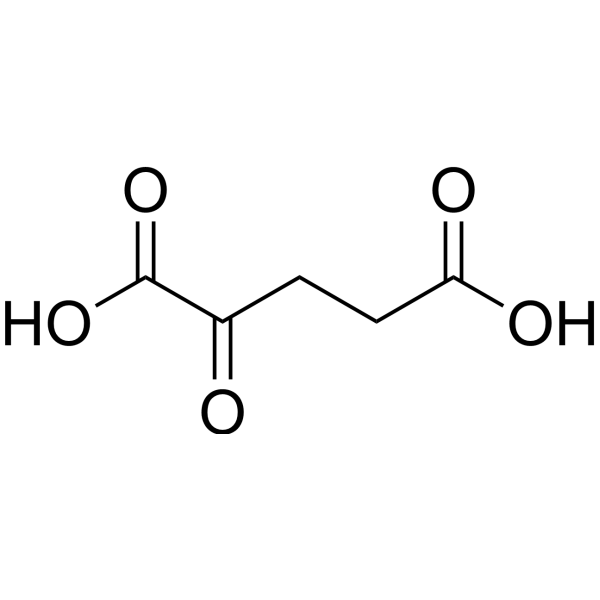
Publications Citing Use of MedChemExpress (MCE) Sodium α-ketoisocaproate
More

Biological Activity
Description
In Vitro
α-ketoisocaproate (15 mM; 45 min) sodium potently stimulates insulin secretion from isolated islets, among which BTBR and (B6 × BTBR) F1 islets exhibit a hyper-responsive phenotype compared with B6 islets[1].
α-ketoisocaproate (15 mM) sodium has no inhibitory effect on the activity of KIR6.2ΔC26 channels in inside-out patches of transfected COS-7 cells[2].
Sodium α-ketoisocaproate binds to native and recombinant SUR1, as well as recombinant SUR2B, with a Kd value range of 46.9~57.2 mM, indicating its low affinity for sulfonylurea receptor sites[2].
Sodium α-ketoisocaproate inhibits the KATP channel current in inside-out membrane patches of mouse pancreatic β cells, with an IC50 of 18.9 mM, and exerts only extremely weak inhibition at the estimated physiological cytoplasmic concentration[2].
MedChemExpress (MCE) has not independently confirmed the accuracy of these methods. They are for reference only.


Chemical Information
-
CAS No. 4502-00-5
-
Appearance Solid
-
Molecular Weight 152.12
-
Formula C6H9NaO3
-
Color White to yellow
-
SMILES
[Na].O=C(O)C(=O)CC(C)C
-
Synonyms
Sodium 4-methyl-2-oxopentanoate; 2-Ketoisocaproic acid sodium salt
-
Shipping
Room temperature in continental US; may vary elsewhere.
-
Storage
4°C, sealed storage, away from moisture
* In solvent : -80°C, 6 months; -20°C, 1 month (sealed storage, away from moisture)


Publications (1)
-
Journal Impact Factor
-
Most Recent
-
Adv Sci (Weinh)
Branched-Chain α Keto-Acid Dehydrogenase Kinase-Mediated AKT Phosphorylation Promotes RCC Tumorigenesis and Drug Resistance. [Abstract]2025 Aug 11:e11081. PMID: 40789057


Solvent & Solubility
In Vitro:
H2O : 50 mg/mL (328.69 mM; Need ultrasonic)
Please refer to the solubility information to select the appropriate solvent. Once prepared, please aliquot and store the solution to prevent product inactivation from repeated freeze-thaw cycles.
Storage method and period of stock solution: -80°C, 6 months; -20°C, 1 month (sealed storage, away from moisture). When stored at -80°C, please use it within 6 months. When stored at -20°C, please use it within 1 month.
* Note: If you choose water as the stock solution, please dilute it to the working solution, then filter and sterilize it with a 0.22 μm filter before use.
Please refer to the solubility information to select the appropriate solvent. Once prepared, please aliquot and store the solution to prevent product inactivation from repeated freeze-thaw cycles.
Storage method and period of stock solution: -80°C, 6 months; -20°C, 1 month (sealed storage, away from moisture). When stored at -80°C, please use it within 6 months. When stored at -20°C, please use it within 1 month.
* Note: If you choose water as the stock solution, please dilute it to the working solution, then filter and sterilize it with a 0.22 μm filter before use.
Concentration (start) × Volume (start) = Concentration (final) × Volume (final)


Purity & Documentation
-
Data Sheet (274 KB)
-
SDS (394 KB)
- English - EN (394 KB)
- Français - FR (394 KB)
- Deutsch - DE (394 KB)
- Norwegian - NO (394 KB)
- Español - ES (394 KB)
- Swedish - SV (394 KB)
- Italian - IT (394 KB)
- Korean - KR (394 KB)
- Portuguese - PT (394 KB)
-
Handling Instructions (2659 KB)
References
[1]. Rabaglia ME, et al. Alpha-Ketoisocaproate-induced hypersecretion of insulin by islets from diabetes-susceptible mice. Am J Physiol Endocrinol Metab. 2005;289(2):E218-E224. [Content Brief]
[2]. Heissig H, et al. Mechanism of the insulin-releasing action of alpha-ketoisocaproate and related alpha-keto acid anions. Mol Pharmacol. 2005 Oct;68(4):1097-105. [Content Brief]
[3]. Zhou Y, et al. Transamination is required for {alpha}-ketoisocaproate but not leucine to stimulate insulin secretion. J Biol Chem. 2010 Oct 29;285(44):33718-26. [Content Brief]


Complete Stock Solution Preparation Table
Please refer to the solubility information to select the appropriate solvent. Once prepared, please aliquot and store the solution to prevent product inactivation from repeated freeze-thaw cycles.
Storage method and period of stock solution: -80°C, 6 months; -20°C, 1 month (sealed storage, away from moisture). When stored at -80°C, please use it within 6 months. When stored at -20°C, please use it within 1 month.
| Optional Solvent | Concentration Solvent Mass | 1 mg | 5 mg | 10 mg | 25 mg |
|---|---|---|---|---|---|
| H2O | 1 mM | 6.5738 mL | 32.8688 mL | 65.7376 mL | 164.3439 mL |
| 5 mM | 1.3148 mL | 6.5738 mL | 13.1475 mL | 32.8688 mL | |
| 10 mM | 0.6574 mL | 3.2869 mL | 6.5738 mL | 16.4344 mL | |
| 15 mM | 0.4383 mL | 2.1913 mL | 4.3825 mL | 10.9563 mL | |
| 20 mM | 0.3287 mL | 1.6434 mL | 3.2869 mL | 8.2172 mL | |
| 25 mM | 0.2630 mL | 1.3148 mL | 2.6295 mL | 6.5738 mL | |
| 30 mM | 0.2191 mL | 1.0956 mL | 2.1913 mL | 5.4781 mL | |
| 40 mM | 0.1643 mL | 0.8217 mL | 1.6434 mL | 4.1086 mL | |
| 50 mM | 0.1315 mL | 0.6574 mL | 1.3148 mL | 3.2869 mL | |
| 60 mM | 0.1096 mL | 0.5478 mL | 1.0956 mL | 2.7391 mL | |
| 80 mM | 0.0822 mL | 0.4109 mL | 0.8217 mL | 2.0543 mL | |
| 100 mM | 0.0657 mL | 0.3287 mL | 0.6574 mL | 1.6434 mL |
* Note: If you choose water as the stock solution, please dilute it to the working solution, then filter and sterilize it with a 0.22 μm filter before use.


Sodium α-ketoisocaproate Related Classifications
HY-W017387 Related Classifications
 Powered by Bioz